Hue Dang Thi Minh, Gelu Coman, Hoc Nguyen Quang, Dung Nguyen Trong
{"title":"Influence of heating rate, temperature, pressure on the structure, and phase transition of amorphous Ni material: A molecular dynamics study.","authors":"Hue Dang Thi Minh, Gelu Coman, Hoc Nguyen Quang, Dung Nguyen Trong","doi":"10.1016/j.heliyon.2020.e05548","DOIUrl":null,"url":null,"abstract":"<p><p>The present article is aimed to investigate influence of the heating rate, temperature (T), pressure (P) on the structure and phase transition of amorphous Ni material with heating rate 2 × 10<sup>5</sup>, 2 × 10<sup>6</sup> and 2 × 10<sup>7</sup> K/s at T = 300 K; T = 300, 400, 500, 600, 700, 800, 900 and 1000 K at heating rate 2 × 10<sup>6</sup> K/s; T = 300, 621 and 900 K at P = 1, 2, 3, 4 and 5 GPa by molecular dynamics simulation method with Sutton-Chen embedded potential and periodic boundary conditions. The structure of amorphous Ni material determined through the radial distribution function, the total energy, the size and the average coordination number. The phase transition and the glass transition temperature determined through the relationship between the total energy and temperature. The result shows that when the heating rate increases, the first peak's position for the radial distribution function is 2.45 Å and a constant, the first peak's height, the total energy and the size increase, the average coordination number decreases from 13 to 12. When temperature increases from 300 to 1000 K at P = 0 GPa, the position decreases from 2.45 Å to 2.40 Å, the average coordination number is 13 and a constant, glass transition temperature is 631 K, the total energy increases, the size increases and happens the phase transition from the amorphous state to the liquid state. When pressure increases from 0 GPa to 5 GPa at T = 300, 621 and 900 K, the position decreases, the height increases, the total energy increases, the size decreases, the average coordination number decreases from 13 to 12, that shows with amorphous Ni material when increasing heating rate, T, P lead to structural change, phase transition of materials is significant.</p>","PeriodicalId":3,"journal":{"name":"ACS Applied Electronic Materials","volume":" ","pages":"e05548"},"PeriodicalIF":4.7000,"publicationDate":"2020-11-19","publicationTypes":"Journal Article","fieldsOfStudy":null,"isOpenAccess":false,"openAccessPdf":"https://ftp.ncbi.nlm.nih.gov/pub/pmc/oa_pdf/5b/2e/main.PMC7689414.pdf","citationCount":"0","resultStr":null,"platform":"Semanticscholar","paperid":null,"PeriodicalName":"ACS Applied Electronic Materials","FirstCategoryId":"103","ListUrlMain":"https://doi.org/10.1016/j.heliyon.2020.e05548","RegionNum":3,"RegionCategory":"材料科学","ArticlePicture":[],"TitleCN":null,"AbstractTextCN":null,"PMCID":null,"EPubDate":"2020/11/1 0:00:00","PubModel":"eCollection","JCR":"Q1","JCRName":"ENGINEERING, ELECTRICAL & ELECTRONIC","Score":null,"Total":0}
引用次数: 0
Abstract
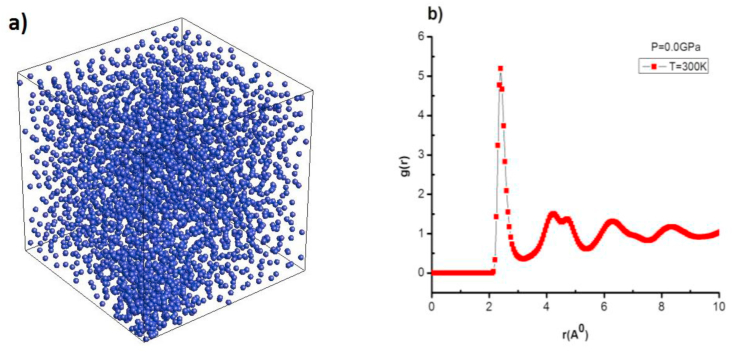
The present article is aimed to investigate influence of the heating rate, temperature (T), pressure (P) on the structure and phase transition of amorphous Ni material with heating rate 2 × 10⁵, 2 × 10⁶ and 2 × 10⁷ K/s at T = 300 K; T = 300, 400, 500, 600, 700, 800, 900 and 1000 K at heating rate 2 × 10⁶ K/s; T = 300, 621 and 900 K at P = 1, 2, 3, 4 and 5 GPa by molecular dynamics simulation method with Sutton-Chen embedded potential and periodic boundary conditions. The structure of amorphous Ni material determined through the radial distribution function, the total energy, the size and the average coordination number. The phase transition and the glass transition temperature determined through the relationship between the total energy and temperature. The result shows that when the heating rate increases, the first peak's position for the radial distribution function is 2.45 Å and a constant, the first peak's height, the total energy and the size increase, the average coordination number decreases from 13 to 12. When temperature increases from 300 to 1000 K at P = 0 GPa, the position decreases from 2.45 Å to 2.40 Å, the average coordination number is 13 and a constant, glass transition temperature is 631 K, the total energy increases, the size increases and happens the phase transition from the amorphous state to the liquid state. When pressure increases from 0 GPa to 5 GPa at T = 300, 621 and 900 K, the position decreases, the height increases, the total energy increases, the size decreases, the average coordination number decreases from 13 to 12, that shows with amorphous Ni material when increasing heating rate, T, P lead to structural change, phase transition of materials is significant.
期刊介绍:
ACS Applied Electronic Materials is an interdisciplinary journal publishing original research covering all aspects of electronic materials. The journal is devoted to reports of new and original experimental and theoretical research of an applied nature that integrate knowledge in the areas of materials science, engineering, optics, physics, and chemistry into important applications of electronic materials. Sample research topics that span the journal's scope are inorganic, organic, ionic and polymeric materials with properties that include conducting, semiconducting, superconducting, insulating, dielectric, magnetic, optoelectronic, piezoelectric, ferroelectric and thermoelectric.
Indexed/Abstracted:
Web of Science SCIE
Scopus
CAS
INSPEC
Portico






 京公网安备 11010802042870号
京ICP备2023020795号-1
京公网安备 11010802042870号
京ICP备2023020795号-1

 分享
分享
 求助内容:
求助内容: 应助结果提醒方式:
 扫码关注我们
