Sang Chul Lee, Kang Ju Son, Chang Hoon Han, Ji Ye Jung, Seon Cheol Park
{"title":"Impact of comorbid asthma on severity of coronavirus disease (COVID-19).","authors":"Sang Chul Lee, Kang Ju Son, Chang Hoon Han, Ji Ye Jung, Seon Cheol Park","doi":"10.1038/s41598-020-77791-8","DOIUrl":null,"url":null,"abstract":"<p><p>The severity of the coronavirus disease (COVID-19) is associated with various comorbidities. However, no studies have yet demonstrated the potential risk of respiratory failure and mortality in COVID-19 patients with pre-existing asthma. We selected 7272 adult COVID-19 patients from the Korean Health Insurance Review and Assessment COVID-19 database for this nationwide retrospective cohort study. Among these, 686 patients with asthma were assessed by their severities and evaluated by the clinical outcome of COVID-19 compared to patients without asthma. Of 7272 adult COVID-19 patients, 686 with asthma and 6586 without asthma were compared. Asthma was not a significant risk factor for respiratory failure or mortality among all COVID-19 patients (odds ratio [OR] = 0.99, P = 0.997 and OR = 1.06, P = 0.759) after adjusting for age, sex, and the Charlson comorbidity score. However, a history of acute exacerbation (OR = 2.63, P = 0.043) was significant risk factors for death among COVID-19 patients with asthma. Asthma is not a risk factor for poor prognosis of COVID-19. However, asthma patients who had any experience of acute exacerbation in the previous year before COVID-19 showed higher COVID-19-related mortality, especially in case of old age and male sex.</p>","PeriodicalId":3,"journal":{"name":"ACS Applied Electronic Materials","volume":" ","pages":"21805"},"PeriodicalIF":4.7000,"publicationDate":"2020-12-11","publicationTypes":"Journal Article","fieldsOfStudy":null,"isOpenAccess":false,"openAccessPdf":"https://www.ncbi.nlm.nih.gov/pmc/articles/PMC7733453/pdf/","citationCount":"0","resultStr":null,"platform":"Semanticscholar","paperid":null,"PeriodicalName":"ACS Applied Electronic Materials","FirstCategoryId":"103","ListUrlMain":"https://doi.org/10.1038/s41598-020-77791-8","RegionNum":3,"RegionCategory":"材料科学","ArticlePicture":[],"TitleCN":null,"AbstractTextCN":null,"PMCID":null,"EPubDate":"","PubModel":"","JCR":"Q1","JCRName":"ENGINEERING, ELECTRICAL & ELECTRONIC","Score":null,"Total":0}
引用次数: 0
Abstract
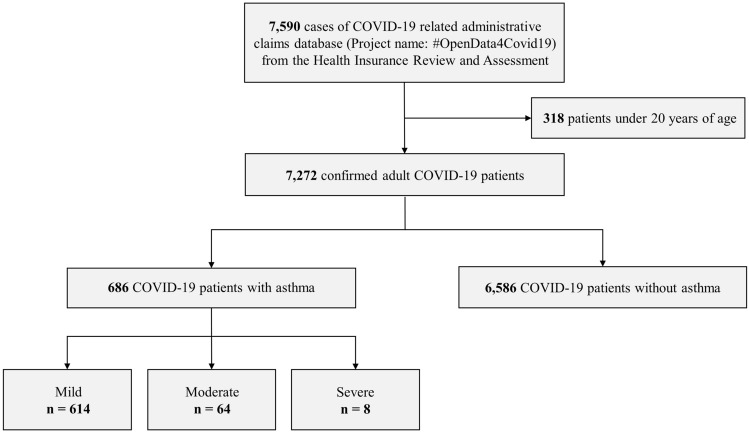
The severity of the coronavirus disease (COVID-19) is associated with various comorbidities. However, no studies have yet demonstrated the potential risk of respiratory failure and mortality in COVID-19 patients with pre-existing asthma. We selected 7272 adult COVID-19 patients from the Korean Health Insurance Review and Assessment COVID-19 database for this nationwide retrospective cohort study. Among these, 686 patients with asthma were assessed by their severities and evaluated by the clinical outcome of COVID-19 compared to patients without asthma. Of 7272 adult COVID-19 patients, 686 with asthma and 6586 without asthma were compared. Asthma was not a significant risk factor for respiratory failure or mortality among all COVID-19 patients (odds ratio [OR] = 0.99, P = 0.997 and OR = 1.06, P = 0.759) after adjusting for age, sex, and the Charlson comorbidity score. However, a history of acute exacerbation (OR = 2.63, P = 0.043) was significant risk factors for death among COVID-19 patients with asthma. Asthma is not a risk factor for poor prognosis of COVID-19. However, asthma patients who had any experience of acute exacerbation in the previous year before COVID-19 showed higher COVID-19-related mortality, especially in case of old age and male sex.
期刊介绍:
ACS Applied Electronic Materials is an interdisciplinary journal publishing original research covering all aspects of electronic materials. The journal is devoted to reports of new and original experimental and theoretical research of an applied nature that integrate knowledge in the areas of materials science, engineering, optics, physics, and chemistry into important applications of electronic materials. Sample research topics that span the journal's scope are inorganic, organic, ionic and polymeric materials with properties that include conducting, semiconducting, superconducting, insulating, dielectric, magnetic, optoelectronic, piezoelectric, ferroelectric and thermoelectric.
Indexed/Abstracted:
Web of Science SCIE
Scopus
CAS
INSPEC
Portico




 京公网安备 11010802042870号
京ICP备2023020795号-1
京公网安备 11010802042870号
京ICP备2023020795号-1

 分享
分享
 求助内容:
求助内容: 应助结果提醒方式:
 扫码关注我们
