Elissavet N Rousanoglou, Nikolaos Kondilopoulos, Konstantinos D Boudolos
{"title":"Fast Motion Speed Alters the Sit-to-Walk Spatial and Temporal Pattern in Healthy Young Men.","authors":"Elissavet N Rousanoglou, Nikolaos Kondilopoulos, Konstantinos D Boudolos","doi":"10.1055/a-1286-5863","DOIUrl":null,"url":null,"abstract":"<p><p>Sit-to-Walk (STW) is a critical task for daily independence, yet its two inherent destabilizing events (seat-off, walking initiation) may diminish postural stability under fast motion speed (FS). This study aimed at the FS effect on the STW spatial and temporal patterns, with a specific interest in the relative STW temporal pattern. The STW kinetics and kinematics were recorded (n=18 men, 20.7±2.0 years) at preferred and FS. Statistics included One-Way repeated measures ANOVA (SPSS 25.0, p≤0.05). The FS spatial pattern reveals a discontinuous mode of the forward ground reaction force, indicating a balance rather than a propulsive strategy during the Rising phase. The FS relative temporal pattern reveals the prolongation of the Leaning phase (most possibly due to the feet repositioning), the shortening of the Rising and the Walking phases, and a relative delay in the spatial variables (p≤0.05). Overall, the results do not allow the STW consideration at FS as a \"magnified\" with respect to force, or a \"shrinked-in\" with respect to time, copy of the preferred motion speed. As more generic and versatile than the absolute one, the relative temporal pattern may be used as a reference for a variety of populations.</p>","PeriodicalId":74857,"journal":{"name":"Sports medicine international open","volume":"4 3","pages":"E77-E84"},"PeriodicalIF":0.0000,"publicationDate":"2020-12-09","publicationTypes":"Journal Article","fieldsOfStudy":null,"isOpenAccess":false,"openAccessPdf":"https://sci-hub-pdf.com/10.1055/a-1286-5863","citationCount":"4","resultStr":null,"platform":"Semanticscholar","paperid":null,"PeriodicalName":"Sports medicine international open","FirstCategoryId":"1085","ListUrlMain":"https://doi.org/10.1055/a-1286-5863","RegionNum":0,"RegionCategory":null,"ArticlePicture":[],"TitleCN":null,"AbstractTextCN":null,"PMCID":null,"EPubDate":"2020/12/1 0:00:00","PubModel":"eCollection","JCR":"","JCRName":"","Score":null,"Total":0}
引用次数: 4
Abstract
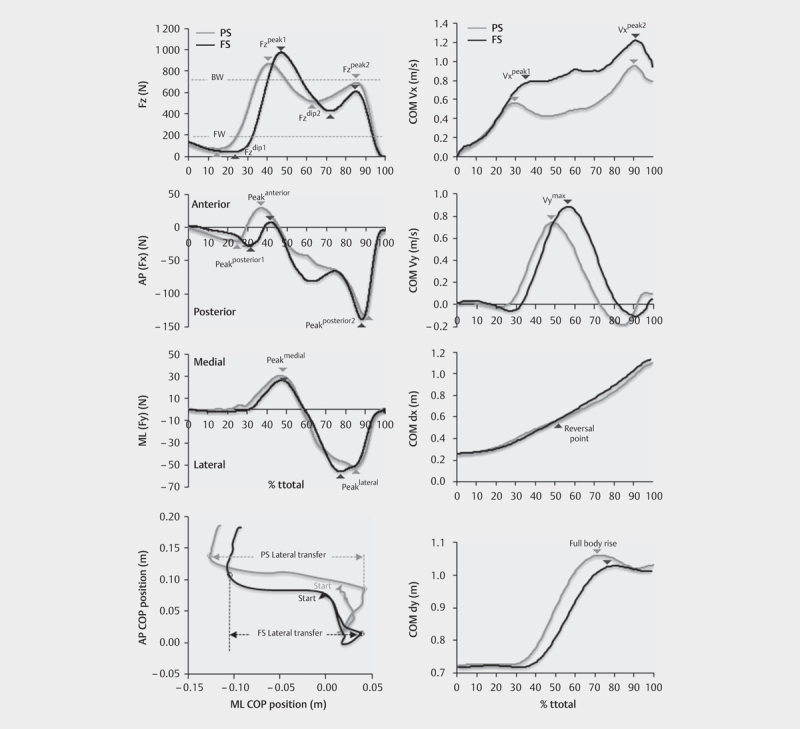
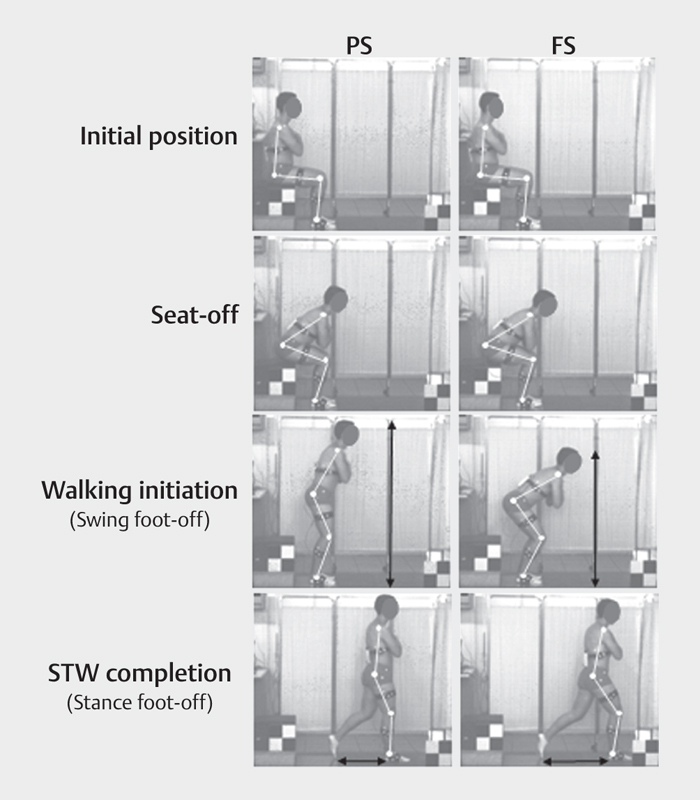
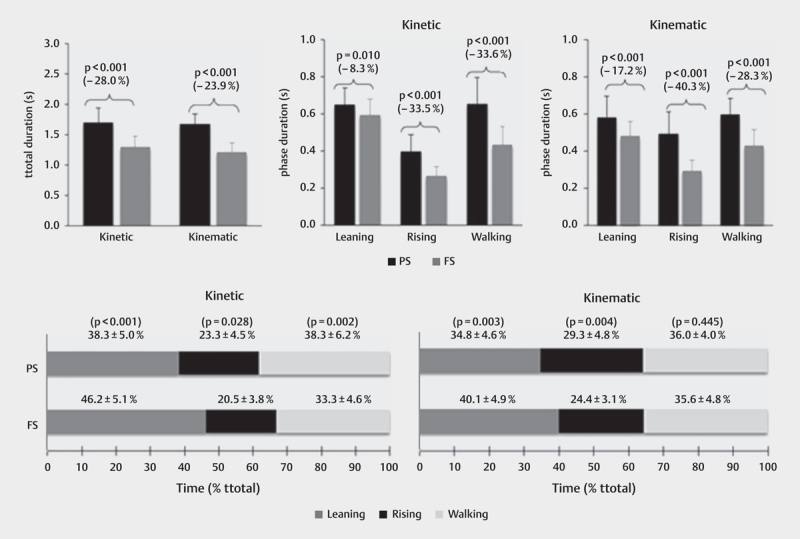
Sit-to-Walk (STW) is a critical task for daily independence, yet its two inherent destabilizing events (seat-off, walking initiation) may diminish postural stability under fast motion speed (FS). This study aimed at the FS effect on the STW spatial and temporal patterns, with a specific interest in the relative STW temporal pattern. The STW kinetics and kinematics were recorded (n=18 men, 20.7±2.0 years) at preferred and FS. Statistics included One-Way repeated measures ANOVA (SPSS 25.0, p≤0.05). The FS spatial pattern reveals a discontinuous mode of the forward ground reaction force, indicating a balance rather than a propulsive strategy during the Rising phase. The FS relative temporal pattern reveals the prolongation of the Leaning phase (most possibly due to the feet repositioning), the shortening of the Rising and the Walking phases, and a relative delay in the spatial variables (p≤0.05). Overall, the results do not allow the STW consideration at FS as a "magnified" with respect to force, or a "shrinked-in" with respect to time, copy of the preferred motion speed. As more generic and versatile than the absolute one, the relative temporal pattern may be used as a reference for a variety of populations.



 京公网安备 11010802042870号
京ICP备2023020795号-1
京公网安备 11010802042870号
京ICP备2023020795号-1

 分享
分享

 求助内容:
求助内容: 应助结果提醒方式:
 扫码关注我们
