{"title":"Development of Plant Prime-Editing Systems for Precise Genome Editing.","authors":"Rongfang Xu, Juan Li, Xiaoshuang Liu, Tiaofeng Shan, Ruiying Qin, Pengcheng Wei","doi":"10.1016/j.xplc.2020.100043","DOIUrl":null,"url":null,"abstract":"<p><p>Prime-editing systems have the capability to perform efficient and precise genome editing in human cells. In this study, we first developed a plant prime editor 2 (pPE2) system and test its activity by generating a targeted mutation on an HPT<sup>-ATG</sup> reporter in rice. Our results showed that the pPE2 system could induce programmable editing at different genome sites. In transgenic T<sub>0</sub> plants, pPE2-generated mutants occurred with 0%-31.3% frequency, suggesting that the efficiency of pPE2 varied greatly at different genomic sites and with prime-editing guide RNAs of diverse structures. To optimize editing efficiency, guide RNAs were introduced into the pPE2 system following the PE3 and PE3b strategy in human cells. However, at the genomic sites tested in this study, pPE3 systems generated only comparable or even lower editing frequencies. Furthemore, we developed a surrogate pPE2 system by incorporating the HPT<sup>-ATG</sup> reporter to enrich the prime-edited cells. The nucleotide editing was easily detected in the resistant calli transformed with the surrogate pPE2 system, presumably due to the enhanced screening efficiency of edited cells. Taken together, our results indicate that plant prime-editing systems we developed could provide versatile and flexible editing in rice genome.</p>","PeriodicalId":52373,"journal":{"name":"Plant Communications","volume":"1 3","pages":"100043"},"PeriodicalIF":11.6000,"publicationDate":"2020-04-08","publicationTypes":"Journal Article","fieldsOfStudy":null,"isOpenAccess":false,"openAccessPdf":"https://sci-hub-pdf.com/10.1016/j.xplc.2020.100043","citationCount":"110","resultStr":null,"platform":"Semanticscholar","paperid":null,"PeriodicalName":"Plant Communications","FirstCategoryId":"99","ListUrlMain":"https://doi.org/10.1016/j.xplc.2020.100043","RegionNum":1,"RegionCategory":"生物学","ArticlePicture":[],"TitleCN":null,"AbstractTextCN":null,"PMCID":null,"EPubDate":"2020/5/11 0:00:00","PubModel":"eCollection","JCR":"Q1","JCRName":"BIOCHEMISTRY & MOLECULAR BIOLOGY","Score":null,"Total":0}
引用次数: 110
Abstract
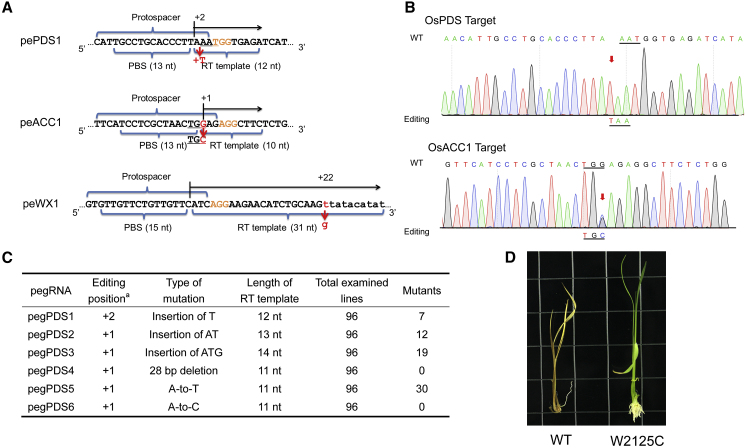
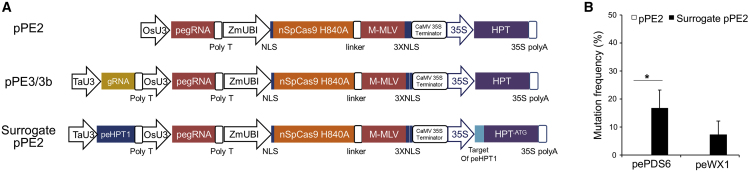
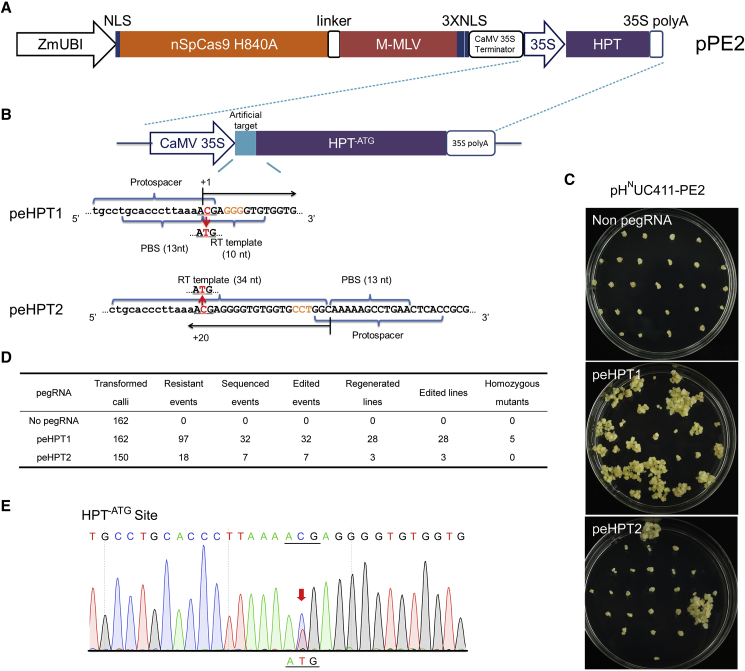
Prime-editing systems have the capability to perform efficient and precise genome editing in human cells. In this study, we first developed a plant prime editor 2 (pPE2) system and test its activity by generating a targeted mutation on an HPT-ATG reporter in rice. Our results showed that the pPE2 system could induce programmable editing at different genome sites. In transgenic T0 plants, pPE2-generated mutants occurred with 0%-31.3% frequency, suggesting that the efficiency of pPE2 varied greatly at different genomic sites and with prime-editing guide RNAs of diverse structures. To optimize editing efficiency, guide RNAs were introduced into the pPE2 system following the PE3 and PE3b strategy in human cells. However, at the genomic sites tested in this study, pPE3 systems generated only comparable or even lower editing frequencies. Furthemore, we developed a surrogate pPE2 system by incorporating the HPT-ATG reporter to enrich the prime-edited cells. The nucleotide editing was easily detected in the resistant calli transformed with the surrogate pPE2 system, presumably due to the enhanced screening efficiency of edited cells. Taken together, our results indicate that plant prime-editing systems we developed could provide versatile and flexible editing in rice genome.
期刊介绍:
Plant Communications is an open access publishing platform that supports the global plant science community. It publishes original research, review articles, technical advances, and research resources in various areas of plant sciences. The scope of topics includes evolution, ecology, physiology, biochemistry, development, reproduction, metabolism, molecular and cellular biology, genetics, genomics, environmental interactions, biotechnology, breeding of higher and lower plants, and their interactions with other organisms. The goal of Plant Communications is to provide a high-quality platform for the dissemination of plant science research.



 京公网安备 11010802042870号
京ICP备2023020795号-1
京公网安备 11010802042870号
京ICP备2023020795号-1

 分享
分享
 求助内容:
求助内容: 应助结果提醒方式:
 扫码关注我们
