{"title":"Frequency of IL-10+CD19+ B cells in patients with prostate cancer compared to patients with benign prostatic hyperplasia.","authors":"Nazmabadi Roya, Taheri Fatemeh, Mohammad-Alibeigi Faramarz, Sabzevary-Ghahfarokhi Milad, Sanaei Mohammad-Javad, Salehi-Vanani Najmeh, Mirzaei Yousef, Bagheri Nader","doi":"10.4314/ahs.v20i3.31","DOIUrl":null,"url":null,"abstract":"<p><strong>Background: </strong>The function of the immune system in prostate cancer (PC) might promote carcinogenesis. PC is a common cancer in men. Regulatory B cells (Bregs) are a new subtype of B cells that have suppressive roles in the immune system. Interleukin-10 (IL-10) is a dominant mediator of immune suppression released by Bregs.</p><p><strong>Objective: </strong>The purpose of this research was to examine the frequency of CD19+IL10+ B cells and IL-10 mRNA expression in patients with PC compared to patients with benign prostatic hyperplasia (BPH).</p><p><strong>Methods: </strong>Forty paraffin tissue samples from patients with PC and 32 paraffin tissue samples from patients with BPH were entered in this study. The immunohistochemistry staining was used to evaluate the pattern expression of CD19 and IL-10 markers. IL-10 mRNA expression in fresh tissue was determined by real time-polymerase chain reaction (RT-PCR).</p><p><strong>Results: </strong>The frequency of CD19+IL-10+ B cells and IL-10 mRNA expression in PC patients were significantly higher than patients with BPH. Also, there was no meaningful relationship between the frequency of IL-10+CD19+ B cells and gleason scores in patients with PC.</p><p><strong>Conclusions: </strong>Our findings suggested that frequency of IL-10+CD19+ B cells correlates with progressive stage of PC.</p>","PeriodicalId":7853,"journal":{"name":"African Health Sciences","volume":"20 3","pages":"1264-1272"},"PeriodicalIF":0.9000,"publicationDate":"2020-09-01","publicationTypes":"Journal Article","fieldsOfStudy":null,"isOpenAccess":false,"openAccessPdf":"https://www.ncbi.nlm.nih.gov/pmc/articles/PMC7751534/pdf/","citationCount":"14","resultStr":null,"platform":"Semanticscholar","paperid":null,"PeriodicalName":"African Health Sciences","FirstCategoryId":"3","ListUrlMain":"https://doi.org/10.4314/ahs.v20i3.31","RegionNum":4,"RegionCategory":"医学","ArticlePicture":[],"TitleCN":null,"AbstractTextCN":null,"PMCID":null,"EPubDate":"","PubModel":"","JCR":"Q3","JCRName":"MEDICINE, GENERAL & INTERNAL","Score":null,"Total":0}
引用次数: 14
Abstract
Background: The function of the immune system in prostate cancer (PC) might promote carcinogenesis. PC is a common cancer in men. Regulatory B cells (Bregs) are a new subtype of B cells that have suppressive roles in the immune system. Interleukin-10 (IL-10) is a dominant mediator of immune suppression released by Bregs.
Objective: The purpose of this research was to examine the frequency of CD19+IL10+ B cells and IL-10 mRNA expression in patients with PC compared to patients with benign prostatic hyperplasia (BPH).
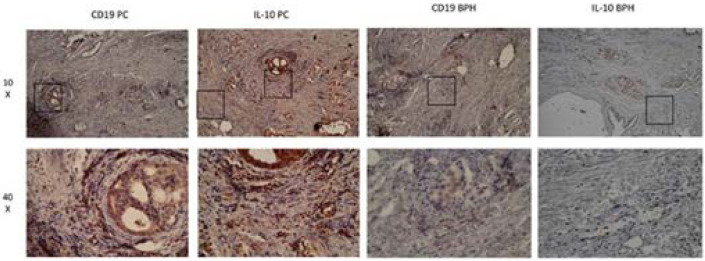
Methods: Forty paraffin tissue samples from patients with PC and 32 paraffin tissue samples from patients with BPH were entered in this study. The immunohistochemistry staining was used to evaluate the pattern expression of CD19 and IL-10 markers. IL-10 mRNA expression in fresh tissue was determined by real time-polymerase chain reaction (RT-PCR).
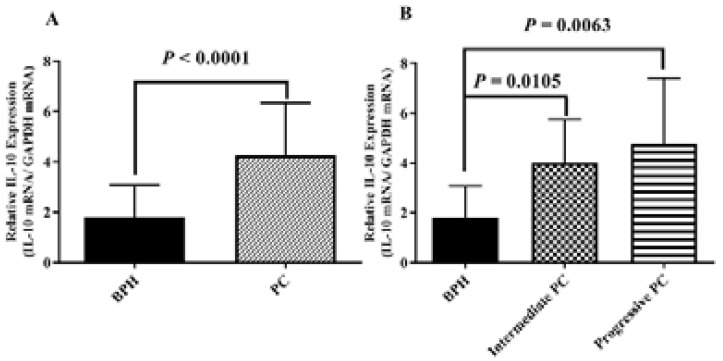
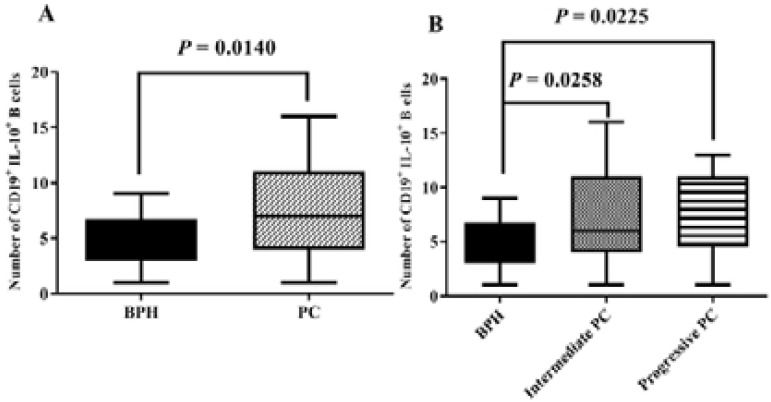
Results: The frequency of CD19+IL-10+ B cells and IL-10 mRNA expression in PC patients were significantly higher than patients with BPH. Also, there was no meaningful relationship between the frequency of IL-10+CD19+ B cells and gleason scores in patients with PC.
Conclusions: Our findings suggested that frequency of IL-10+CD19+ B cells correlates with progressive stage of PC.
期刊介绍:
The African Health Sciences is an internationally refereed journal publishing original articles on research, clinical practice, public health, policy, planning, implementation and evaluation, in the health and related sciences relevant to Africa and the tropics. Its objectives are to: Advocate for and promote the growth of reading culture in sub Saharan Africa; Provide a high quality journal in which health and policy and other researchers and practitioners in the region can and world wide, can publish their work; Promote relevant health system research and publication in the region including alternative means of health care financing, the burden of and solution of health problems in marginalized urban and rural communities amongst the displaced and others affected by conflict; Promote research and the systematic collection and collation and publication of data on diseases and conditions of equity and influence; Promote development of evidence-based policies and guidelines for clinical, public health and other practitioners. African Health Sciences acknowledges support provided by the African Health Journals Partnership Project that is funded by the US National Institutes of Health (through the National Library of Medicine and the Fogarty International Center) and facilitated by the Council of Science Editors.



 京公网安备 11010802042870号
京ICP备2023020795号-1
京公网安备 11010802042870号
京ICP备2023020795号-1

 分享
分享
 求助内容:
求助内容: 应助结果提醒方式:
 扫码关注我们
