{"title":"Association of relapse-linked ARID5B single nucleotide polymorphisms with drug resistance in B-cell precursor acute lymphoblastic leukemia cell lines.","authors":"Minori Tamai, Meixian Huang, Keiko Kagami, Masako Abe, Shinpei Somazu, Tamao Shinohara, Daisuke Harama, Atsushi Watanabe, Koshi Akahane, Kumiko Goi, Kanji Sugita, Hiroaki Goto, Masayoshi Minegishi, Shotaro Iwamoto, Takeshi Inukai","doi":"10.1186/s12935-020-01524-0","DOIUrl":null,"url":null,"abstract":"<p><strong>Background: </strong>The genetic variants of the ARID5B gene have recently been reported to be associated with disease susceptibility and treatment outcome in childhood acute lymphoblastic leukemia (ALL). However, few studies have explored the association of ARID5B with sensitivities to chemotherapeutic agents.</p><p><strong>Methods: </strong>We genotyped susceptibility-linked rs7923074 and rs10821936 as well as relapse-linked rs4948488, rs2893881, and rs6479778 of ARDI5B by direct sequencing of polymerase chain reaction (PCR) products in 72 B-cell precursor-ALL (BCP-ALL) cell lines established from Japanese patients. We also quantified their ARID5B expression levels by real-time reverse transcription PCR, and determined their 50% inhibitory concentration (IC50) values by alamarBlue assays in nine representative chemotherapeutic agents used for ALL treatment.</p><p><strong>Results: </strong>No significant associations were observed in genotypes of the susceptibility-linked single nucleotide polymorphisms (SNPs) and the relapsed-linked SNPs with ARID5B gene expression levels. Of note, IC50 values of vincristine (VCR) (median IC50: 39.6 ng/ml) in 12 cell lines with homozygous genotype of risk allele (C) in the relapse-linked rs4948488 were significantly higher (p = 0.031 in Mann-Whitney U test) than those (1.04 ng/ml) in 60 cell lines with heterozygous or homozygous genotypes of the non-risk allele (T). Furthermore, the IC50 values of mafosfamide [Maf; active metabolite of cyclophosphamide (CY)] and cytarabine (AraC) tended to be associated with the genotype of rs4948488. Similar associations were observed in genotypes of the relapse-linked rs2893881 and rs6479778, but not in those of the susceptibility-linked rs7923074 and rs10821936. In addition, the IC50 values of methotrexate (MTX) were significantly higher (p = 0.023) in 36 cell lines with lower ARID5B gene expression (median IC50: 37.1 ng/ml) than those in the other 36 cell lines with higher expression (16.9 ng/ml).</p><p><strong>Conclusion: </strong>These observations in 72 BCP-ALL cell lines suggested that the risk allele of the relapse-linked SNPs of ARID5B may be involved in a higher relapse rate because of resistance to chemotherapeutic agents such as VCR, CY, and AraC. In addition, lower ARID5B gene expression may be associated with MTX resistance.</p>","PeriodicalId":9385,"journal":{"name":"Cancer Cell International","volume":" ","pages":"434"},"PeriodicalIF":6.0000,"publicationDate":"2020-09-04","publicationTypes":"Journal Article","fieldsOfStudy":null,"isOpenAccess":false,"openAccessPdf":"https://sci-hub-pdf.com/10.1186/s12935-020-01524-0","citationCount":"3","resultStr":null,"platform":"Semanticscholar","paperid":null,"PeriodicalName":"Cancer Cell International","FirstCategoryId":"3","ListUrlMain":"https://doi.org/10.1186/s12935-020-01524-0","RegionNum":2,"RegionCategory":"医学","ArticlePicture":[],"TitleCN":null,"AbstractTextCN":null,"PMCID":null,"EPubDate":"","PubModel":"","JCR":"Q1","JCRName":"ONCOLOGY","Score":null,"Total":0}
引用次数: 3
Abstract
Background: The genetic variants of the ARID5B gene have recently been reported to be associated with disease susceptibility and treatment outcome in childhood acute lymphoblastic leukemia (ALL). However, few studies have explored the association of ARID5B with sensitivities to chemotherapeutic agents.
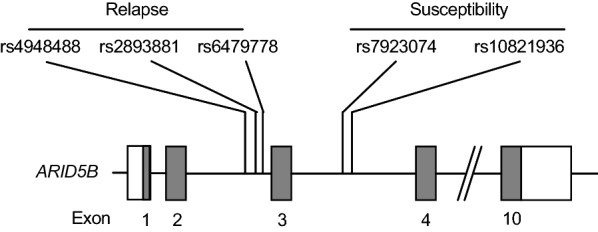
Methods: We genotyped susceptibility-linked rs7923074 and rs10821936 as well as relapse-linked rs4948488, rs2893881, and rs6479778 of ARDI5B by direct sequencing of polymerase chain reaction (PCR) products in 72 B-cell precursor-ALL (BCP-ALL) cell lines established from Japanese patients. We also quantified their ARID5B expression levels by real-time reverse transcription PCR, and determined their 50% inhibitory concentration (IC50) values by alamarBlue assays in nine representative chemotherapeutic agents used for ALL treatment.
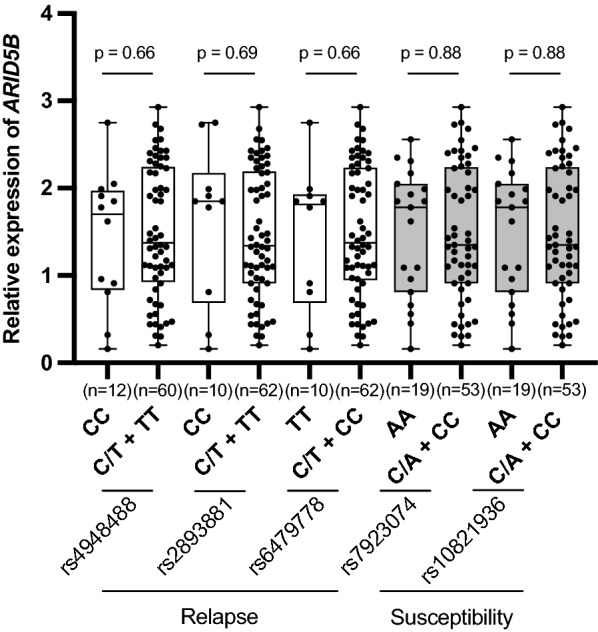
Results: No significant associations were observed in genotypes of the susceptibility-linked single nucleotide polymorphisms (SNPs) and the relapsed-linked SNPs with ARID5B gene expression levels. Of note, IC50 values of vincristine (VCR) (median IC50: 39.6 ng/ml) in 12 cell lines with homozygous genotype of risk allele (C) in the relapse-linked rs4948488 were significantly higher (p = 0.031 in Mann-Whitney U test) than those (1.04 ng/ml) in 60 cell lines with heterozygous or homozygous genotypes of the non-risk allele (T). Furthermore, the IC50 values of mafosfamide [Maf; active metabolite of cyclophosphamide (CY)] and cytarabine (AraC) tended to be associated with the genotype of rs4948488. Similar associations were observed in genotypes of the relapse-linked rs2893881 and rs6479778, but not in those of the susceptibility-linked rs7923074 and rs10821936. In addition, the IC50 values of methotrexate (MTX) were significantly higher (p = 0.023) in 36 cell lines with lower ARID5B gene expression (median IC50: 37.1 ng/ml) than those in the other 36 cell lines with higher expression (16.9 ng/ml).
Conclusion: These observations in 72 BCP-ALL cell lines suggested that the risk allele of the relapse-linked SNPs of ARID5B may be involved in a higher relapse rate because of resistance to chemotherapeutic agents such as VCR, CY, and AraC. In addition, lower ARID5B gene expression may be associated with MTX resistance.
期刊介绍:
Cancer Cell International publishes articles on all aspects of cancer cell biology, originating largely from, but not limited to, work using cell culture techniques.
The journal focuses on novel cancer studies reporting data from biological experiments performed on cells grown in vitro, in two- or three-dimensional systems, and/or in vivo (animal experiments). These types of experiments have provided crucial data in many fields, from cell proliferation and transformation, to epithelial-mesenchymal interaction, to apoptosis, and host immune response to tumors.
Cancer Cell International also considers articles that focus on novel technologies or novel pathways in molecular analysis and on epidemiological studies that may affect patient care, as well as articles reporting translational cancer research studies where in vitro discoveries are bridged to the clinic. As such, the journal is interested in laboratory and animal studies reporting on novel biomarkers of tumor progression and response to therapy and on their applicability to human cancers.




 京公网安备 11010802042870号
京ICP备2023020795号-1
京公网安备 11010802042870号
京ICP备2023020795号-1

 分享
分享
 求助内容:
求助内容: 应助结果提醒方式:
 扫码关注我们
