Pascal Bauer, Lutz Kraushaar, Sophie Hoelscher, Rebecca Weber, Ebru Akdogan, Stanislav Keranov, Oliver Dörr, Holger Nef, Christian W Hamm, Astrid Most
{"title":"Blood Pressure Response and Vascular Function of Professional Athletes and Controls.","authors":"Pascal Bauer, Lutz Kraushaar, Sophie Hoelscher, Rebecca Weber, Ebru Akdogan, Stanislav Keranov, Oliver Dörr, Holger Nef, Christian W Hamm, Astrid Most","doi":"10.1055/a-1400-1897","DOIUrl":null,"url":null,"abstract":"<p><p>Workload-indexed blood pressure response (wiBPR) to exercise has been shown to be superior to peak systolic blood pressure (SBP) in predicting mortality in healthy men. Thus far, however, markers of wiBPR have not been evaluated for athletes and the association with vascular function is unclear. We examined 95 male professional athletes (26±5 y) and 30 male controls (26±4 y). We assessed vascular functional parameters at rest and wiBPR with a graded bicycle ergometer test and compared values for athletes with those of controls. Athletes had a lower pulse wave velocity (6.4±0.9 vs. 7.2±1.5 m/s, p=0.001) compared to controls. SBP/Watt slope (0.34±0.13 vs. 0.44±0.12 mmHg/W), SBP/MET slope (6.2±1.8 vs. 7.85±1.8 mmHg/MET) and peak SBP/Watt ratio (0.61±0.12 vs. 0.95±0.17 mmHg/W) were lower in athletes than in controls (p<0.001). The SBP/Watt and SBP/MET slope in athletes were comparable to the reference values, whereas the peak SBP/Watt-ratio was lower. All vascular functional parameters measured were not significantly correlated to the wiBPR in either athletes or controls. In conclusion, our findings indicate the potential use of the SBP/Watt and SBP/MET slope in pre-participation screening of athletes. Further, vascular functional parameters, measured at rest, were unrelated to the wiBPR in athletes and controls.</p>","PeriodicalId":74857,"journal":{"name":"Sports medicine international open","volume":"5 2","pages":"E45-E52"},"PeriodicalIF":0.0000,"publicationDate":"2021-04-19","publicationTypes":"Journal Article","fieldsOfStudy":null,"isOpenAccess":false,"openAccessPdf":"https://sci-hub-pdf.com/10.1055/a-1400-1897","citationCount":"9","resultStr":null,"platform":"Semanticscholar","paperid":null,"PeriodicalName":"Sports medicine international open","FirstCategoryId":"1085","ListUrlMain":"https://doi.org/10.1055/a-1400-1897","RegionNum":0,"RegionCategory":null,"ArticlePicture":[],"TitleCN":null,"AbstractTextCN":null,"PMCID":null,"EPubDate":"2021/3/1 0:00:00","PubModel":"eCollection","JCR":"","JCRName":"","Score":null,"Total":0}
引用次数: 9
Abstract
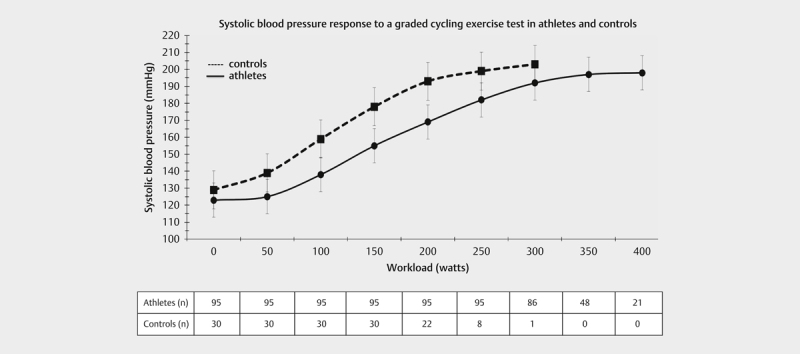
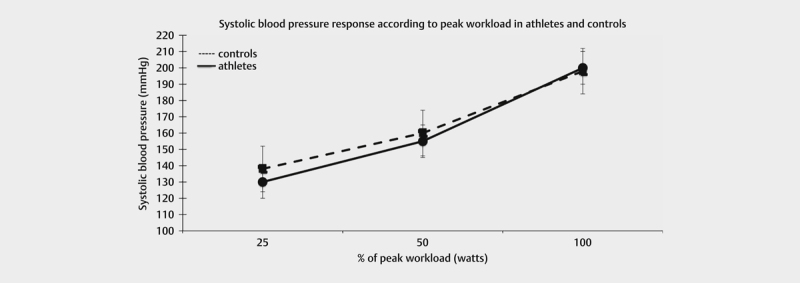
Workload-indexed blood pressure response (wiBPR) to exercise has been shown to be superior to peak systolic blood pressure (SBP) in predicting mortality in healthy men. Thus far, however, markers of wiBPR have not been evaluated for athletes and the association with vascular function is unclear. We examined 95 male professional athletes (26±5 y) and 30 male controls (26±4 y). We assessed vascular functional parameters at rest and wiBPR with a graded bicycle ergometer test and compared values for athletes with those of controls. Athletes had a lower pulse wave velocity (6.4±0.9 vs. 7.2±1.5 m/s, p=0.001) compared to controls. SBP/Watt slope (0.34±0.13 vs. 0.44±0.12 mmHg/W), SBP/MET slope (6.2±1.8 vs. 7.85±1.8 mmHg/MET) and peak SBP/Watt ratio (0.61±0.12 vs. 0.95±0.17 mmHg/W) were lower in athletes than in controls (p<0.001). The SBP/Watt and SBP/MET slope in athletes were comparable to the reference values, whereas the peak SBP/Watt-ratio was lower. All vascular functional parameters measured were not significantly correlated to the wiBPR in either athletes or controls. In conclusion, our findings indicate the potential use of the SBP/Watt and SBP/MET slope in pre-participation screening of athletes. Further, vascular functional parameters, measured at rest, were unrelated to the wiBPR in athletes and controls.



 京公网安备 11010802042870号
京ICP备2023020795号-1
京公网安备 11010802042870号
京ICP备2023020795号-1

 分享
分享

 求助内容:
求助内容: 应助结果提醒方式:
 扫码关注我们
