Pathway-based protein–protein association network to explore mechanism of α-glucosidase inhibitors from Scutellaria baicalensis Georgi against type 2 diabetes
Le Wang, Wenbo Diwu, Nana Tan, Huan Wang, Jingbo Hu, Bailu Xu, Xiaoling Wang
{"title":"Pathway-based protein–protein association network to explore mechanism of α-glucosidase inhibitors from Scutellaria baicalensis Georgi against type 2 diabetes","authors":"Le Wang, Wenbo Diwu, Nana Tan, Huan Wang, Jingbo Hu, Bailu Xu, Xiaoling Wang","doi":"10.1049/syb2.12019","DOIUrl":null,"url":null,"abstract":"<p>Natural products have been widely used in the treatment of type 2 diabetes (T2D). However, their mechanisms are often obscured due to multi-components and multi-targets. The authors constructed a pathway-based protein–protein association (PPA) network for target proteins of 13 α-glucosidase inhibitors (AGIs) identified from <i>Scutellaria baicalensis</i> Georgi (<i>SBG</i>), designed to explore the underlying mechanisms. This network contained 118 nodes and 1167 connections. An uneven degree distribution and small-world property were observed, characterised by high clustering coefficient and short average path length. The PPA network had an inherent hierarchy as <i>C(k)∼k</i><sup>−0.71</sup>. It also exhibited potential weak disassortative mixing pattern, coupled with a decreased function <i>Knn</i> (<i>k</i>) and negative value of assortativity coefficient. These properties indicated that a few nodes were crucial to the network. PGH2, GNAS, MAPK1, MAPK3, PRKCA, and MAOA were then identified as key targets with the highest degree values and centrality indices. Additionally, a core subnetwork showed that chrysin, 5,8,2′-trihydroxy-7-methoxyflavone, and wogonin were the main active constituents of these AGIs, and that the serotonergic synapse pathway was the critical pathway for <i>SBG</i> against T2D. The application of a pathway-based protein–protein association network provides a novel strategy to explore the mechanisms of natural products on complex diseases.</p>","PeriodicalId":50379,"journal":{"name":"IET Systems Biology","volume":"15 4","pages":"126-135"},"PeriodicalIF":1.9000,"publicationDate":"2021-04-26","publicationTypes":"Journal Article","fieldsOfStudy":null,"isOpenAccess":false,"openAccessPdf":"https://www.ncbi.nlm.nih.gov/pmc/articles/PMC8675860/pdf/","citationCount":"2","resultStr":null,"platform":"Semanticscholar","paperid":null,"PeriodicalName":"IET Systems Biology","FirstCategoryId":"99","ListUrlMain":"https://onlinelibrary.wiley.com/doi/10.1049/syb2.12019","RegionNum":4,"RegionCategory":"生物学","ArticlePicture":[],"TitleCN":null,"AbstractTextCN":null,"PMCID":null,"EPubDate":"","PubModel":"","JCR":"Q4","JCRName":"CELL BIOLOGY","Score":null,"Total":0}
引用次数: 2
Abstract
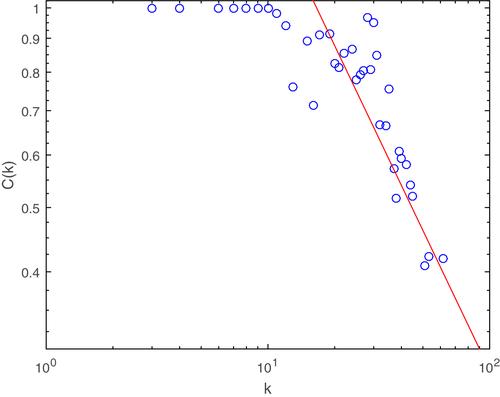
Natural products have been widely used in the treatment of type 2 diabetes (T2D). However, their mechanisms are often obscured due to multi-components and multi-targets. The authors constructed a pathway-based protein–protein association (PPA) network for target proteins of 13 α-glucosidase inhibitors (AGIs) identified from Scutellaria baicalensis Georgi (SBG), designed to explore the underlying mechanisms. This network contained 118 nodes and 1167 connections. An uneven degree distribution and small-world property were observed, characterised by high clustering coefficient and short average path length. The PPA network had an inherent hierarchy as C(k)∼k−0.71. It also exhibited potential weak disassortative mixing pattern, coupled with a decreased function Knn (k) and negative value of assortativity coefficient. These properties indicated that a few nodes were crucial to the network. PGH2, GNAS, MAPK1, MAPK3, PRKCA, and MAOA were then identified as key targets with the highest degree values and centrality indices. Additionally, a core subnetwork showed that chrysin, 5,8,2′-trihydroxy-7-methoxyflavone, and wogonin were the main active constituents of these AGIs, and that the serotonergic synapse pathway was the critical pathway for SBG against T2D. The application of a pathway-based protein–protein association network provides a novel strategy to explore the mechanisms of natural products on complex diseases.
期刊介绍:
IET Systems Biology covers intra- and inter-cellular dynamics, using systems- and signal-oriented approaches. Papers that analyse genomic data in order to identify variables and basic relationships between them are considered if the results provide a basis for mathematical modelling and simulation of cellular dynamics. Manuscripts on molecular and cell biological studies are encouraged if the aim is a systems approach to dynamic interactions within and between cells.
The scope includes the following topics:
Genomics, transcriptomics, proteomics, metabolomics, cells, tissue and the physiome; molecular and cellular interaction, gene, cell and protein function; networks and pathways; metabolism and cell signalling; dynamics, regulation and control; systems, signals, and information; experimental data analysis; mathematical modelling, simulation and theoretical analysis; biological modelling, simulation, prediction and control; methodologies, databases, tools and algorithms for modelling and simulation; modelling, analysis and control of biological networks; synthetic biology and bioengineering based on systems biology.



 京公网安备 11010802042870号
京ICP备2023020795号-1
京公网安备 11010802042870号
京ICP备2023020795号-1

 分享
分享
 求助内容:
求助内容: 应助结果提醒方式:
 扫码关注我们
