Clare L Thompson, Megan McFie, J Paul Chapple, Philip Beales, Martin M Knight
{"title":"Polycystin-2 Is Required for Chondrocyte Mechanotransduction and Traffics to the Primary Cilium in Response to Mechanical Stimulation.","authors":"Clare L Thompson, Megan McFie, J Paul Chapple, Philip Beales, Martin M Knight","doi":"10.3390/ijms22094313","DOIUrl":null,"url":null,"abstract":"<p><p>Primary cilia and associated intraflagellar transport are essential for skeletal development, joint homeostasis, and the response to mechanical stimuli, although the mechanisms remain unclear. Polycystin-2 (PC2) is a member of the transient receptor potential polycystic (TRPP) family of cation channels, and together with Polycystin-1 (PC1), it has been implicated in cilia-mediated mechanotransduction in epithelial cells. The current study investigates the effect of mechanical stimulation on the localization of ciliary polycystins in chondrocytes and tests the hypothesis that they are required in chondrocyte mechanosignaling. Isolated chondrocytes were subjected to mechanical stimulation in the form of uniaxial cyclic tensile strain (CTS) in order to examine the effects on PC2 ciliary localization and matrix gene expression. In the absence of strain, PC2 localizes to the chondrocyte ciliary membrane and neither PC1 nor PC2 are required for ciliogenesis. Cartilage matrix gene expression (<i>Acan</i>, <i>Col2a</i>) is increased in response to 10% CTS. This response is inhibited by siRNA-mediated loss of PC1 or PC2 expression. PC2 ciliary localization requires PC1 and is increased in response to CTS. Increased PC2 cilia trafficking is dependent on the activation of transient receptor potential cation channel subfamily V member 4 (TRPV4) activation. Together, these findings demonstrate for the first time that polycystins are required for chondrocyte mechanotransduction and highlight the mechanosensitive cilia trafficking of PC2 as an important component of cilia-mediated mechanotransduction.</p>","PeriodicalId":49179,"journal":{"name":"International Journal of Molecular Sciences","volume":"22 9","pages":""},"PeriodicalIF":4.9000,"publicationDate":"2021-04-21","publicationTypes":"Journal Article","fieldsOfStudy":null,"isOpenAccess":false,"openAccessPdf":"https://www.ncbi.nlm.nih.gov/pmc/articles/PMC8122406/pdf/","citationCount":"0","resultStr":null,"platform":"Semanticscholar","paperid":null,"PeriodicalName":"International Journal of Molecular Sciences","FirstCategoryId":"99","ListUrlMain":"https://doi.org/10.3390/ijms22094313","RegionNum":2,"RegionCategory":"生物学","ArticlePicture":[],"TitleCN":null,"AbstractTextCN":null,"PMCID":null,"EPubDate":"","PubModel":"","JCR":"Q1","JCRName":"BIOCHEMISTRY & MOLECULAR BIOLOGY","Score":null,"Total":0}
引用次数: 0
Abstract
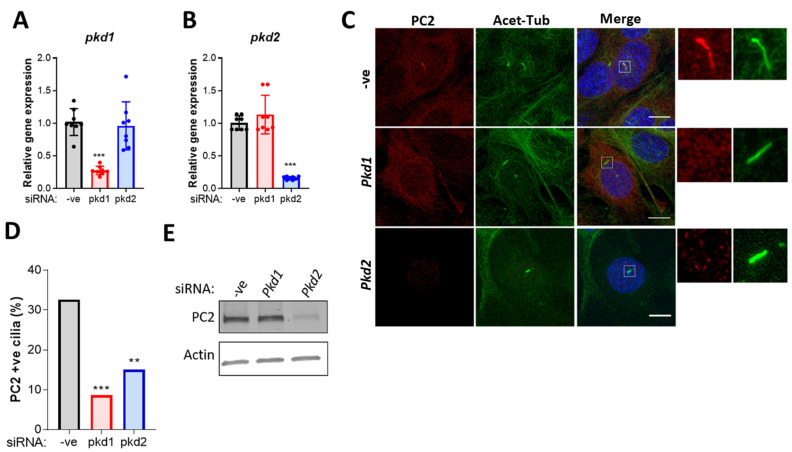
Primary cilia and associated intraflagellar transport are essential for skeletal development, joint homeostasis, and the response to mechanical stimuli, although the mechanisms remain unclear. Polycystin-2 (PC2) is a member of the transient receptor potential polycystic (TRPP) family of cation channels, and together with Polycystin-1 (PC1), it has been implicated in cilia-mediated mechanotransduction in epithelial cells. The current study investigates the effect of mechanical stimulation on the localization of ciliary polycystins in chondrocytes and tests the hypothesis that they are required in chondrocyte mechanosignaling. Isolated chondrocytes were subjected to mechanical stimulation in the form of uniaxial cyclic tensile strain (CTS) in order to examine the effects on PC2 ciliary localization and matrix gene expression. In the absence of strain, PC2 localizes to the chondrocyte ciliary membrane and neither PC1 nor PC2 are required for ciliogenesis. Cartilage matrix gene expression (Acan, Col2a) is increased in response to 10% CTS. This response is inhibited by siRNA-mediated loss of PC1 or PC2 expression. PC2 ciliary localization requires PC1 and is increased in response to CTS. Increased PC2 cilia trafficking is dependent on the activation of transient receptor potential cation channel subfamily V member 4 (TRPV4) activation. Together, these findings demonstrate for the first time that polycystins are required for chondrocyte mechanotransduction and highlight the mechanosensitive cilia trafficking of PC2 as an important component of cilia-mediated mechanotransduction.
期刊介绍:
The International Journal of Molecular Sciences (ISSN 1422-0067) provides an advanced forum for chemistry, molecular physics (chemical physics and physical chemistry) and molecular biology. It publishes research articles, reviews, communications and short notes. Our aim is to encourage scientists to publish their theoretical and experimental results in as much detail as possible. Therefore, there is no restriction on the length of the papers or the number of electronics supplementary files. For articles with computational results, the full experimental details must be provided so that the results can be reproduced. Electronic files regarding the full details of the calculation and experimental procedure, if unable to be published in a normal way, can be deposited as supplementary material (including animated pictures, videos, interactive Excel sheets, software executables and others).





 京公网安备 11010802042870号
京ICP备2023020795号-1
京公网安备 11010802042870号
京ICP备2023020795号-1

 分享
分享
 求助内容:
求助内容: 应助结果提醒方式:
 扫码关注我们
