Mateus Picada Corrêa, Guilherme Soldatelli Kurtz, Larissa Bianchini, Lauren Copatti, Marcelo Ribeiro, Jaber Nashat Saleh, Rafael Stevan Noel, Julio Cesar Bajerski
{"title":"Prevalence of left iliac vein compression on computed tomography scans from a population.","authors":"Mateus Picada Corrêa, Guilherme Soldatelli Kurtz, Larissa Bianchini, Lauren Copatti, Marcelo Ribeiro, Jaber Nashat Saleh, Rafael Stevan Noel, Julio Cesar Bajerski","doi":"10.1590/1677-5449.190060","DOIUrl":null,"url":null,"abstract":"<p><strong>Background: </strong>May-Thurner syndrome (MTS) is defined as compression of the left iliac vein between the right iliac artery and the lumbar vertebral body in the presence of signs and symptoms of unilateral left chronic venous insufficiency. However, imaging findings of compression are not manifest in symptoms of the syndrome in all subjects.</p><p><strong>Objectives: </strong>To evaluate findings of compression in an asymptomatic population.</p><p><strong>Methods: </strong>Computed tomography angiographies or venous phase computed tomographies were analyzed. Demographic data and reason for the exam were recorded. Vein diameter was measured at the site of greatest compression and distal of the compression and the ratio between the two diameters was calculated.</p><p><strong>Results: </strong>From January to July of 2016, 590 computed tomography scans were analyzed (357 women and 233 men). Left iliac compression was found in 14.74% of patients. Patients with a left iliac diameter below the 5mm threshold had a mean diameter at the site of greatest iliac vein compression of 4.4 mm (range: 2.67 mm-4.97 mm). The ratio between the two measurements was < 0.5 in 30% of patients.</p><p><strong>Conclusions: </strong>Our study suggests that iliac vein compression is common among random patients who have had computed tomography for any other reason. This indicates that compression found on tomography images is not the only finding to consider when treating a patient.</p>","PeriodicalId":14814,"journal":{"name":"Jornal Vascular Brasileiro","volume":"19 ","pages":"e20190060"},"PeriodicalIF":1.0000,"publicationDate":"2020-08-31","publicationTypes":"Journal Article","fieldsOfStudy":null,"isOpenAccess":false,"openAccessPdf":"https://www.ncbi.nlm.nih.gov/pmc/articles/PMC8202169/pdf/","citationCount":"1","resultStr":null,"platform":"Semanticscholar","paperid":null,"PeriodicalName":"Jornal Vascular Brasileiro","FirstCategoryId":"1085","ListUrlMain":"https://doi.org/10.1590/1677-5449.190060","RegionNum":0,"RegionCategory":null,"ArticlePicture":[],"TitleCN":null,"AbstractTextCN":null,"PMCID":null,"EPubDate":"","PubModel":"","JCR":"Q4","JCRName":"PERIPHERAL VASCULAR DISEASE","Score":null,"Total":0}
引用次数: 1
Abstract
Background: May-Thurner syndrome (MTS) is defined as compression of the left iliac vein between the right iliac artery and the lumbar vertebral body in the presence of signs and symptoms of unilateral left chronic venous insufficiency. However, imaging findings of compression are not manifest in symptoms of the syndrome in all subjects.
Objectives: To evaluate findings of compression in an asymptomatic population.
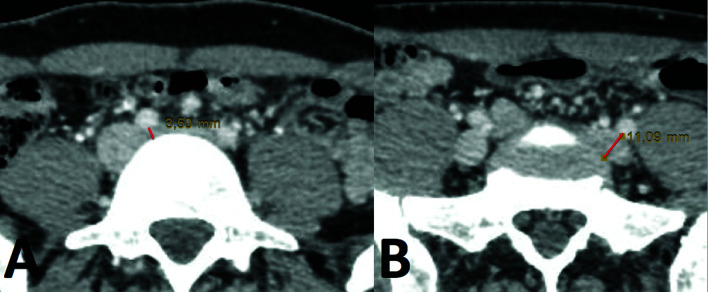
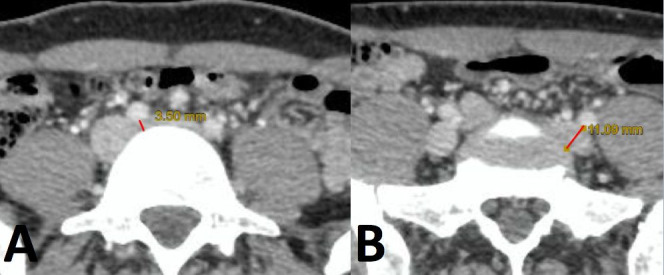
Methods: Computed tomography angiographies or venous phase computed tomographies were analyzed. Demographic data and reason for the exam were recorded. Vein diameter was measured at the site of greatest compression and distal of the compression and the ratio between the two diameters was calculated.
Results: From January to July of 2016, 590 computed tomography scans were analyzed (357 women and 233 men). Left iliac compression was found in 14.74% of patients. Patients with a left iliac diameter below the 5mm threshold had a mean diameter at the site of greatest iliac vein compression of 4.4 mm (range: 2.67 mm-4.97 mm). The ratio between the two measurements was < 0.5 in 30% of patients.
Conclusions: Our study suggests that iliac vein compression is common among random patients who have had computed tomography for any other reason. This indicates that compression found on tomography images is not the only finding to consider when treating a patient.
期刊介绍:
The Jornal Vascular Brasileiro is editated and published quaterly to select and disseminate high-quality scientific contents concerning original research, novel surgical and diagnostic techniques, and clinical observations in the field of vascular surgery, angiology, and endovascular surgery. Its abbreviated title is J. Vasc. Bras., which should be used in bibliographies, footnotes and bibliographical references and strips.




 京公网安备 11010802042870号
京ICP备2023020795号-1
京公网安备 11010802042870号
京ICP备2023020795号-1

 分享
分享
 求助内容:
求助内容: 应助结果提醒方式:
 扫码关注我们
