Jelena S. Nikolić , Bojan K. Zlatković , Snežana Č. Jovanović , Gordana S. Stojanović , Petar D. Marin , Zorica S. Mitić
{"title":"Needle volatiles as chemophenetic markers in differentiation of natural populations of Abies alba, A. x borisii-regis, and A. cephalonica","authors":"Jelena S. Nikolić , Bojan K. Zlatković , Snežana Č. Jovanović , Gordana S. Stojanović , Petar D. Marin , Zorica S. Mitić","doi":"10.1016/j.phytochem.2020.112612","DOIUrl":null,"url":null,"abstract":"<div><p><span>Seventeen native fir populations from the presumed zones of natural hybridization in the Balkan Peninsula were analyzed using headspace needle volatiles and GC-MS/FID analyses. The multivariate statistical analyses revealed clear differentiation between populations of </span><span><em>Abies alba</em></span> and <em>A. cephalonica</em><span>, suggesting that Silver and Greek Fir are characterized by distinct volatile profiles. Three populations from northern and central Greece identified as </span><em>A</em>. x <em>borisii</em>-<em>regis</em><span> shared the volatile profiles with both of the supposed parent species, whereby profile frequencies changed clinally along the latitudinal gradient connecting the ranges of parent species. Therefore, observed geographical distribution of volatile entities support the hypothesis that studied </span><em>A</em>. x <em>borisii</em>-<em>regis</em> populations are of secondary origin, formed by hybridization between <em>A. alba</em> and <em>A. cephalonica</em><span><span>. All three populations should be included in conservation projects, as the genetic constitution of these polymorphic fir populations may contain useful </span>genetic variation necessary for survival regarding the future environmental challenges in this area.</span></p></div>","PeriodicalId":20170,"journal":{"name":"Phytochemistry","volume":"183 ","pages":"Article 112612"},"PeriodicalIF":3.4000,"publicationDate":"2021-03-01","publicationTypes":"Journal Article","fieldsOfStudy":null,"isOpenAccess":false,"openAccessPdf":"https://sci-hub-pdf.com/10.1016/j.phytochem.2020.112612","citationCount":"11","resultStr":null,"platform":"Semanticscholar","paperid":null,"PeriodicalName":"Phytochemistry","FirstCategoryId":"99","ListUrlMain":"https://www.sciencedirect.com/science/article/pii/S0031942220312279","RegionNum":2,"RegionCategory":"生物学","ArticlePicture":[],"TitleCN":null,"AbstractTextCN":null,"PMCID":null,"EPubDate":"","PubModel":"","JCR":"Q2","JCRName":"BIOCHEMISTRY & MOLECULAR BIOLOGY","Score":null,"Total":0}
引用次数: 11
Abstract
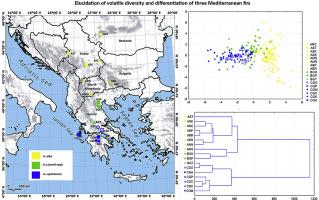
Seventeen native fir populations from the presumed zones of natural hybridization in the Balkan Peninsula were analyzed using headspace needle volatiles and GC-MS/FID analyses. The multivariate statistical analyses revealed clear differentiation between populations of Abies alba and A. cephalonica, suggesting that Silver and Greek Fir are characterized by distinct volatile profiles. Three populations from northern and central Greece identified as A. x borisii-regis shared the volatile profiles with both of the supposed parent species, whereby profile frequencies changed clinally along the latitudinal gradient connecting the ranges of parent species. Therefore, observed geographical distribution of volatile entities support the hypothesis that studied A. x borisii-regis populations are of secondary origin, formed by hybridization between A. alba and A. cephalonica. All three populations should be included in conservation projects, as the genetic constitution of these polymorphic fir populations may contain useful genetic variation necessary for survival regarding the future environmental challenges in this area.
采用顶空针挥发物和气相色谱-质谱联用分析(GC-MS/FID)对来自巴尔干半岛自然杂交区17个原生冷杉种群进行了分析。多变量统计分析显示,白冷杉和头冷杉种群之间存在明显的差异,表明银杉和希腊冷杉具有不同的挥发谱特征。来自希腊北部和中部的3个种群被鉴定为A. x borisii-regis,它们与这两个假定的亲本物种具有相同的挥发性剖面,即剖面频率沿连接亲本物种范围的纬度梯度呈临床变化。因此,观察到的挥发性实体的地理分布支持了所研究的A. x borisii-regis种群是由A. alba和A. cephalonica杂交形成的次生起源的假设。这三个种群都应纳入保护项目,因为这些多态冷杉种群的遗传构成可能包含在该地区未来环境挑战中生存所必需的有用遗传变异。
期刊介绍:
Phytochemistry is a leading international journal publishing studies of plant chemistry, biochemistry, molecular biology and genetics, structure and bioactivities of phytochemicals, including ''-omics'' and bioinformatics/computational biology approaches. Phytochemistry is a primary source for papers dealing with phytochemicals, especially reports concerning their biosynthesis, regulation, and biological properties both in planta and as bioactive principles. Articles are published online as soon as possible as Articles-in-Press and in 12 volumes per year. Occasional topic-focussed special issues are published composed of papers from invited authors.



 京公网安备 11010802042870号
京ICP备2023020795号-1
京公网安备 11010802042870号
京ICP备2023020795号-1

 分享
分享
 求助内容:
求助内容: 应助结果提醒方式:
 扫码关注我们
