Tuuli-Maria Haula, Juha Puustinen, Mari Takala, Anu Holm
{"title":"Wake-up strokes are linked to obstructive sleep apnea and worse early functional outcome","authors":"Tuuli-Maria Haula, Juha Puustinen, Mari Takala, Anu Holm","doi":"10.1002/brb3.2284","DOIUrl":null,"url":null,"abstract":"<div>\n \n \n <section>\n \n <h3> Background and Aims</h3>\n \n <p>Presence of sleep-disordered breathing (SDB) and especially obstructive sleep apnea (OSA) is a known risk factor for ischemic stroke. Additionally, SDB effects negatively on recovery after stroke. Up to one fourth of strokes are present on awakening. The link between OSA and wake-up stroke (WUS) has been suggested. We aim to determine the association between OSA and WUS in a Finnish stroke unit cohort.</p>\n </section>\n \n <section>\n \n <h3> Material and Methods</h3>\n \n <p>An observational prospective longitudinal study consisted of 95 TIA (transient ischemic attack) and mild to moderate stroke patients referred to a Stroke Unit in Finland. Respiratory polygraphy was performed within 72 h of hospital admission. Patients were classified into WUS and non-WUS, and functional outcome measures (mRS, rehabilitation, hospitalization time) were collected. Functional outcomes and prevalence of OSA were compared between non-WUS and WUS.</p>\n </section>\n \n <section>\n \n <h3> Results</h3>\n \n <p>OSA (AHI <span>></span> 15/h) was more frequent among WUS than non-WUS (71% and 36%, respectively, <i>p</i> = 0.009). Functional outcome measured with mRS was worse in patients with WUS than non-WUS on registration day and at hospital discharge (<i>p</i> = 0.001). Need for rehabilitation in WUS was 43% of cases compared to 23% of non-WUS (<i>p</i> = 0.067). Hospitalization time was longer (5–15days) in 55% of WUS and 41% of non-WUS patients (<i>p</i> = 0.261).</p>\n </section>\n \n <section>\n \n <h3> Conclusion</h3>\n \n <p>Moderate-to-severe OSA is related to WUS compared to non-WUS. In addition, WUS have worse short-term outcomes measured in mRS. Further studies are needed to determine if OSA is causally linked to WUS.</p>\n </section>\n </div>","PeriodicalId":9081,"journal":{"name":"Brain and Behavior","volume":"11 8","pages":""},"PeriodicalIF":2.7000,"publicationDate":"2021-07-21","publicationTypes":"Journal Article","fieldsOfStudy":null,"isOpenAccess":false,"openAccessPdf":"https://sci-hub-pdf.com/10.1002/brb3.2284","citationCount":"6","resultStr":null,"platform":"Semanticscholar","paperid":null,"PeriodicalName":"Brain and Behavior","FirstCategoryId":"102","ListUrlMain":"https://onlinelibrary.wiley.com/doi/10.1002/brb3.2284","RegionNum":3,"RegionCategory":"心理学","ArticlePicture":[],"TitleCN":null,"AbstractTextCN":null,"PMCID":null,"EPubDate":"","PubModel":"","JCR":"Q2","JCRName":"BEHAVIORAL SCIENCES","Score":null,"Total":0}
引用次数: 6
Abstract
Background and Aims
Presence of sleep-disordered breathing (SDB) and especially obstructive sleep apnea (OSA) is a known risk factor for ischemic stroke. Additionally, SDB effects negatively on recovery after stroke. Up to one fourth of strokes are present on awakening. The link between OSA and wake-up stroke (WUS) has been suggested. We aim to determine the association between OSA and WUS in a Finnish stroke unit cohort.
Material and Methods
An observational prospective longitudinal study consisted of 95 TIA (transient ischemic attack) and mild to moderate stroke patients referred to a Stroke Unit in Finland. Respiratory polygraphy was performed within 72 h of hospital admission. Patients were classified into WUS and non-WUS, and functional outcome measures (mRS, rehabilitation, hospitalization time) were collected. Functional outcomes and prevalence of OSA were compared between non-WUS and WUS.
Results
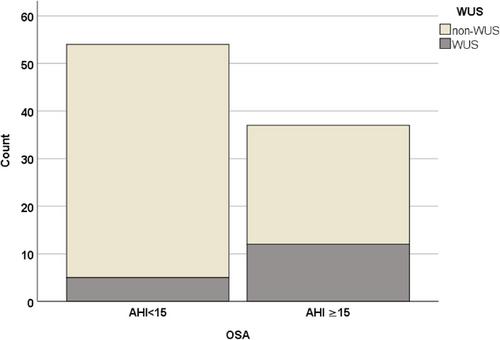
OSA (AHI > 15/h) was more frequent among WUS than non-WUS (71% and 36%, respectively, p = 0.009). Functional outcome measured with mRS was worse in patients with WUS than non-WUS on registration day and at hospital discharge (p = 0.001). Need for rehabilitation in WUS was 43% of cases compared to 23% of non-WUS (p = 0.067). Hospitalization time was longer (5–15days) in 55% of WUS and 41% of non-WUS patients (p = 0.261).
Conclusion
Moderate-to-severe OSA is related to WUS compared to non-WUS. In addition, WUS have worse short-term outcomes measured in mRS. Further studies are needed to determine if OSA is causally linked to WUS.
期刊介绍:
Brain and Behavior is supported by other journals published by Wiley, including a number of society-owned journals. The journals listed below support Brain and Behavior and participate in the Manuscript Transfer Program by referring articles of suitable quality and offering authors the option to have their paper, with any peer review reports, automatically transferred to Brain and Behavior.
* [Acta Psychiatrica Scandinavica](https://publons.com/journal/1366/acta-psychiatrica-scandinavica)
* [Addiction Biology](https://publons.com/journal/1523/addiction-biology)
* [Aggressive Behavior](https://publons.com/journal/3611/aggressive-behavior)
* [Brain Pathology](https://publons.com/journal/1787/brain-pathology)
* [Child: Care, Health and Development](https://publons.com/journal/6111/child-care-health-and-development)
* [Criminal Behaviour and Mental Health](https://publons.com/journal/3839/criminal-behaviour-and-mental-health)
* [Depression and Anxiety](https://publons.com/journal/1528/depression-and-anxiety)
* Developmental Neurobiology
* [Developmental Science](https://publons.com/journal/1069/developmental-science)
* [European Journal of Neuroscience](https://publons.com/journal/1441/european-journal-of-neuroscience)
* [Genes, Brain and Behavior](https://publons.com/journal/1635/genes-brain-and-behavior)
* [GLIA](https://publons.com/journal/1287/glia)
* [Hippocampus](https://publons.com/journal/1056/hippocampus)
* [Human Brain Mapping](https://publons.com/journal/500/human-brain-mapping)
* [Journal for the Theory of Social Behaviour](https://publons.com/journal/7330/journal-for-the-theory-of-social-behaviour)
* [Journal of Comparative Neurology](https://publons.com/journal/1306/journal-of-comparative-neurology)
* [Journal of Neuroimaging](https://publons.com/journal/6379/journal-of-neuroimaging)
* [Journal of Neuroscience Research](https://publons.com/journal/2778/journal-of-neuroscience-research)
* [Journal of Organizational Behavior](https://publons.com/journal/1123/journal-of-organizational-behavior)
* [Journal of the Peripheral Nervous System](https://publons.com/journal/3929/journal-of-the-peripheral-nervous-system)
* [Muscle & Nerve](https://publons.com/journal/4448/muscle-and-nerve)
* [Neural Pathology and Applied Neurobiology](https://publons.com/journal/2401/neuropathology-and-applied-neurobiology)



 京公网安备 11010802042870号
京ICP备2023020795号-1
京公网安备 11010802042870号
京ICP备2023020795号-1

 分享
分享
 求助内容:
求助内容: 应助结果提醒方式:
 扫码关注我们
