Carolina Espejo-Paeres, Iván J Núñez-Gil, Vicente Estrada, Cristina Fernández-Pérez, Giovanna Uribe-Heredia, Clara Cabré-Verdiell, Aitor Uribarri, Rodolfo Romero, Marcos García-Aguado, Inmaculada Fernández-Rozas, Victor Becerra-Muñoz, Martino Pepe, Enrico Cerrato, Sergio Raposeiras-Roubín, María Barrionuevo-Ramos, Freddy Aveiga-Ligua, Carolina Aguilar-Andrea, Emilio Alfonso-Rodríguez, Fabrizio Ugo, Juan Fortunato García-Prieto, Gisela Feltes, Ibrahim Akin, Jia Huang, Jorge Jativa, Antonio Fernández-Ortiz, Carlos Macaya, Ana Carrero-Fernández, Jaime Signes-Costa
{"title":"Impact of smoking on COVID-19 outcomes: a HOPE Registry subanalysis.","authors":"Carolina Espejo-Paeres, Iván J Núñez-Gil, Vicente Estrada, Cristina Fernández-Pérez, Giovanna Uribe-Heredia, Clara Cabré-Verdiell, Aitor Uribarri, Rodolfo Romero, Marcos García-Aguado, Inmaculada Fernández-Rozas, Victor Becerra-Muñoz, Martino Pepe, Enrico Cerrato, Sergio Raposeiras-Roubín, María Barrionuevo-Ramos, Freddy Aveiga-Ligua, Carolina Aguilar-Andrea, Emilio Alfonso-Rodríguez, Fabrizio Ugo, Juan Fortunato García-Prieto, Gisela Feltes, Ibrahim Akin, Jia Huang, Jorge Jativa, Antonio Fernández-Ortiz, Carlos Macaya, Ana Carrero-Fernández, Jaime Signes-Costa","doi":"10.1136/bmjnph-2021-000269","DOIUrl":null,"url":null,"abstract":"<p><strong>Background: </strong>Smoking has been associated with poorer outcomes in relation to COVID-19. Smokers have higher risk of mortality and have a more severe clinical course. There is paucity of data available on this issue, and a definitive link between smoking and COVID-19 prognosis has yet to be established.</p><p><strong>Methods: </strong>We included 5224 patients with COVID-19 with an available smoking history in a multicentre international registry Health Outcome Predictive Evaluation for COVID-19 (NCT04334291). Patients were included following an in-hospital admission with a COVID-19 diagnosis. We analysed the outcomes of patients with a current or prior history of smoking compared with the non-smoking group. The primary endpoint was all-cause in-hospital death.</p><p><strong>Results: </strong>Finally, 5224 patients with COVID-19 with available smoking status were analysed. A total of 3983 (67.9%) patients were non-smokers, 934 (15.9%) were former smokers and 307 (5.2%) were active smokers. The median age was 66 years (IQR 52.0-77.0) and 58.6% were male. The most frequent comorbidities were hypertension (48.5%) and dyslipidaemia (33.0%). A relevant lung disease was present in 19.4%. In-hospital complications such sepsis (23.6%) and embolic events (4.3%) occurred more frequently in the smoker group (p<0.001 for both). All cause-death was higher among smokers (active or former smokers) compared with non-smokers (27.6 vs 18.4%, p<0.001). Following a multivariate analysis, current smoking was considered as an independent predictor of mortality (OR 1.77, 95% CI 1.11 to 2.82, p=0.017) and a combined endpoint of severe disease (OR 1.68, 95% CI 1.16 to 2.43, p=0.006).</p><p><strong>Conclusion: </strong>Smoking has a negative prognostic impact on patients hospitalised with COVID-19.</p>","PeriodicalId":3,"journal":{"name":"ACS Applied Electronic Materials","volume":" ","pages":"285-292"},"PeriodicalIF":4.7000,"publicationDate":"2021-06-17","publicationTypes":"Journal Article","fieldsOfStudy":null,"isOpenAccess":false,"openAccessPdf":"https://ftp.ncbi.nlm.nih.gov/pub/pmc/oa_pdf/a9/f2/bmjnph-2021-000269.PMC8214987.pdf","citationCount":"0","resultStr":null,"platform":"Semanticscholar","paperid":null,"PeriodicalName":"ACS Applied Electronic Materials","FirstCategoryId":"1085","ListUrlMain":"https://doi.org/10.1136/bmjnph-2021-000269","RegionNum":3,"RegionCategory":"材料科学","ArticlePicture":[],"TitleCN":null,"AbstractTextCN":null,"PMCID":null,"EPubDate":"2021/1/1 0:00:00","PubModel":"eCollection","JCR":"Q1","JCRName":"ENGINEERING, ELECTRICAL & ELECTRONIC","Score":null,"Total":0}
引用次数: 0
Abstract
Background: Smoking has been associated with poorer outcomes in relation to COVID-19. Smokers have higher risk of mortality and have a more severe clinical course. There is paucity of data available on this issue, and a definitive link between smoking and COVID-19 prognosis has yet to be established.
Methods: We included 5224 patients with COVID-19 with an available smoking history in a multicentre international registry Health Outcome Predictive Evaluation for COVID-19 (NCT04334291). Patients were included following an in-hospital admission with a COVID-19 diagnosis. We analysed the outcomes of patients with a current or prior history of smoking compared with the non-smoking group. The primary endpoint was all-cause in-hospital death.
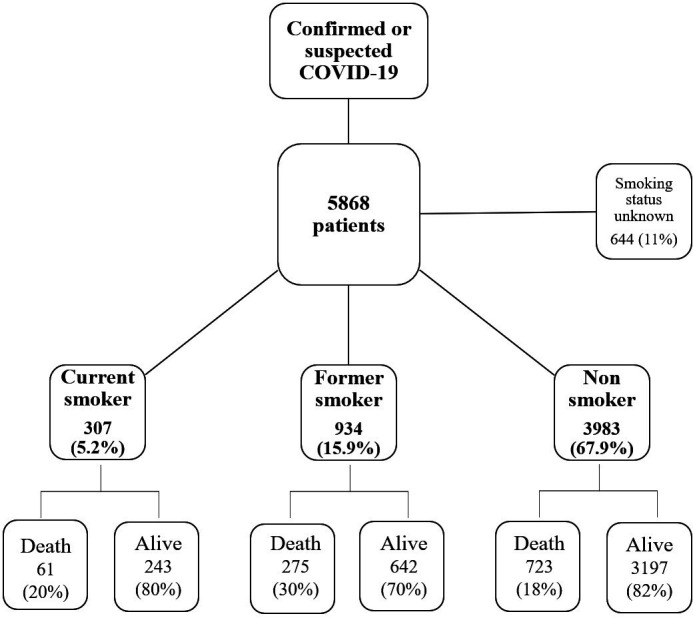
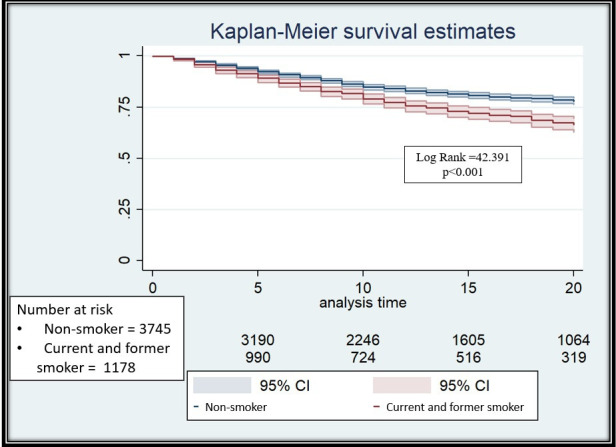
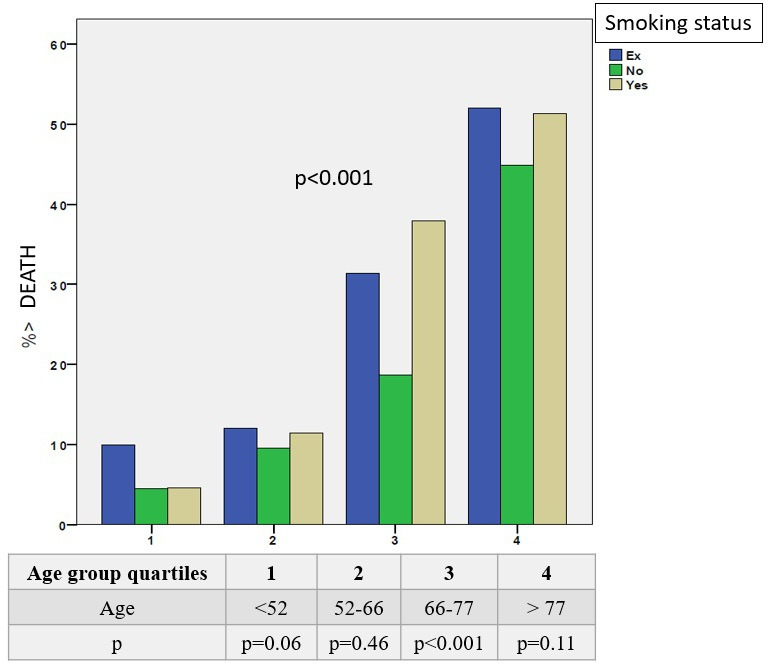
Results: Finally, 5224 patients with COVID-19 with available smoking status were analysed. A total of 3983 (67.9%) patients were non-smokers, 934 (15.9%) were former smokers and 307 (5.2%) were active smokers. The median age was 66 years (IQR 52.0-77.0) and 58.6% were male. The most frequent comorbidities were hypertension (48.5%) and dyslipidaemia (33.0%). A relevant lung disease was present in 19.4%. In-hospital complications such sepsis (23.6%) and embolic events (4.3%) occurred more frequently in the smoker group (p<0.001 for both). All cause-death was higher among smokers (active or former smokers) compared with non-smokers (27.6 vs 18.4%, p<0.001). Following a multivariate analysis, current smoking was considered as an independent predictor of mortality (OR 1.77, 95% CI 1.11 to 2.82, p=0.017) and a combined endpoint of severe disease (OR 1.68, 95% CI 1.16 to 2.43, p=0.006).
Conclusion: Smoking has a negative prognostic impact on patients hospitalised with COVID-19.
期刊介绍:
ACS Applied Electronic Materials is an interdisciplinary journal publishing original research covering all aspects of electronic materials. The journal is devoted to reports of new and original experimental and theoretical research of an applied nature that integrate knowledge in the areas of materials science, engineering, optics, physics, and chemistry into important applications of electronic materials. Sample research topics that span the journal's scope are inorganic, organic, ionic and polymeric materials with properties that include conducting, semiconducting, superconducting, insulating, dielectric, magnetic, optoelectronic, piezoelectric, ferroelectric and thermoelectric.
Indexed/Abstracted:
Web of Science SCIE
Scopus
CAS
INSPEC
Portico




 京公网安备 11010802042870号
京ICP备2023020795号-1
京公网安备 11010802042870号
京ICP备2023020795号-1

 分享
分享
 求助内容:
求助内容: 应助结果提醒方式:
 扫码关注我们
