Meropenem Versus Piperacillin-Tazobactam for Definitive Treatment of Bloodstream Infections Caused by AmpC β-Lactamase-Producing Enterobacter spp, Citrobacter freundii, Morganella morganii, Providencia spp, or Serratia marcescens: A Pilot Multicenter Randomized Controlled Trial (MERINO-2).
Adam G Stewart, David L Paterson, Barnaby Young, David C Lye, Joshua S Davis, Kellie Schneider, Mesut Yilmaz, Rumeysa Dinleyici, Naomi Runnegar, Andrew Henderson, Sophia Archuleta, Shirin Kalimuddin, Brian M Forde, Mark D Chatfield, Michelle J Bauer, Jeffrey Lipman, Tiffany Harris-Brown, Patrick N A Harris
{"title":"Meropenem Versus Piperacillin-Tazobactam for Definitive Treatment of Bloodstream Infections Caused by AmpC β-Lactamase-Producing <i>Enterobacter</i> spp, <i>Citrobacter freundii</i>, <i>Morganella morganii</i>, <i>Providencia</i> spp, or <i>Serratia marcescens</i>: A Pilot Multicenter Randomized Controlled Trial (MERINO-2).","authors":"Adam G Stewart, David L Paterson, Barnaby Young, David C Lye, Joshua S Davis, Kellie Schneider, Mesut Yilmaz, Rumeysa Dinleyici, Naomi Runnegar, Andrew Henderson, Sophia Archuleta, Shirin Kalimuddin, Brian M Forde, Mark D Chatfield, Michelle J Bauer, Jeffrey Lipman, Tiffany Harris-Brown, Patrick N A Harris","doi":"10.1093/ofid/ofab387","DOIUrl":null,"url":null,"abstract":"<p><strong>Background: </strong>Carbapenems are recommended treatment for serious infections caused by AmpC-producing gram-negative bacteria but can select for carbapenem resistance. Piperacillin-tazobactam may be a suitable alternative.</p><p><strong>Methods: </strong>We enrolled adult patients with bloodstream infection due to chromosomal AmpC producers in a multicenter randomized controlled trial. Patients were assigned 1:1 to receive piperacillin-tazobactam 4.5 g every 6 hours or meropenem 1 g every 8 hours. The primary efficacy outcome was a composite of death, clinical failure, microbiological failure, and microbiological relapse at 30 days.</p><p><strong>Results: </strong>Seventy-two patients underwent randomization and were included in the primary analysis population. Eleven of 38 patients (29%) randomized to piperacillin-tazobactam met the primary outcome compared with 7 of 34 patients (21%) in the meropenem group (risk difference, 8% [95% confidence interval {CI}, -12% to 28%]). Effects were consistent in an analysis of the per-protocol population. Within the subcomponents of the primary outcome, 5 of 38 (13%) experienced microbiological failure in the piperacillin-tazobactam group compared to 0 of 34 patients (0%) in the meropenem group (risk difference, 13% [95% CI, 2% to 24%]). In contrast, 0% vs 9% of microbiological relapses were seen in the piperacillin-tazobactam and meropenem arms, respectively. Susceptibility to piperacillin-tazobactam and meropenem using broth microdilution was found in 96.5% and 100% of isolates, respectively. The most common AmpC β-lactamase genes identified were <i>bla</i> <sub>CMY-2</sub>, <i>bla</i> <sub>DHA-17</sub>, <i>bla</i> <sub>CMH-3</sub>, and <i>bla</i> <sub>ACT-17</sub>. No ESBL, OXA, or other carbapenemase genes were identified.</p><p><strong>Conclusions: </strong>Among patients with bloodstream infection due to AmpC producers, piperacillin-tazobactam may lead to more microbiological failures, although fewer microbiological relapses were seen.</p><p><strong>Clinical trials registration: </strong>NCT02437045.</p>","PeriodicalId":19517,"journal":{"name":"Open Forum Infectious Diseases","volume":" ","pages":"ofab387"},"PeriodicalIF":3.8000,"publicationDate":"2021-08-02","publicationTypes":"Journal Article","fieldsOfStudy":null,"isOpenAccess":false,"openAccessPdf":"https://ftp.ncbi.nlm.nih.gov/pub/pmc/oa_pdf/9b/40/ofab387.PMC8361238.pdf","citationCount":"32","resultStr":null,"platform":"Semanticscholar","paperid":null,"PeriodicalName":"Open Forum Infectious Diseases","FirstCategoryId":"3","ListUrlMain":"https://doi.org/10.1093/ofid/ofab387","RegionNum":4,"RegionCategory":"医学","ArticlePicture":[],"TitleCN":null,"AbstractTextCN":null,"PMCID":null,"EPubDate":"2021/8/1 0:00:00","PubModel":"eCollection","JCR":"Q2","JCRName":"IMMUNOLOGY","Score":null,"Total":0}
引用次数: 32
Abstract
Background: Carbapenems are recommended treatment for serious infections caused by AmpC-producing gram-negative bacteria but can select for carbapenem resistance. Piperacillin-tazobactam may be a suitable alternative.
Methods: We enrolled adult patients with bloodstream infection due to chromosomal AmpC producers in a multicenter randomized controlled trial. Patients were assigned 1:1 to receive piperacillin-tazobactam 4.5 g every 6 hours or meropenem 1 g every 8 hours. The primary efficacy outcome was a composite of death, clinical failure, microbiological failure, and microbiological relapse at 30 days.
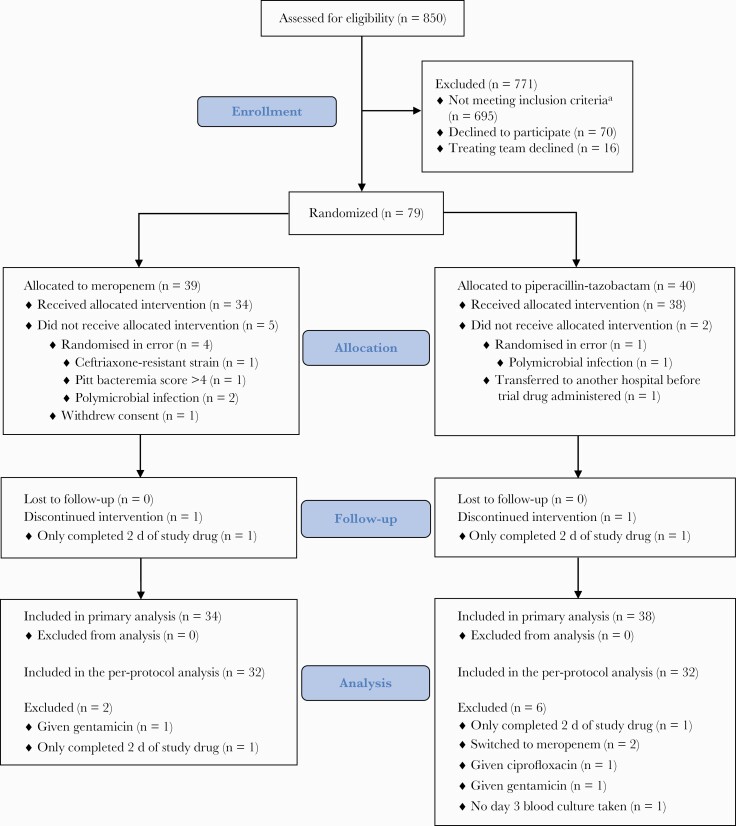
Results: Seventy-two patients underwent randomization and were included in the primary analysis population. Eleven of 38 patients (29%) randomized to piperacillin-tazobactam met the primary outcome compared with 7 of 34 patients (21%) in the meropenem group (risk difference, 8% [95% confidence interval {CI}, -12% to 28%]). Effects were consistent in an analysis of the per-protocol population. Within the subcomponents of the primary outcome, 5 of 38 (13%) experienced microbiological failure in the piperacillin-tazobactam group compared to 0 of 34 patients (0%) in the meropenem group (risk difference, 13% [95% CI, 2% to 24%]). In contrast, 0% vs 9% of microbiological relapses were seen in the piperacillin-tazobactam and meropenem arms, respectively. Susceptibility to piperacillin-tazobactam and meropenem using broth microdilution was found in 96.5% and 100% of isolates, respectively. The most common AmpC β-lactamase genes identified were blaCMY-2, blaDHA-17, blaCMH-3, and blaACT-17. No ESBL, OXA, or other carbapenemase genes were identified.
Conclusions: Among patients with bloodstream infection due to AmpC producers, piperacillin-tazobactam may lead to more microbiological failures, although fewer microbiological relapses were seen.
期刊介绍:
Open Forum Infectious Diseases provides a global forum for the publication of clinical, translational, and basic research findings in a fully open access, online journal environment. The journal reflects the broad diversity of the field of infectious diseases, and focuses on the intersection of biomedical science and clinical practice, with a particular emphasis on knowledge that holds the potential to improve patient care in populations around the world. Fully peer-reviewed, OFID supports the international community of infectious diseases experts by providing a venue for articles that further the understanding of all aspects of infectious diseases.






 京公网安备 11010802042870号
京ICP备2023020795号-1
京公网安备 11010802042870号
京ICP备2023020795号-1

 分享
分享
 求助内容:
求助内容: 应助结果提醒方式:
 扫码关注我们
