{"title":"Nasal Carriage of Methicillin-Resistant <i>Staphylococcus aureus</i> among Healthcare Workers in a Tertiary Care Hospital, Kathmandu, Nepal.","authors":"Nisha Giri, Sujina Maharjan, Tika Bahadur Thapa, Sushant Pokhrel, Govardhan Joshi, Ojaswee Shrestha, Nabina Shrestha, Basista Prasad Rijal","doi":"10.1155/2021/8825746","DOIUrl":null,"url":null,"abstract":"Introduction Methicillin-resistant Staphylococcus aureus (MRSA) is one of the most common causes of nosocomial infections. One of the potential risk factors for nosocomial staphylococcal infections is colonization of the anterior nares of healthcare workers (HCWs). Our study aimed to determine the rate of nasal carriage MRSA among HCWs at Manmohan Memorial Medical College and Teaching Hospital, Kathmandu. Methods Two hundred and thirty-two nasal swabs were collected from HCWs of Manmohan Memorial Medical College and Teaching Hospital, Kathmandu, Nepal, within six months (February 2018–July 2018). Nasal swabs were cultured, and S. aureus isolates were subjected to the antimicrobial susceptibility test by the modified Kirby–Bauer disc diffusion method. MRSA and iMLSB (inducible macrolide lincosamide streptogramin B) resistance was screened using the cefoxitin disc (30 μg) and D-test (clindamycin and erythromycin sensitivity pattern), respectively, following CLSI (Clinical and Laboratory Standard Institute) guidelines. Risk factors for MRSA colonization were determined using the chi-square test considering the p value ˂0.05 as significant. Results A total of 34/232 (14.7%) S. aureus were isolated, out of which 12 (35.3%) were MRSA. The overall rate of nasal carriage MRSA among HCWs was 5.2% (12/232). Colonization of MRSA was higher in males (8.7%) than in females (4.3%). MRSA colonization was found to be at peak among the doctors (11.4%). HCWs of the postoperative ward were colonized highest (18.2%). All MRSA isolates were sensitive to linezolid and tetracycline. iMLSB resistance was shown by 7(20.6%) of the isolates. MRSA strains showed higher iMLSB resistance accounting for 33.3% (4/12) in comparison to methicillin-susceptible strains with 13.6% (3/22). Smoking was found to be significantly associated with MRSA colonization (p=0.004). Conclusion Rate of nasal carriage MRSA is high among HCWs and hence needs special attention to prevent HCW-associated infections that may result due to nasal colonization.","PeriodicalId":14098,"journal":{"name":"International Journal of Microbiology","volume":" ","pages":"8825746"},"PeriodicalIF":3.2000,"publicationDate":"2021-08-10","publicationTypes":"Journal Article","fieldsOfStudy":null,"isOpenAccess":false,"openAccessPdf":"https://www.ncbi.nlm.nih.gov/pmc/articles/PMC8373499/pdf/","citationCount":"4","resultStr":null,"platform":"Semanticscholar","paperid":null,"PeriodicalName":"International Journal of Microbiology","FirstCategoryId":"1085","ListUrlMain":"https://doi.org/10.1155/2021/8825746","RegionNum":0,"RegionCategory":null,"ArticlePicture":[],"TitleCN":null,"AbstractTextCN":null,"PMCID":null,"EPubDate":"2021/1/1 0:00:00","PubModel":"eCollection","JCR":"Q3","JCRName":"MICROBIOLOGY","Score":null,"Total":0}
引用次数: 4
Abstract
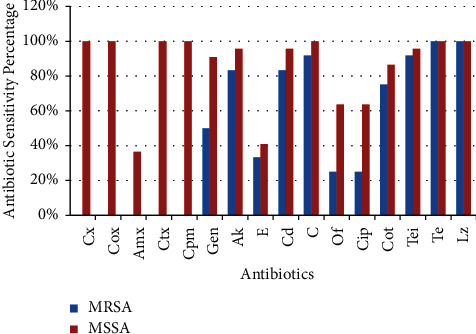
Introduction Methicillin-resistant Staphylococcus aureus (MRSA) is one of the most common causes of nosocomial infections. One of the potential risk factors for nosocomial staphylococcal infections is colonization of the anterior nares of healthcare workers (HCWs). Our study aimed to determine the rate of nasal carriage MRSA among HCWs at Manmohan Memorial Medical College and Teaching Hospital, Kathmandu. Methods Two hundred and thirty-two nasal swabs were collected from HCWs of Manmohan Memorial Medical College and Teaching Hospital, Kathmandu, Nepal, within six months (February 2018–July 2018). Nasal swabs were cultured, and S. aureus isolates were subjected to the antimicrobial susceptibility test by the modified Kirby–Bauer disc diffusion method. MRSA and iMLSB (inducible macrolide lincosamide streptogramin B) resistance was screened using the cefoxitin disc (30 μg) and D-test (clindamycin and erythromycin sensitivity pattern), respectively, following CLSI (Clinical and Laboratory Standard Institute) guidelines. Risk factors for MRSA colonization were determined using the chi-square test considering the p value ˂0.05 as significant. Results A total of 34/232 (14.7%) S. aureus were isolated, out of which 12 (35.3%) were MRSA. The overall rate of nasal carriage MRSA among HCWs was 5.2% (12/232). Colonization of MRSA was higher in males (8.7%) than in females (4.3%). MRSA colonization was found to be at peak among the doctors (11.4%). HCWs of the postoperative ward were colonized highest (18.2%). All MRSA isolates were sensitive to linezolid and tetracycline. iMLSB resistance was shown by 7(20.6%) of the isolates. MRSA strains showed higher iMLSB resistance accounting for 33.3% (4/12) in comparison to methicillin-susceptible strains with 13.6% (3/22). Smoking was found to be significantly associated with MRSA colonization (p=0.004). Conclusion Rate of nasal carriage MRSA is high among HCWs and hence needs special attention to prevent HCW-associated infections that may result due to nasal colonization.
期刊介绍:
International Journal of Microbiology is a peer-reviewed, Open Access journal that publishes original research articles, review articles, and clinical studies on microorganisms and their interaction with hosts and the environment. The journal covers all microbes, including bacteria, fungi, viruses, archaea, and protozoa. Basic science will be considered, as well as medical and applied research.





 京公网安备 11010802042870号
京ICP备2023020795号-1
京公网安备 11010802042870号
京ICP备2023020795号-1

 分享
分享
 求助内容:
求助内容: 应助结果提醒方式:
 扫码关注我们
