Elizabeth A Stuart, Ian Schmid, Trang Nguyen, Elizabeth Sarker, Adam Pittman, Kelly Benke, Kara Rudolph, Elena Badillo-Goicoechea, Jeannie-Marie Leoutsakos
{"title":"Assumptions Not Often Assessed or Satisfied in Published Mediation Analyses in Psychology and Psychiatry.","authors":"Elizabeth A Stuart, Ian Schmid, Trang Nguyen, Elizabeth Sarker, Adam Pittman, Kelly Benke, Kara Rudolph, Elena Badillo-Goicoechea, Jeannie-Marie Leoutsakos","doi":"10.1093/epirev/mxab007","DOIUrl":null,"url":null,"abstract":"<p><p>Mediation analysis aims to investigate the mechanisms of action behind the effects of interventions or treatments. Given the history and common use of mediation in mental health research, we conducted this review to understand how mediation analysis is implemented in psychology and psychiatry and whether analyses adhere to, address, or justify the key underlying assumptions of their approaches. All articles (n = 206) were from top academic psychiatry or psychology journals in the PsycInfo database and were published in English from 2013 to 2018. Information extracted from each article related to study design, covariates adjusted for in the analysis, temporal ordering of variables, and the specific method used to perform the mediation analysis. In most studies, underlying assumptions were not adhered to. Only approximately 20% of articles had full temporal ordering of exposure, mediator, and outcome. Confounding of the exposure-mediator and/or mediator-outcome relationships was controlled for in fewer than half of the studies. In almost none of the articles were the underlying assumptions of their approaches discussed or causal mediation methods used. These results provide insights to how methodologists should aim to communicate methods, and motivation for more outreach to the research community on best practices for mediation analysis.</p>","PeriodicalId":5,"journal":{"name":"ACS Applied Materials & Interfaces","volume":" ","pages":"48-52"},"PeriodicalIF":8.2000,"publicationDate":"2022-01-14","publicationTypes":"Journal Article","fieldsOfStudy":null,"isOpenAccess":false,"openAccessPdf":"https://www.ncbi.nlm.nih.gov/pmc/articles/PMC8900288/pdf/mxab007.pdf","citationCount":"6","resultStr":null,"platform":"Semanticscholar","paperid":null,"PeriodicalName":"ACS Applied Materials & Interfaces","FirstCategoryId":"3","ListUrlMain":"https://doi.org/10.1093/epirev/mxab007","RegionNum":2,"RegionCategory":"材料科学","ArticlePicture":[],"TitleCN":null,"AbstractTextCN":null,"PMCID":null,"EPubDate":"","PubModel":"","JCR":"Q1","JCRName":"MATERIALS SCIENCE, MULTIDISCIPLINARY","Score":null,"Total":0}
引用次数: 6
Abstract
Mediation analysis aims to investigate the mechanisms of action behind the effects of interventions or treatments. Given the history and common use of mediation in mental health research, we conducted this review to understand how mediation analysis is implemented in psychology and psychiatry and whether analyses adhere to, address, or justify the key underlying assumptions of their approaches. All articles (n = 206) were from top academic psychiatry or psychology journals in the PsycInfo database and were published in English from 2013 to 2018. Information extracted from each article related to study design, covariates adjusted for in the analysis, temporal ordering of variables, and the specific method used to perform the mediation analysis. In most studies, underlying assumptions were not adhered to. Only approximately 20% of articles had full temporal ordering of exposure, mediator, and outcome. Confounding of the exposure-mediator and/or mediator-outcome relationships was controlled for in fewer than half of the studies. In almost none of the articles were the underlying assumptions of their approaches discussed or causal mediation methods used. These results provide insights to how methodologists should aim to communicate methods, and motivation for more outreach to the research community on best practices for mediation analysis.
期刊介绍:
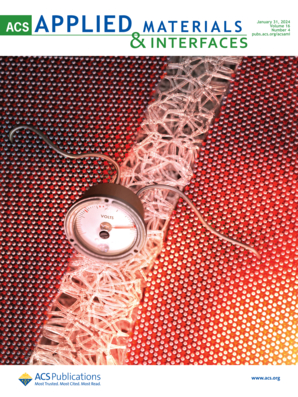
ACS Applied Materials & Interfaces is a leading interdisciplinary journal that brings together chemists, engineers, physicists, and biologists to explore the development and utilization of newly-discovered materials and interfacial processes for specific applications. Our journal has experienced remarkable growth since its establishment in 2009, both in terms of the number of articles published and the impact of the research showcased. We are proud to foster a truly global community, with the majority of published articles originating from outside the United States, reflecting the rapid growth of applied research worldwide.




 京公网安备 11010802042870号
京ICP备2023020795号-1
京公网安备 11010802042870号
京ICP备2023020795号-1

 分享
分享
 求助内容:
求助内容: 应助结果提醒方式:
 扫码关注我们
