{"title":"Relative sensitivity of duckweed <i>Lemna minor</i> and six algae to seven herbicides.","authors":"Koji Ueda, Takashi Nagai","doi":"10.1584/jpestics.D21-018","DOIUrl":null,"url":null,"abstract":"<p><p>We investigated the relative sensitivity of duckweed <i>Lemna minor</i> and six species of algae to seven herbicides, using an efficient high-throughput microplate-based toxicity assay. First, we assessed the sensitivity of <i>L</i>. <i>minor</i> to the seven herbicides, and then we compared its sensitivity to that of previously published data for six algal species based on EC<sub>50</sub> values. For five herbicides, the most sensitive species differed: <i>L</i>. <i>minor</i> was most sensitive to cyclosulfamuron: <i>Raphidocelis subcapitata</i> was most sensitive to pretilachlor and esprocarb: <i>Desmodesmus subspicatus</i> was most sensitive to pyraclonil; and <i>Navicula pelliculosa</i> was most sensitive to pyrazoxyfen. Simetryn was evenly toxic to all species, whereas 2,4-D was evenly less toxic, with only small differences in species sensitivity. These results suggested that a single algal species cannot represent the sensitivity of the primary producer assemblage to a given herbicide. Therefore, to assess the ecological effects of herbicides, aquatic plant and multispecies algal toxicity data sets are essential.</p>","PeriodicalId":16712,"journal":{"name":"Journal of Pesticide Science","volume":"46 3","pages":"267-273"},"PeriodicalIF":1.8000,"publicationDate":"2021-08-20","publicationTypes":"Journal Article","fieldsOfStudy":null,"isOpenAccess":false,"openAccessPdf":"https://ftp.ncbi.nlm.nih.gov/pub/pmc/oa_pdf/3d/82/jps-46-3-D21-018.PMC8422251.pdf","citationCount":"1","resultStr":null,"platform":"Semanticscholar","paperid":null,"PeriodicalName":"Journal of Pesticide Science","FirstCategoryId":"97","ListUrlMain":"https://doi.org/10.1584/jpestics.D21-018","RegionNum":4,"RegionCategory":"农林科学","ArticlePicture":[],"TitleCN":null,"AbstractTextCN":null,"PMCID":null,"EPubDate":"","PubModel":"","JCR":"Q2","JCRName":"ENTOMOLOGY","Score":null,"Total":0}
引用次数: 1
Abstract
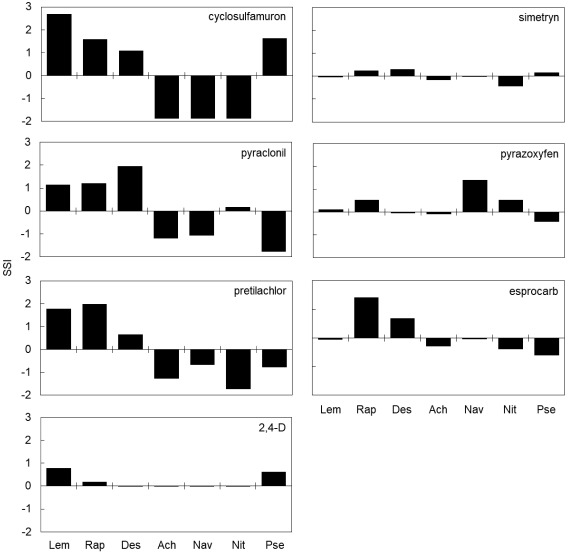
We investigated the relative sensitivity of duckweed Lemna minor and six species of algae to seven herbicides, using an efficient high-throughput microplate-based toxicity assay. First, we assessed the sensitivity of L. minor to the seven herbicides, and then we compared its sensitivity to that of previously published data for six algal species based on EC50 values. For five herbicides, the most sensitive species differed: L. minor was most sensitive to cyclosulfamuron: Raphidocelis subcapitata was most sensitive to pretilachlor and esprocarb: Desmodesmus subspicatus was most sensitive to pyraclonil; and Navicula pelliculosa was most sensitive to pyrazoxyfen. Simetryn was evenly toxic to all species, whereas 2,4-D was evenly less toxic, with only small differences in species sensitivity. These results suggested that a single algal species cannot represent the sensitivity of the primary producer assemblage to a given herbicide. Therefore, to assess the ecological effects of herbicides, aquatic plant and multispecies algal toxicity data sets are essential.
期刊介绍:
The Journal of Pesticide Science publishes the results of original research regarding the chemistry and biochemistry of pesticides including bio-based materials. It also covers their metabolism, toxicology, environmental fate and formulation.





 京公网安备 11010802042870号
京ICP备2023020795号-1
京公网安备 11010802042870号
京ICP备2023020795号-1

 分享
分享
 求助内容:
求助内容: 应助结果提醒方式:
 扫码关注我们
