Ben Alderson-Day, Jamie Moffatt, César F Lima, Saloni Krishnan, Charles Fernyhough, Sophie K Scott, Sophie Denton, Ivy Yi Ting Leong, Alena D Oncel, Yu-Lin Wu, Zehra Gurbuz, Samuel Evans
{"title":"Susceptibility to auditory hallucinations is associated with spontaneous but not directed modulation of top-down expectations for speech.","authors":"Ben Alderson-Day, Jamie Moffatt, César F Lima, Saloni Krishnan, Charles Fernyhough, Sophie K Scott, Sophie Denton, Ivy Yi Ting Leong, Alena D Oncel, Yu-Lin Wu, Zehra Gurbuz, Samuel Evans","doi":"10.1093/nc/niac002","DOIUrl":null,"url":null,"abstract":"<p><p>Auditory verbal hallucinations (AVHs)-or hearing voices-occur in clinical and non-clinical populations, but their mechanisms remain unclear. Predictive processing models of psychosis have proposed that hallucinations arise from an over-weighting of prior expectations in perception. It is unknown, however, whether this reflects (i) a sensitivity to explicit modulation of prior knowledge or (ii) a pre-existing tendency to spontaneously use such knowledge in ambiguous contexts. Four experiments were conducted to examine this question in healthy participants listening to ambiguous speech stimuli. In experiments 1a (<i>n</i> = 60) and 1b (<i>n</i> = 60), participants discriminated intelligible and unintelligible sine-wave speech before and after exposure to the original language templates (i.e. a modulation of expectation). No relationship was observed between top-down modulation and two common measures of hallucination-proneness. Experiment 2 (<i>n</i> = 99) confirmed this pattern with a different stimulus-sine-vocoded speech (SVS)-that was designed to minimize ceiling effects in discrimination and more closely model previous top-down effects reported in psychosis. In Experiment 3 (<i>n</i> = 134), participants were exposed to SVS without prior knowledge that it contained speech (i.e. naïve listening). AVH-proneness significantly predicted both pre-exposure identification of speech and successful recall for words hidden in SVS, indicating that participants could actually decode the hidden signal spontaneously. Altogether, these findings support a pre-existing tendency to spontaneously draw upon prior knowledge in healthy people prone to AVH, rather than a sensitivity to temporary modulations of expectation. We propose a model of clinical and non-clinical hallucinations, across auditory and visual modalities, with testable predictions for future research.</p>","PeriodicalId":3,"journal":{"name":"ACS Applied Electronic Materials","volume":" ","pages":"niac002"},"PeriodicalIF":4.7000,"publicationDate":"2022-02-01","publicationTypes":"Journal Article","fieldsOfStudy":null,"isOpenAccess":false,"openAccessPdf":"https://www.ncbi.nlm.nih.gov/pmc/articles/PMC8824703/pdf/","citationCount":"0","resultStr":null,"platform":"Semanticscholar","paperid":null,"PeriodicalName":"ACS Applied Electronic Materials","FirstCategoryId":"88","ListUrlMain":"https://doi.org/10.1093/nc/niac002","RegionNum":3,"RegionCategory":"材料科学","ArticlePicture":[],"TitleCN":null,"AbstractTextCN":null,"PMCID":null,"EPubDate":"2022/1/1 0:00:00","PubModel":"eCollection","JCR":"Q1","JCRName":"ENGINEERING, ELECTRICAL & ELECTRONIC","Score":null,"Total":0}
引用次数: 0
Abstract
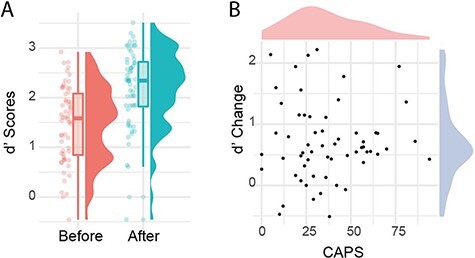
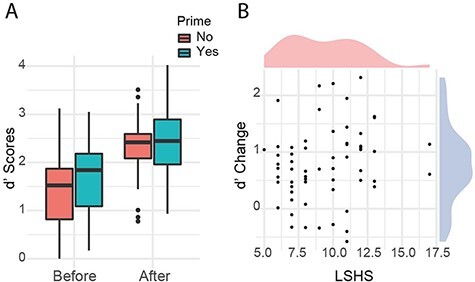
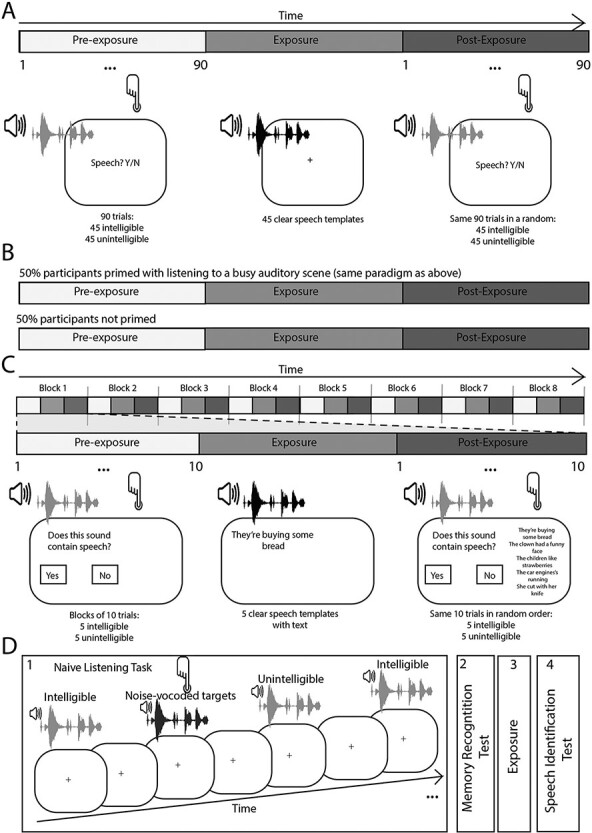
Auditory verbal hallucinations (AVHs)-or hearing voices-occur in clinical and non-clinical populations, but their mechanisms remain unclear. Predictive processing models of psychosis have proposed that hallucinations arise from an over-weighting of prior expectations in perception. It is unknown, however, whether this reflects (i) a sensitivity to explicit modulation of prior knowledge or (ii) a pre-existing tendency to spontaneously use such knowledge in ambiguous contexts. Four experiments were conducted to examine this question in healthy participants listening to ambiguous speech stimuli. In experiments 1a (n = 60) and 1b (n = 60), participants discriminated intelligible and unintelligible sine-wave speech before and after exposure to the original language templates (i.e. a modulation of expectation). No relationship was observed between top-down modulation and two common measures of hallucination-proneness. Experiment 2 (n = 99) confirmed this pattern with a different stimulus-sine-vocoded speech (SVS)-that was designed to minimize ceiling effects in discrimination and more closely model previous top-down effects reported in psychosis. In Experiment 3 (n = 134), participants were exposed to SVS without prior knowledge that it contained speech (i.e. naïve listening). AVH-proneness significantly predicted both pre-exposure identification of speech and successful recall for words hidden in SVS, indicating that participants could actually decode the hidden signal spontaneously. Altogether, these findings support a pre-existing tendency to spontaneously draw upon prior knowledge in healthy people prone to AVH, rather than a sensitivity to temporary modulations of expectation. We propose a model of clinical and non-clinical hallucinations, across auditory and visual modalities, with testable predictions for future research.
期刊介绍:
ACS Applied Electronic Materials is an interdisciplinary journal publishing original research covering all aspects of electronic materials. The journal is devoted to reports of new and original experimental and theoretical research of an applied nature that integrate knowledge in the areas of materials science, engineering, optics, physics, and chemistry into important applications of electronic materials. Sample research topics that span the journal's scope are inorganic, organic, ionic and polymeric materials with properties that include conducting, semiconducting, superconducting, insulating, dielectric, magnetic, optoelectronic, piezoelectric, ferroelectric and thermoelectric.
Indexed/Abstracted:
Web of Science SCIE
Scopus
CAS
INSPEC
Portico





 京公网安备 11010802042870号
京ICP备2023020795号-1
京公网安备 11010802042870号
京ICP备2023020795号-1

 分享
分享
 求助内容:
求助内容: 应助结果提醒方式:
 扫码关注我们
