Hannah G Lunkenheimer, Oskar Burger, Santosh Akhauri, Indrajit Chaudhuri, Lisa Dibbell, Faiz A Hashmi, Tracy Johnson, Emily E Little, Sudipta Mondal, Nachiket Mor, Neela Saldanha, Janine Schooley, Cristine H Legare
{"title":"Tradition, taste and taboo: the gastroecology of maternal perinatal diet.","authors":"Hannah G Lunkenheimer, Oskar Burger, Santosh Akhauri, Indrajit Chaudhuri, Lisa Dibbell, Faiz A Hashmi, Tracy Johnson, Emily E Little, Sudipta Mondal, Nachiket Mor, Neela Saldanha, Janine Schooley, Cristine H Legare","doi":"10.1136/bmjnph-2021-000252","DOIUrl":null,"url":null,"abstract":"<p><strong>Background: </strong>Maternal malnutrition is a major source of regional health inequity and contributes to maternal and infant morbidity and mortality. Bihar, a state in eastern India adjacent to Jharkhand and West Bengal, has relatively high neonatal mortality rates because a large portion of infants are born to young mothers. Bihar has the second-highest proportion of underweight children under 3 in India, with infant mortality rates of 48 per 1000 live births. Maternal malnutrition remains a major threat to perinatal health in Bihar, where 58.3% of pregnant women are anaemic.</p><p><strong>Methods: </strong>We examined dietary beliefs and practices among mothers, mothers-in-law and community members, including Accredited Social Health Activists (ASHAs), using focus group discussions (n=40 groups, 213 participants), key informant interviews (n=50 participants) and quantitative surveys (n=1200 recent mothers and 400 community health workers). We report foods that are added/avoided during the perinatal period, along with stated reasons underlying food choice. We summarise the content of the diet based on responses to the quantitative survey and identify influencers of food choice and stated explanations for adding and avoiding foods.</p><p><strong>Key findings: </strong>Analyses for all methodologies included gathering frequency counts and running descriptive statistics by food item, recommendation to eat or avoid, pregnancy or post partum, food group and health promoting or risk avoiding. During pregnancy, commonly added foods were generally nutritious (milk, pulses) with explanations for consuming these foods related to promoting health. Commonly avoided foods during pregnancy were also nutritious (wood apples, eggplant) with explanations for avoiding these foods related to miscarriage, newborn appearance and issues with digestion. Post partum, commonly added foods included sweets because they ease digestion whereas commonly avoided foods included eggplants and oily or spicy foods. Family, friends, relatives or neighbours influenced food choice for both mothers and ASHAs more than ASHAs and other health workers.Perinatal dietary beliefs and behaviours are shaped by local <i>gastroecologies</i> or systems of knowledge and practice that surround and inform dietary choices, as well as how those choices are explained and influenced. Our data provide novel insight into how health influencers operating within traditional and biomedical health systems shape the perinatal dietary beliefs of both mothers and community health workers.</p>","PeriodicalId":3,"journal":{"name":"ACS Applied Electronic Materials","volume":" ","pages":"385-396"},"PeriodicalIF":4.7000,"publicationDate":"2021-07-05","publicationTypes":"Journal Article","fieldsOfStudy":null,"isOpenAccess":false,"openAccessPdf":"https://www.ncbi.nlm.nih.gov/pmc/articles/PMC8718855/pdf/","citationCount":"0","resultStr":null,"platform":"Semanticscholar","paperid":null,"PeriodicalName":"ACS Applied Electronic Materials","FirstCategoryId":"88","ListUrlMain":"https://doi.org/10.1136/bmjnph-2021-000252","RegionNum":3,"RegionCategory":"材料科学","ArticlePicture":[],"TitleCN":null,"AbstractTextCN":null,"PMCID":null,"EPubDate":"2021/1/1 0:00:00","PubModel":"eCollection","JCR":"Q1","JCRName":"ENGINEERING, ELECTRICAL & ELECTRONIC","Score":null,"Total":0}
引用次数: 0
Abstract
Background: Maternal malnutrition is a major source of regional health inequity and contributes to maternal and infant morbidity and mortality. Bihar, a state in eastern India adjacent to Jharkhand and West Bengal, has relatively high neonatal mortality rates because a large portion of infants are born to young mothers. Bihar has the second-highest proportion of underweight children under 3 in India, with infant mortality rates of 48 per 1000 live births. Maternal malnutrition remains a major threat to perinatal health in Bihar, where 58.3% of pregnant women are anaemic.
Methods: We examined dietary beliefs and practices among mothers, mothers-in-law and community members, including Accredited Social Health Activists (ASHAs), using focus group discussions (n=40 groups, 213 participants), key informant interviews (n=50 participants) and quantitative surveys (n=1200 recent mothers and 400 community health workers). We report foods that are added/avoided during the perinatal period, along with stated reasons underlying food choice. We summarise the content of the diet based on responses to the quantitative survey and identify influencers of food choice and stated explanations for adding and avoiding foods.
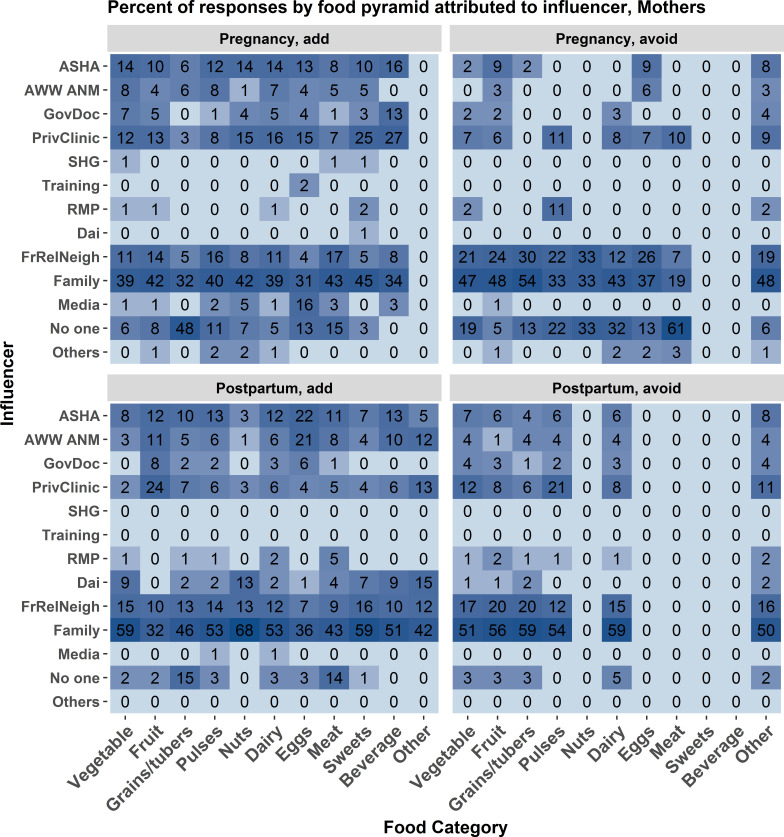
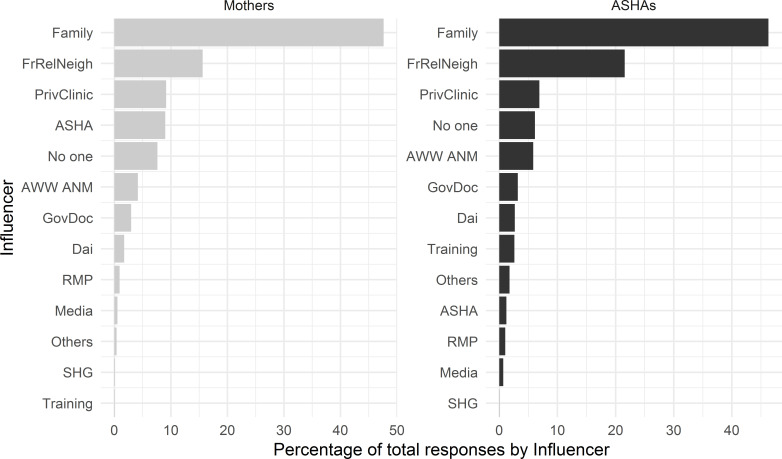
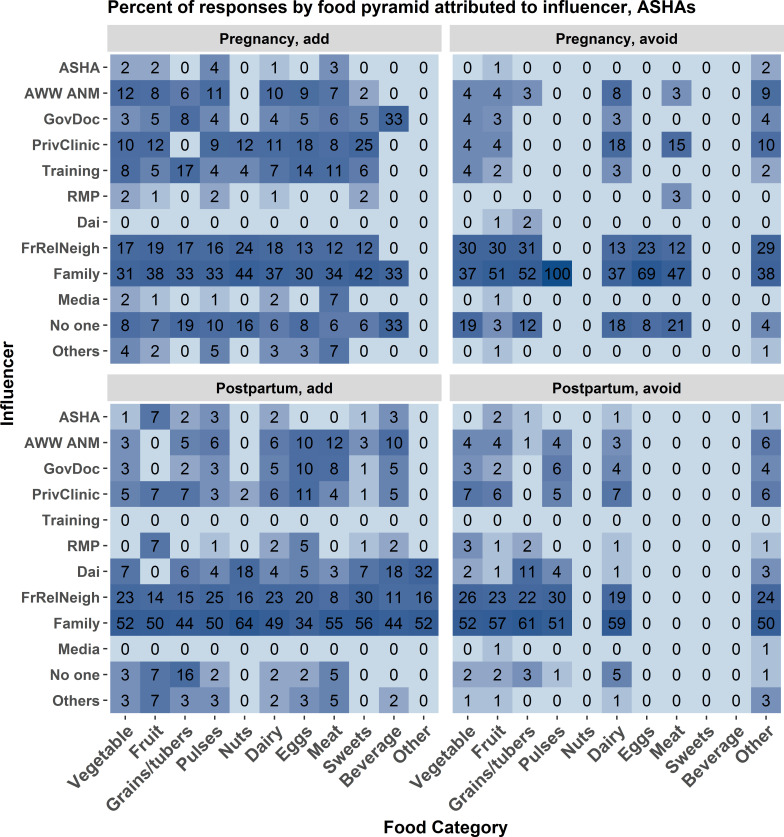
Key findings: Analyses for all methodologies included gathering frequency counts and running descriptive statistics by food item, recommendation to eat or avoid, pregnancy or post partum, food group and health promoting or risk avoiding. During pregnancy, commonly added foods were generally nutritious (milk, pulses) with explanations for consuming these foods related to promoting health. Commonly avoided foods during pregnancy were also nutritious (wood apples, eggplant) with explanations for avoiding these foods related to miscarriage, newborn appearance and issues with digestion. Post partum, commonly added foods included sweets because they ease digestion whereas commonly avoided foods included eggplants and oily or spicy foods. Family, friends, relatives or neighbours influenced food choice for both mothers and ASHAs more than ASHAs and other health workers.Perinatal dietary beliefs and behaviours are shaped by local gastroecologies or systems of knowledge and practice that surround and inform dietary choices, as well as how those choices are explained and influenced. Our data provide novel insight into how health influencers operating within traditional and biomedical health systems shape the perinatal dietary beliefs of both mothers and community health workers.
期刊介绍:
ACS Applied Electronic Materials is an interdisciplinary journal publishing original research covering all aspects of electronic materials. The journal is devoted to reports of new and original experimental and theoretical research of an applied nature that integrate knowledge in the areas of materials science, engineering, optics, physics, and chemistry into important applications of electronic materials. Sample research topics that span the journal's scope are inorganic, organic, ionic and polymeric materials with properties that include conducting, semiconducting, superconducting, insulating, dielectric, magnetic, optoelectronic, piezoelectric, ferroelectric and thermoelectric.
Indexed/Abstracted:
Web of Science SCIE
Scopus
CAS
INSPEC
Portico




 京公网安备 11010802042870号
京ICP备2023020795号-1
京公网安备 11010802042870号
京ICP备2023020795号-1

 分享
分享
 求助内容:
求助内容: 应助结果提醒方式:
 扫码关注我们
