Paul R Davis, Hans P Sviggum, Daniel J Delaney, Katherine W Arendt, Adam K Jacob, Emily E Sharpe
{"title":"Intravenous Dexmedetomidine as an Adjunct to Neuraxial Anesthesia in Cesarean Delivery: A Retrospective Chart Review.","authors":"Paul R Davis, Hans P Sviggum, Daniel J Delaney, Katherine W Arendt, Adam K Jacob, Emily E Sharpe","doi":"10.1155/2021/9887825","DOIUrl":null,"url":null,"abstract":"<p><strong>Background: </strong>Dexmedetomidine is a selective <i>α</i>-2 agonist commonly used for sedation that has been used in obstetric anesthesia for multimodal labor analgesia, postcesarean delivery analgesia, and perioperative shivering. This study evaluated the role of intravenous dexmedetomidine to provide rescue analgesia and/or sedation during cesarean delivery under neuraxial anesthesia.</p><p><strong>Methods: </strong>We conducted a single-center, retrospective cohort study of all parturients undergoing cesarean delivery under neuraxial anesthesia between December 1, 2018, and November 30, 2019, who required supplemental analgesia during the procedure. Patients were divided into two groups: patients who received intravenous dexmedetomidine (Dexmed group) and patients who received adjunct medications such as fentanyl, midazolam, ketamine, and nitrous oxide (Standard group). Primary outcome was incidence of conversion to general anesthesia.</p><p><strong>Results: </strong>During the study period, 107 patients received adjunct medications. There was no difference in conversion to general anesthesia between the Dexmed group and the Standard group (6% (4/62) vs. 9% (4/45); <i>p</i>=0.718). In the Dexmed group, the mean dexmedetomidine dose received was 37 <i>μ</i>g (range 10 to 140 <i>μ</i>g). While the use of inotropic/vasopressor medications was common and similar in both groups, there was an increase in the incidence of bradycardia (Dexmed 15% vs. Standard 2%; <i>p</i>=0.042) but not hypotension (Dexmed 24% vs. Standard 24%; <i>p</i>=1.00) in the Dexmed group.</p><p><strong>Conclusion: </strong>In patients who required supplemental analgesia for cesarean delivery, those who received dexmedetomidine versus other medications had a similar rate of conversion to general anesthesia, a statistically significant increase in bradycardia, but no difference in the incidence of hypotension.</p>","PeriodicalId":7834,"journal":{"name":"Anesthesiology Research and Practice","volume":"2021 ","pages":"9887825"},"PeriodicalIF":1.3000,"publicationDate":"2021-12-27","publicationTypes":"Journal Article","fieldsOfStudy":null,"isOpenAccess":false,"openAccessPdf":"https://www.ncbi.nlm.nih.gov/pmc/articles/PMC8723858/pdf/","citationCount":"3","resultStr":null,"platform":"Semanticscholar","paperid":null,"PeriodicalName":"Anesthesiology Research and Practice","FirstCategoryId":"1085","ListUrlMain":"https://doi.org/10.1155/2021/9887825","RegionNum":0,"RegionCategory":null,"ArticlePicture":[],"TitleCN":null,"AbstractTextCN":null,"PMCID":null,"EPubDate":"2021/1/1 0:00:00","PubModel":"eCollection","JCR":"Q2","JCRName":"ANESTHESIOLOGY","Score":null,"Total":0}
引用次数: 3
Abstract
Background: Dexmedetomidine is a selective α-2 agonist commonly used for sedation that has been used in obstetric anesthesia for multimodal labor analgesia, postcesarean delivery analgesia, and perioperative shivering. This study evaluated the role of intravenous dexmedetomidine to provide rescue analgesia and/or sedation during cesarean delivery under neuraxial anesthesia.
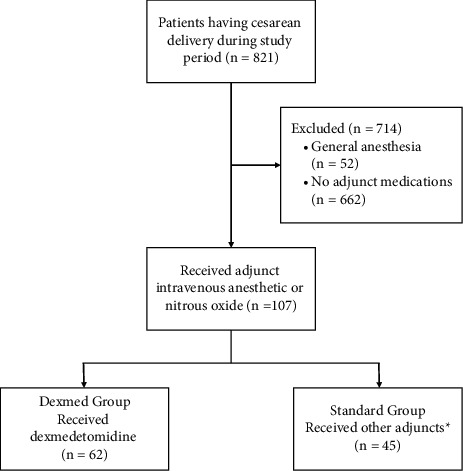
Methods: We conducted a single-center, retrospective cohort study of all parturients undergoing cesarean delivery under neuraxial anesthesia between December 1, 2018, and November 30, 2019, who required supplemental analgesia during the procedure. Patients were divided into two groups: patients who received intravenous dexmedetomidine (Dexmed group) and patients who received adjunct medications such as fentanyl, midazolam, ketamine, and nitrous oxide (Standard group). Primary outcome was incidence of conversion to general anesthesia.
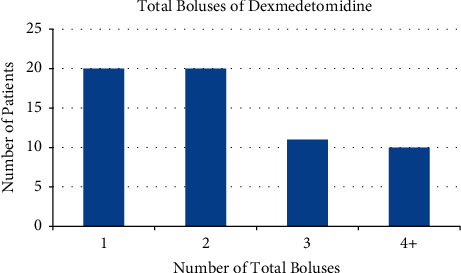
Results: During the study period, 107 patients received adjunct medications. There was no difference in conversion to general anesthesia between the Dexmed group and the Standard group (6% (4/62) vs. 9% (4/45); p=0.718). In the Dexmed group, the mean dexmedetomidine dose received was 37 μg (range 10 to 140 μg). While the use of inotropic/vasopressor medications was common and similar in both groups, there was an increase in the incidence of bradycardia (Dexmed 15% vs. Standard 2%; p=0.042) but not hypotension (Dexmed 24% vs. Standard 24%; p=1.00) in the Dexmed group.
Conclusion: In patients who required supplemental analgesia for cesarean delivery, those who received dexmedetomidine versus other medications had a similar rate of conversion to general anesthesia, a statistically significant increase in bradycardia, but no difference in the incidence of hypotension.




 京公网安备 11010802042870号
京ICP备2023020795号-1
京公网安备 11010802042870号
京ICP备2023020795号-1

 分享
分享
 求助内容:
求助内容: 应助结果提醒方式:
 扫码关注我们
