Murali Sabapathy , Frankie Tan , Shadiq Al Hussein , Haiyum Jaafar , Franck Brocherie , Sebastien Racinais , Mohammed Ihsan
{"title":"Effect of heat pre-conditioning on recovery following exercise-induced muscle damage","authors":"Murali Sabapathy , Frankie Tan , Shadiq Al Hussein , Haiyum Jaafar , Franck Brocherie , Sebastien Racinais , Mohammed Ihsan","doi":"10.1016/j.crphys.2021.06.002","DOIUrl":null,"url":null,"abstract":"<div><p>This study investigated the influence of heat pre-conditioning on the recovery of muscle torque, microvascular function, movement economy and stride mechanics following exercise-induced muscle damage (EIMD). Twenty male participants were equally assigned to a control (CON) and an experimental group (HEAT), and performed a 30-min downhill run (DHR) to elicit EIMD. HEAT group received three consecutive days of heat exposure (45.1 ± 3.2 min of hot water immersion at 42 °C) prior to DHR. Microvascular function (near-infrared spectroscopy), maximal voluntary contraction (MVC) torque of the knee extensors, as well as two treadmill-based steady-state runs performed below (SSR-1) and above (SSR-2) the first ventilatory threshold were assessed prior to DHR and repeated for four consecutive days post-DHR (D1-POST to D4-POST). The decline in MVC torque following EIMD was attenuated in HEAT compared with CON at D1-POST (p = 0.037), D3-POST (p = 0.002) and D4-POST (p = 0.022). Muscle soreness increased in both CON and HEAT, but was significantly attenuated in HEAT compared with CON at D2-POST (p = 0.024) and D3-POST (p = 0.013). Microvascular function decreased in CON from D1-POST to D3-POST (p = 0.009 to 0.018), and was lower compared with HEAT throughout D1-POST to D3-POST (p = 0.003 to 0.017). Pre-heat treatment decreased the magnitude of strength loss and muscle soreness, as well as attenuated the decline in microvascular function following EIMD. Heat treatment appears a promising pre-conditioning strategy when embarking on intensified training periods or competition.</p></div>","PeriodicalId":72753,"journal":{"name":"Current research in physiology","volume":"4 ","pages":"Pages 155-162"},"PeriodicalIF":1.7000,"publicationDate":"2021-01-01","publicationTypes":"Journal Article","fieldsOfStudy":null,"isOpenAccess":false,"openAccessPdf":"https://sci-hub-pdf.com/10.1016/j.crphys.2021.06.002","citationCount":"5","resultStr":null,"platform":"Semanticscholar","paperid":null,"PeriodicalName":"Current research in physiology","FirstCategoryId":"1085","ListUrlMain":"https://www.sciencedirect.com/science/article/pii/S2665944121000195","RegionNum":0,"RegionCategory":null,"ArticlePicture":[],"TitleCN":null,"AbstractTextCN":null,"PMCID":null,"EPubDate":"","PubModel":"","JCR":"Q3","JCRName":"PHYSIOLOGY","Score":null,"Total":0}
引用次数: 5
Abstract
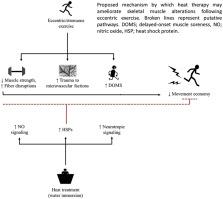
This study investigated the influence of heat pre-conditioning on the recovery of muscle torque, microvascular function, movement economy and stride mechanics following exercise-induced muscle damage (EIMD). Twenty male participants were equally assigned to a control (CON) and an experimental group (HEAT), and performed a 30-min downhill run (DHR) to elicit EIMD. HEAT group received three consecutive days of heat exposure (45.1 ± 3.2 min of hot water immersion at 42 °C) prior to DHR. Microvascular function (near-infrared spectroscopy), maximal voluntary contraction (MVC) torque of the knee extensors, as well as two treadmill-based steady-state runs performed below (SSR-1) and above (SSR-2) the first ventilatory threshold were assessed prior to DHR and repeated for four consecutive days post-DHR (D1-POST to D4-POST). The decline in MVC torque following EIMD was attenuated in HEAT compared with CON at D1-POST (p = 0.037), D3-POST (p = 0.002) and D4-POST (p = 0.022). Muscle soreness increased in both CON and HEAT, but was significantly attenuated in HEAT compared with CON at D2-POST (p = 0.024) and D3-POST (p = 0.013). Microvascular function decreased in CON from D1-POST to D3-POST (p = 0.009 to 0.018), and was lower compared with HEAT throughout D1-POST to D3-POST (p = 0.003 to 0.017). Pre-heat treatment decreased the magnitude of strength loss and muscle soreness, as well as attenuated the decline in microvascular function following EIMD. Heat treatment appears a promising pre-conditioning strategy when embarking on intensified training periods or competition.




 京公网安备 11010802042870号
京ICP备2023020795号-1
京公网安备 11010802042870号
京ICP备2023020795号-1

 分享
分享
 求助内容:
求助内容: 应助结果提醒方式:
 扫码关注我们
