Juliane Tetzlaff, Fabian Tetzlaff, Siegfried Geyer, Stefanie Sperlich, Jelena Epping
{"title":"Widening or narrowing income inequalities in myocardial infarction? Time trends in life years free of myocardial infarction and after incidence.","authors":"Juliane Tetzlaff, Fabian Tetzlaff, Siegfried Geyer, Stefanie Sperlich, Jelena Epping","doi":"10.1186/s12963-021-00280-1","DOIUrl":null,"url":null,"abstract":"<p><strong>Background: </strong>Despite substantial improvements in prevention and therapy, myocardial infarction (MI) remains a frequent health event, causing high mortality and serious health impairments. Previous research lacks evidence on how social inequalities in incidence and mortality risks developed over time, and on how these developments affect the lifespan free of MI and after MI in different social subgroups. This study investigates income inequalities in MI-free life years and life years after MI and whether these inequalities widened or narrowed over time.</p><p><strong>Methods: </strong>The analyses are based on claims data of a large German health insurance provider insuring approximately 2.8 million individuals in the federal state Lower Saxony. Trends in income inequalities in incidence and mortality were assessed for all subjects aged 60 years and older by comparing the time periods 2006-2008 and 2015-2017 using multistate survival models. Trends in the number of life years free of MI and after MI were calculated separately for income groups by applying multistate life table analyses.</p><p><strong>Results: </strong>MI incidence and mortality risks decreased over time, but declines were strongest among men and women in the higher-income group. While life years free of MI increased in men and women with higher incomes, no MI-free life years were gained in the low-income group. Among men, life years after MI increased irrespective of income group.</p><p><strong>Conclusions: </strong>Income inequalities in the lifespan spent free of MI and after MI widened over time. In particular, men with low incomes are disadvantaged, as life years spent after MI increased, but no life years free of MI were gained.</p>","PeriodicalId":3,"journal":{"name":"ACS Applied Electronic Materials","volume":" ","pages":"47"},"PeriodicalIF":4.7000,"publicationDate":"2021-12-24","publicationTypes":"Journal Article","fieldsOfStudy":null,"isOpenAccess":false,"openAccessPdf":"https://www.ncbi.nlm.nih.gov/pmc/articles/PMC8709953/pdf/","citationCount":"0","resultStr":null,"platform":"Semanticscholar","paperid":null,"PeriodicalName":"ACS Applied Electronic Materials","FirstCategoryId":"3","ListUrlMain":"https://doi.org/10.1186/s12963-021-00280-1","RegionNum":3,"RegionCategory":"材料科学","ArticlePicture":[],"TitleCN":null,"AbstractTextCN":null,"PMCID":null,"EPubDate":"","PubModel":"","JCR":"Q1","JCRName":"ENGINEERING, ELECTRICAL & ELECTRONIC","Score":null,"Total":0}
引用次数: 0
Abstract
Background: Despite substantial improvements in prevention and therapy, myocardial infarction (MI) remains a frequent health event, causing high mortality and serious health impairments. Previous research lacks evidence on how social inequalities in incidence and mortality risks developed over time, and on how these developments affect the lifespan free of MI and after MI in different social subgroups. This study investigates income inequalities in MI-free life years and life years after MI and whether these inequalities widened or narrowed over time.
Methods: The analyses are based on claims data of a large German health insurance provider insuring approximately 2.8 million individuals in the federal state Lower Saxony. Trends in income inequalities in incidence and mortality were assessed for all subjects aged 60 years and older by comparing the time periods 2006-2008 and 2015-2017 using multistate survival models. Trends in the number of life years free of MI and after MI were calculated separately for income groups by applying multistate life table analyses.
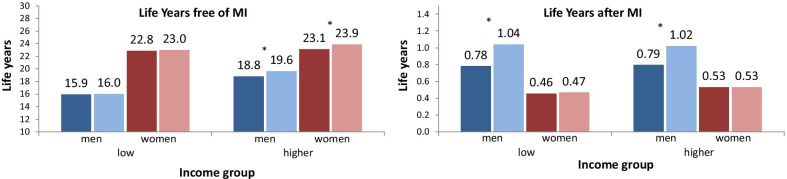
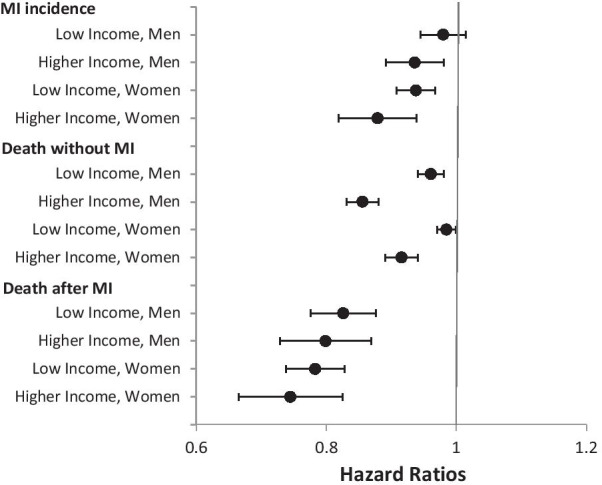
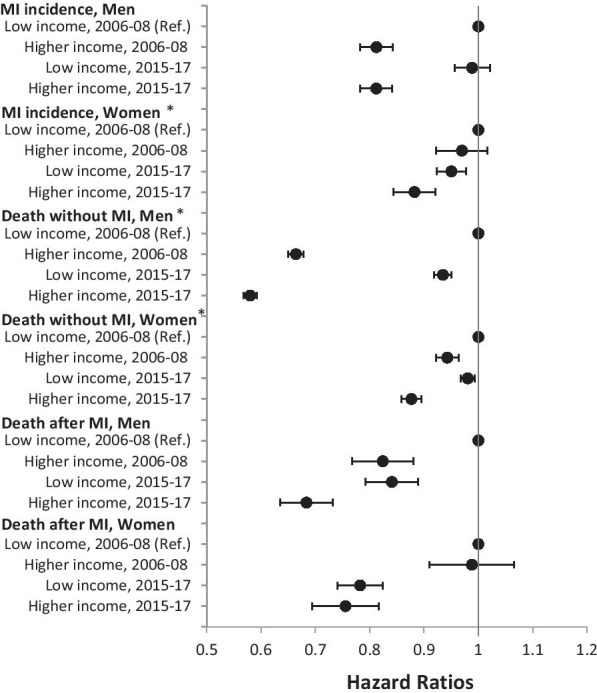
Results: MI incidence and mortality risks decreased over time, but declines were strongest among men and women in the higher-income group. While life years free of MI increased in men and women with higher incomes, no MI-free life years were gained in the low-income group. Among men, life years after MI increased irrespective of income group.
Conclusions: Income inequalities in the lifespan spent free of MI and after MI widened over time. In particular, men with low incomes are disadvantaged, as life years spent after MI increased, but no life years free of MI were gained.
期刊介绍:
ACS Applied Electronic Materials is an interdisciplinary journal publishing original research covering all aspects of electronic materials. The journal is devoted to reports of new and original experimental and theoretical research of an applied nature that integrate knowledge in the areas of materials science, engineering, optics, physics, and chemistry into important applications of electronic materials. Sample research topics that span the journal's scope are inorganic, organic, ionic and polymeric materials with properties that include conducting, semiconducting, superconducting, insulating, dielectric, magnetic, optoelectronic, piezoelectric, ferroelectric and thermoelectric.
Indexed/Abstracted:
Web of Science SCIE
Scopus
CAS
INSPEC
Portico




 京公网安备 11010802042870号
京ICP备2023020795号-1
京公网安备 11010802042870号
京ICP备2023020795号-1

 分享
分享
 求助内容:
求助内容: 应助结果提醒方式:
 扫码关注我们
