Claire Carvell , Nadine Mitschunas , Rachel McDonald , Sarah Hulmes , Lucy Hulmes , Rory S. O'Connor , Michael P.D. Garratt , Simon G. Potts , Michelle T. Fountain , Dinara Sadykova , Mike Edwards , Marek Nowakowski , Richard F. Pywell , John W. Redhead
{"title":"Establishment and management of wildflower areas for insect pollinators in commercial orchards","authors":"Claire Carvell , Nadine Mitschunas , Rachel McDonald , Sarah Hulmes , Lucy Hulmes , Rory S. O'Connor , Michael P.D. Garratt , Simon G. Potts , Michelle T. Fountain , Dinara Sadykova , Mike Edwards , Marek Nowakowski , Richard F. Pywell , John W. Redhead","doi":"10.1016/j.baae.2021.11.001","DOIUrl":null,"url":null,"abstract":"<div><p>Sown wildflower areas are increasingly recommended as an agri-environmental intervention measure, but evidence for their success is limited to particular insect groups or hampered by the challenges of establishing seed mixes and maintaining flower abundance over time. We conducted a replicated experiment to establish wildflower areas to support insect pollinators in apple orchards. Over three years, and across 23 commercial UK orchards with and without sown wildflowers, we conducted 828 transect surveys across various non-crop habitats. We found that the abundance of flower-visiting solitary bees, bumblebees, honeybees, and beetles was increased in sown wildflower areas, compared with existing non-crop habitats in control orchards, from the second year following floral establishment. Abundance of hoverflies and other non-syrphid flies was increased in wildflower areas from the first year. Beyond the effect of wildflower areas, solitary bee abundance was also positively related to levels of floral cover in other local habitats within orchards, but neither local nor wider landscape-scale context affected abundance of other studied insect taxa within study orchards. There was a change in plant community composition on the sown wildflower areas between years, and in patterns of flowering within and between years, showing a succession from unsown weedy species towards a dominance of sown species over time. We discuss how the successful establishment of sown wildflower areas and delivery of benefits for different insect taxa relies on appropriate and reactive management practices as a key component of any such agri-environment scheme.</p></div>","PeriodicalId":8708,"journal":{"name":"Basic and Applied Ecology","volume":"58 ","pages":"Pages 2-14"},"PeriodicalIF":3.5000,"publicationDate":"2022-02-01","publicationTypes":"Journal Article","fieldsOfStudy":null,"isOpenAccess":false,"openAccessPdf":"https://www.ncbi.nlm.nih.gov/pmc/articles/PMC8752464/pdf/","citationCount":"10","resultStr":null,"platform":"Semanticscholar","paperid":null,"PeriodicalName":"Basic and Applied Ecology","FirstCategoryId":"93","ListUrlMain":"https://www.sciencedirect.com/science/article/pii/S1439179121001729","RegionNum":2,"RegionCategory":"环境科学与生态学","ArticlePicture":[],"TitleCN":null,"AbstractTextCN":null,"PMCID":null,"EPubDate":"2021/11/10 0:00:00","PubModel":"Epub","JCR":"Q2","JCRName":"ECOLOGY","Score":null,"Total":0}
引用次数: 10
Abstract
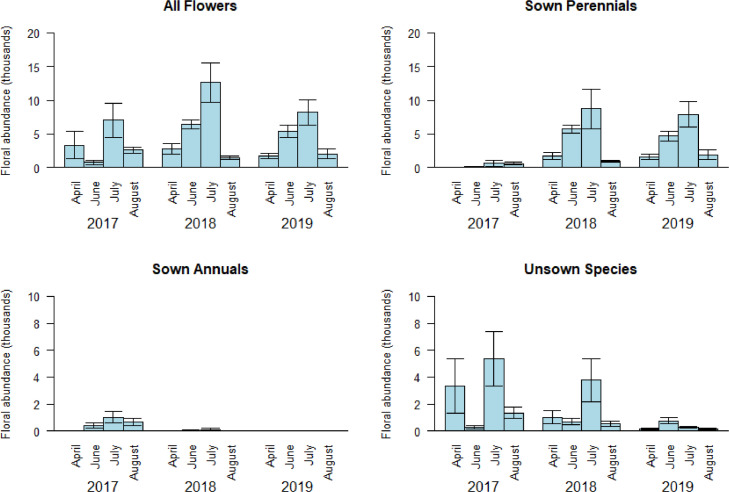
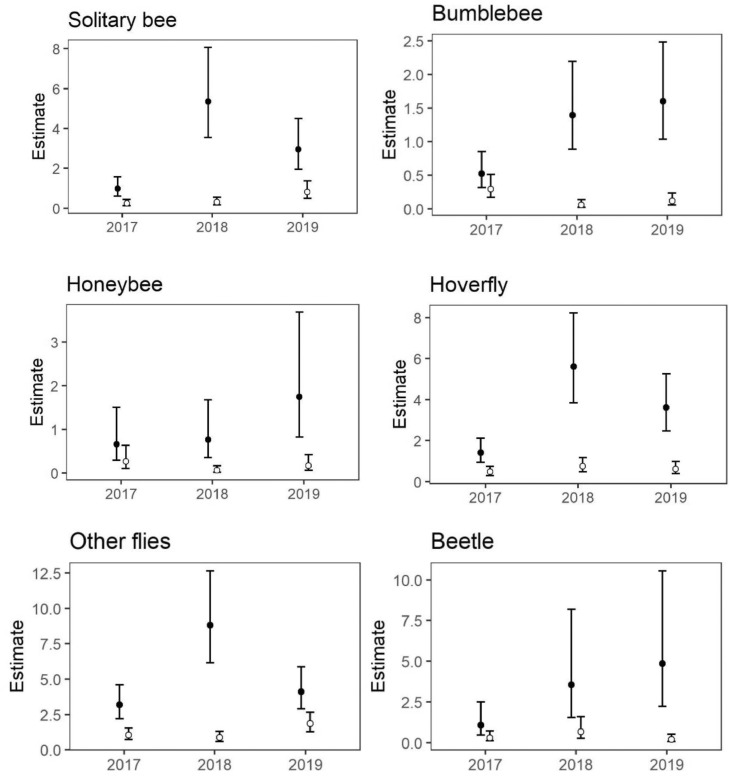
Sown wildflower areas are increasingly recommended as an agri-environmental intervention measure, but evidence for their success is limited to particular insect groups or hampered by the challenges of establishing seed mixes and maintaining flower abundance over time. We conducted a replicated experiment to establish wildflower areas to support insect pollinators in apple orchards. Over three years, and across 23 commercial UK orchards with and without sown wildflowers, we conducted 828 transect surveys across various non-crop habitats. We found that the abundance of flower-visiting solitary bees, bumblebees, honeybees, and beetles was increased in sown wildflower areas, compared with existing non-crop habitats in control orchards, from the second year following floral establishment. Abundance of hoverflies and other non-syrphid flies was increased in wildflower areas from the first year. Beyond the effect of wildflower areas, solitary bee abundance was also positively related to levels of floral cover in other local habitats within orchards, but neither local nor wider landscape-scale context affected abundance of other studied insect taxa within study orchards. There was a change in plant community composition on the sown wildflower areas between years, and in patterns of flowering within and between years, showing a succession from unsown weedy species towards a dominance of sown species over time. We discuss how the successful establishment of sown wildflower areas and delivery of benefits for different insect taxa relies on appropriate and reactive management practices as a key component of any such agri-environment scheme.
期刊介绍:
Basic and Applied Ecology provides a forum in which significant advances and ideas can be rapidly communicated to a wide audience. Basic and Applied Ecology publishes original contributions, perspectives and reviews from all areas of basic and applied ecology. Ecologists from all countries are invited to publish ecological research of international interest in its pages. There is no bias with regard to taxon or geographical area.