Francesco Visioli, Franca Marangoni, Vincenzo Fogliano, Daniele Del Rio, J Alfredo Martinez, Gunter Kuhnle, Judith Buttriss, Hugo Da Costa Ribeiro, Dennis Bier, Andrea Poli
{"title":"The ultra-processed foods hypothesis: a product processed well beyond the basic ingredients in the package.","authors":"Francesco Visioli, Franca Marangoni, Vincenzo Fogliano, Daniele Del Rio, J Alfredo Martinez, Gunter Kuhnle, Judith Buttriss, Hugo Da Costa Ribeiro, Dennis Bier, Andrea Poli","doi":"10.1017/S0954422422000117","DOIUrl":null,"url":null,"abstract":"<p><p>The NOVA classification of food items has become increasingly popular and is being used in several observational studies as well as in nutritional guidelines and recommendations. We propose that there is a need for this classification and its use in the formulation of public health policies to be critically discussed and re-appraised. The terms 'processing' and 'ultra-processing', which are crucial to the NOVA classification, are ill-defined, as no scientific, measurable or precise reference parameters exist for them. Likewise, the theoretical grounds of the NOVA classification are unclear and inaccurate. Overall, the NOVA classification conflicts with the classic, evidence-based evaluation of foods based on composition and portion size because NOVA postulates that the food itself (or how much of it is eaten) is unimportant, but rather that dietary effects are due to how the food is produced. We contend that the NOVA system suffers from a lack of biological plausibility so the assertion that ultra-processed foods are intrinsically unhealthful is largely unproven, and needs further examination and elaboration.</p>","PeriodicalId":5,"journal":{"name":"ACS Applied Materials & Interfaces","volume":" ","pages":"340-350"},"PeriodicalIF":8.2000,"publicationDate":"2023-12-01","publicationTypes":"Journal Article","fieldsOfStudy":null,"isOpenAccess":false,"openAccessPdf":"","citationCount":"0","resultStr":null,"platform":"Semanticscholar","paperid":null,"PeriodicalName":"ACS Applied Materials & Interfaces","FirstCategoryId":"88","ListUrlMain":"https://doi.org/10.1017/S0954422422000117","RegionNum":2,"RegionCategory":"材料科学","ArticlePicture":[],"TitleCN":null,"AbstractTextCN":null,"PMCID":null,"EPubDate":"2022/6/22 0:00:00","PubModel":"Epub","JCR":"Q1","JCRName":"MATERIALS SCIENCE, MULTIDISCIPLINARY","Score":null,"Total":0}
引用次数: 0
Abstract
The NOVA classification of food items has become increasingly popular and is being used in several observational studies as well as in nutritional guidelines and recommendations. We propose that there is a need for this classification and its use in the formulation of public health policies to be critically discussed and re-appraised. The terms 'processing' and 'ultra-processing', which are crucial to the NOVA classification, are ill-defined, as no scientific, measurable or precise reference parameters exist for them. Likewise, the theoretical grounds of the NOVA classification are unclear and inaccurate. Overall, the NOVA classification conflicts with the classic, evidence-based evaluation of foods based on composition and portion size because NOVA postulates that the food itself (or how much of it is eaten) is unimportant, but rather that dietary effects are due to how the food is produced. We contend that the NOVA system suffers from a lack of biological plausibility so the assertion that ultra-processed foods are intrinsically unhealthful is largely unproven, and needs further examination and elaboration.
期刊介绍:
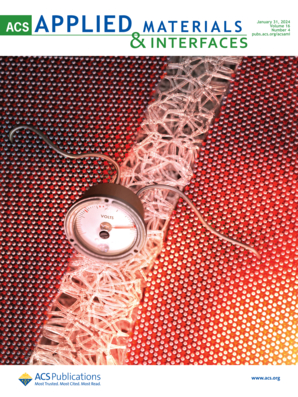
ACS Applied Materials & Interfaces is a leading interdisciplinary journal that brings together chemists, engineers, physicists, and biologists to explore the development and utilization of newly-discovered materials and interfacial processes for specific applications. Our journal has experienced remarkable growth since its establishment in 2009, both in terms of the number of articles published and the impact of the research showcased. We are proud to foster a truly global community, with the majority of published articles originating from outside the United States, reflecting the rapid growth of applied research worldwide.



 京公网安备 11010802042870号
京ICP备2023020795号-1
京公网安备 11010802042870号
京ICP备2023020795号-1

 分享
分享
 求助内容:
求助内容: 应助结果提醒方式:
 扫码关注我们
