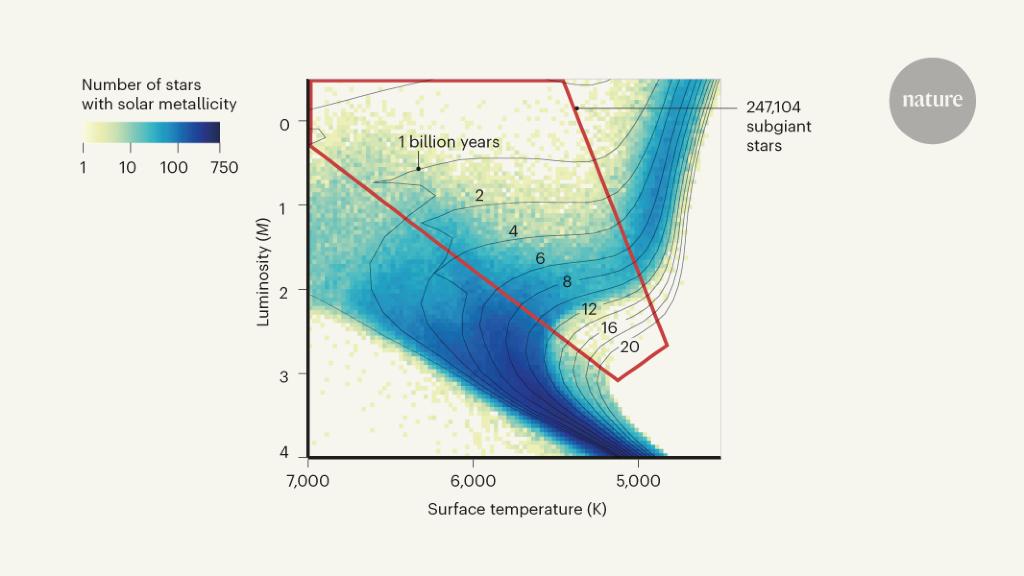
{"title":"A stellar clock reveals the assembly history of the Milky Way","authors":"Timothy C. Beers","doi":"10.1038/d41586-022-00768-2","DOIUrl":null,"url":null,"abstract":"A brief stage in stellar evolution offers a precise means of dating stars in the Milky Way. The ages, compositions and motions of these stars all pinpoint the dynamical processes involved in the Galaxy’s formation. Galaxy formation reconstructed by dating subgiant stars.","PeriodicalId":18787,"journal":{"name":"Nature","volume":"603 7902","pages":"580-581"},"PeriodicalIF":48.5000,"publicationDate":"2022-03-23","publicationTypes":"Journal Article","fieldsOfStudy":null,"isOpenAccess":false,"openAccessPdf":"","citationCount":"0","resultStr":null,"platform":"Semanticscholar","paperid":null,"PeriodicalName":"Nature","FirstCategoryId":"103","ListUrlMain":"https://www.nature.com/articles/d41586-022-00768-2","RegionNum":1,"RegionCategory":"综合性期刊","ArticlePicture":[],"TitleCN":null,"AbstractTextCN":null,"PMCID":null,"EPubDate":"","PubModel":"","JCR":"Q1","JCRName":"MULTIDISCIPLINARY SCIENCES","Score":null,"Total":0}
引用次数: 0
Abstract
A brief stage in stellar evolution offers a precise means of dating stars in the Milky Way. The ages, compositions and motions of these stars all pinpoint the dynamical processes involved in the Galaxy’s formation. Galaxy formation reconstructed by dating subgiant stars.
期刊介绍:
Nature is a prestigious international journal that publishes peer-reviewed research in various scientific and technological fields. The selection of articles is based on criteria such as originality, importance, interdisciplinary relevance, timeliness, accessibility, elegance, and surprising conclusions. In addition to showcasing significant scientific advances, Nature delivers rapid, authoritative, insightful news, and interpretation of current and upcoming trends impacting science, scientists, and the broader public. The journal serves a dual purpose: firstly, to promptly share noteworthy scientific advances and foster discussions among scientists, and secondly, to ensure the swift dissemination of scientific results globally, emphasizing their significance for knowledge, culture, and daily life.



 京公网安备 11010802042870号
京ICP备2023020795号-1
京公网安备 11010802042870号
京ICP备2023020795号-1

 分享
分享
 求助内容:
求助内容: 应助结果提醒方式:
 扫码关注我们
