{"title":"Potential of Aspergillus oryzae as a biosynthetic platform for indigoidine, a non-ribosomal peptide pigment with antioxidant activity.","authors":"Sarocha Panchanawaporn, Chanikul Chutrakul, Sukanya Jeennor, Jutamas Anantayanon, Nakul Rattanaphan, Kobkul Laoteng","doi":"10.1371/journal.pone.0270359","DOIUrl":null,"url":null,"abstract":"<p><p>The growing demand for natural pigments in the industrial sector is a significant driving force in the development of production processes. The production of natural blue pigments, which have wide industrial applications, using microbial systems has been gaining significant attention. In this study, we used Aspergillus oryzae as a platform cell factory to produce the blue pigment indigoidine (InK), by genetic manipulation of its non-ribosomal peptide synthetase system to overexpress the indigoidine synthetase gene (AoinK). Phenotypic analysis showed that InK production from the engineered strain was growth associated, owing to the constitutive control of gene expression. Furthermore, the initial pH, temperature, and glutamine and MgSO4 concentrations were key factors affecting InK production by the engineered strain. The pigment secretion was enhanced by addition of 1% Tween 80 solution to the culture medium. The maximum titer of total InK was 1409.22 ± 95.33 mg/L, and the maximum productivity was 265.09 ± 14.74 mg/L·d. Moreover, the recombinant InK produced by the engineered strain exhibited antioxidant activity. These results indicate that A. oryzae has the potential to be used as a fungal platform for overproduction of extracellular non-ribosomal peptide pigments.</p>","PeriodicalId":20189,"journal":{"name":"PLoS ONE","volume":" ","pages":"e0270359"},"PeriodicalIF":2.6000,"publicationDate":"2022-06-23","publicationTypes":"Journal Article","fieldsOfStudy":null,"isOpenAccess":false,"openAccessPdf":"https://www.ncbi.nlm.nih.gov/pmc/articles/PMC9223385/pdf/","citationCount":"2","resultStr":null,"platform":"Semanticscholar","paperid":null,"PeriodicalName":"PLoS ONE","FirstCategoryId":"103","ListUrlMain":"https://doi.org/10.1371/journal.pone.0270359","RegionNum":3,"RegionCategory":"综合性期刊","ArticlePicture":[],"TitleCN":null,"AbstractTextCN":null,"PMCID":null,"EPubDate":"2022/1/1 0:00:00","PubModel":"eCollection","JCR":"Q1","JCRName":"MULTIDISCIPLINARY SCIENCES","Score":null,"Total":0}
引用次数: 2
Abstract
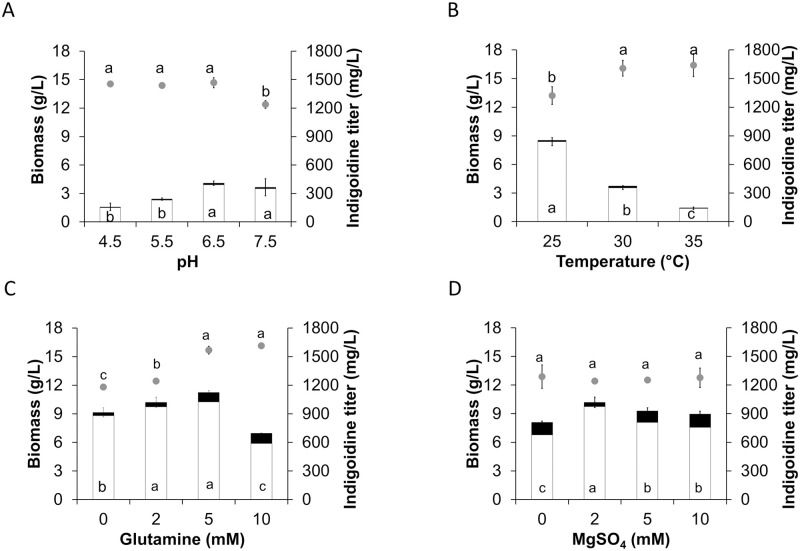
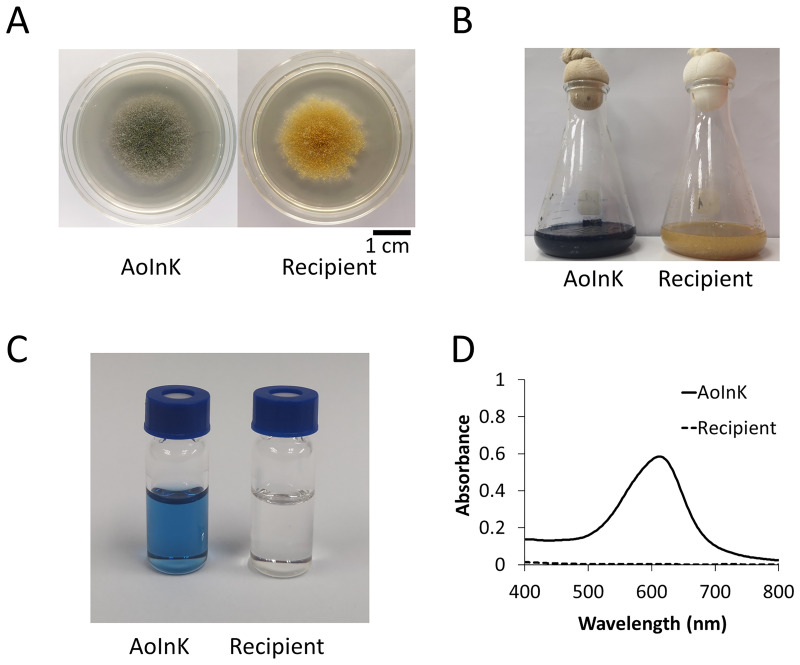
The growing demand for natural pigments in the industrial sector is a significant driving force in the development of production processes. The production of natural blue pigments, which have wide industrial applications, using microbial systems has been gaining significant attention. In this study, we used Aspergillus oryzae as a platform cell factory to produce the blue pigment indigoidine (InK), by genetic manipulation of its non-ribosomal peptide synthetase system to overexpress the indigoidine synthetase gene (AoinK). Phenotypic analysis showed that InK production from the engineered strain was growth associated, owing to the constitutive control of gene expression. Furthermore, the initial pH, temperature, and glutamine and MgSO4 concentrations were key factors affecting InK production by the engineered strain. The pigment secretion was enhanced by addition of 1% Tween 80 solution to the culture medium. The maximum titer of total InK was 1409.22 ± 95.33 mg/L, and the maximum productivity was 265.09 ± 14.74 mg/L·d. Moreover, the recombinant InK produced by the engineered strain exhibited antioxidant activity. These results indicate that A. oryzae has the potential to be used as a fungal platform for overproduction of extracellular non-ribosomal peptide pigments.
期刊介绍:
PLOS ONE is an international, peer-reviewed, open-access, online publication. PLOS ONE welcomes reports on primary research from any scientific discipline. It provides:
* Open-access—freely accessible online, authors retain copyright
* Fast publication times
* Peer review by expert, practicing researchers
* Post-publication tools to indicate quality and impact
* Community-based dialogue on articles
* Worldwide media coverage




 京公网安备 11010802042870号
京ICP备2023020795号-1
京公网安备 11010802042870号
京ICP备2023020795号-1

 分享
分享
 求助内容:
求助内容: 应助结果提醒方式:
 扫码关注我们
