Ultrasound and surface electromyography analyses reveal an intensity dependent active stretch-shortening cycle of the vastus lateralis muscle during ergometer rowing
Steffen Held, Brent Raiteri, Ludwig Rappelt, Daniel Hahn, Lars Donath
{"title":"Ultrasound and surface electromyography analyses reveal an intensity dependent active stretch-shortening cycle of the vastus lateralis muscle during ergometer rowing","authors":"Steffen Held, Brent Raiteri, Ludwig Rappelt, Daniel Hahn, Lars Donath","doi":"10.1080/17461391.2022.2119434","DOIUrl":null,"url":null,"abstract":"<div>\n \n <p>A rowing cycle is characterised by a stretch-shortening cycle (SSC) at the quadriceps femoris muscle-tendon unit (MTU) level. However, due to the associated decoupling between MTU and muscle fascicle length changes, it remains unclear whether a rowing cycle causes active stretch at the muscle level. Fifteen young, sub-elite, male rowers (19.5 ± 1.6 yr; 1.94 ± 0.06 m; 91.9 ± 5.4 kg; rowing experience: 7.5 ± 2.8 yr) performed randomised 60-s rowing intervals using a traditional style at a low (LiR) and high intensity (HiR) and a micro-pause style at a low intensity (MpR). Muscle activity, knee joint angles, and muscle fascicle length changes from the left-sided vastus lateralis (VL) muscle were quantified using surface electromyography, inertial measurement units, and B-mode ultrasound imaging, respectively. All rowing conditions showed active fascicle stretch during late knee flexion (<i>p</i>≤0.001, standardised mean difference (SMD) ≥0.72) and subsequent active fascicle shortening throughout knee extension. Active fascicle stretch duration, amplitude and velocity (rANOVA: <i>p</i>≤0.001, η<sub>p</sub><sup>2 </sup>= 0.49) were not significantly different (<i>p</i>≥0.174; SMD≤0.26) between LiR and MpR, but were significantly increased during HiR (<i>p</i>≤0.001; SMD≥0.70). The percentage of rowing cycles that involved active fascicle stretch (rANOVA: <i>p</i>≤0.001, η<sub>p</sub><sup>2 </sup>= 0.95; post-hoc: <i>p</i>≤0.001, SMD≥0.87) was also significantly higher for HiR (98.3 ±12.9%) compared with both LiR (65.0 ± 48.1%) and MpR (68.3 ± 46.9%). In conclusion, rowing involves SSC at the VL muscle fascicle level, but the amount of active stretch differs between rowing intensities, with the longest, largest, and fastest active stretch occurring during HiR. SSC-based mechanisms may therefore contribute more to rowing performance during HiR than LiR or MpR.</p>\n </div>","PeriodicalId":93999,"journal":{"name":"European journal of sport science","volume":"23 9","pages":"1940-1949"},"PeriodicalIF":3.0000,"publicationDate":"2022-10-10","publicationTypes":"Journal Article","fieldsOfStudy":null,"isOpenAccess":false,"openAccessPdf":"https://onlinelibrary.wiley.com/doi/epdf/10.1080/17461391.2022.2119434","citationCount":"0","resultStr":null,"platform":"Semanticscholar","paperid":null,"PeriodicalName":"European journal of sport science","FirstCategoryId":"1085","ListUrlMain":"https://onlinelibrary.wiley.com/doi/10.1080/17461391.2022.2119434","RegionNum":0,"RegionCategory":null,"ArticlePicture":[],"TitleCN":null,"AbstractTextCN":null,"PMCID":null,"EPubDate":"","PubModel":"","JCR":"","JCRName":"","Score":null,"Total":0}
引用次数: 0
Abstract
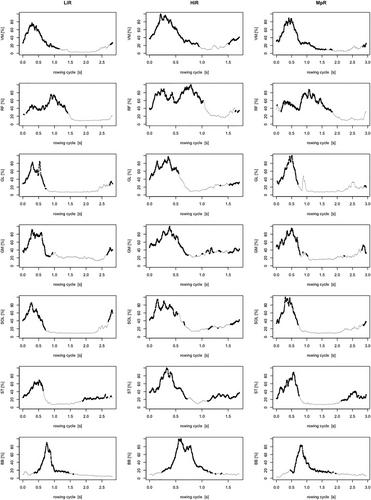
A rowing cycle is characterised by a stretch-shortening cycle (SSC) at the quadriceps femoris muscle-tendon unit (MTU) level. However, due to the associated decoupling between MTU and muscle fascicle length changes, it remains unclear whether a rowing cycle causes active stretch at the muscle level. Fifteen young, sub-elite, male rowers (19.5 ± 1.6 yr; 1.94 ± 0.06 m; 91.9 ± 5.4 kg; rowing experience: 7.5 ± 2.8 yr) performed randomised 60-s rowing intervals using a traditional style at a low (LiR) and high intensity (HiR) and a micro-pause style at a low intensity (MpR). Muscle activity, knee joint angles, and muscle fascicle length changes from the left-sided vastus lateralis (VL) muscle were quantified using surface electromyography, inertial measurement units, and B-mode ultrasound imaging, respectively. All rowing conditions showed active fascicle stretch during late knee flexion (p≤0.001, standardised mean difference (SMD) ≥0.72) and subsequent active fascicle shortening throughout knee extension. Active fascicle stretch duration, amplitude and velocity (rANOVA: p≤0.001, ηp2 = 0.49) were not significantly different (p≥0.174; SMD≤0.26) between LiR and MpR, but were significantly increased during HiR (p≤0.001; SMD≥0.70). The percentage of rowing cycles that involved active fascicle stretch (rANOVA: p≤0.001, ηp2 = 0.95; post-hoc: p≤0.001, SMD≥0.87) was also significantly higher for HiR (98.3 ±12.9%) compared with both LiR (65.0 ± 48.1%) and MpR (68.3 ± 46.9%). In conclusion, rowing involves SSC at the VL muscle fascicle level, but the amount of active stretch differs between rowing intensities, with the longest, largest, and fastest active stretch occurring during HiR. SSC-based mechanisms may therefore contribute more to rowing performance during HiR than LiR or MpR.



 京公网安备 11010802042870号
京ICP备2023020795号-1
京公网安备 11010802042870号
京ICP备2023020795号-1

 分享
分享

 求助内容:
求助内容: 应助结果提醒方式:
 扫码关注我们
