Cognitive Functioning of Unaffected First-degree Relatives of Individuals With Late-onset Alzheimer's Disease: A Systematic Literature Review and Meta-analysis.
Ari Alex Ramos, Noelia Galiano-Castillo, Liana Machado
{"title":"Cognitive Functioning of Unaffected First-degree Relatives of Individuals With Late-onset Alzheimer's Disease: A Systematic Literature Review and Meta-analysis.","authors":"Ari Alex Ramos, Noelia Galiano-Castillo, Liana Machado","doi":"10.1007/s11065-022-09555-2","DOIUrl":null,"url":null,"abstract":"<p><p>First-degree relatives of individuals with late-onset Alzheimer's disease (LOAD) are at increased risk for developing dementia, yet the associations between family history of LOAD and cognitive dysfunction remain unclear. In this quantitative review, we provide the first meta-analysis on the cognitive profile of unaffected first-degree blood relatives of LOAD-affected individuals compared to controls without a family history of LOAD. A systematic literature search was conducted in PsycINFO, PubMed /MEDLINE, and Scopus. We fitted a three-level structural equation modeling meta-analysis to control for non-independent effect sizes. Heterogeneity and risk of publication bias were also investigated. Thirty-four studies enabled us to estimate 218 effect sizes across several cognitive domains. Overall, first-degree relatives (n = 4,086, mean age = 57.40, SD = 4.71) showed significantly inferior cognitive performance (Hedges' g = -0.16; 95% CI, -0.25 to -0.08; p < .001) compared to controls (n = 2,388, mean age = 58.43, SD = 5.69). Specifically, controls outperformed first-degree relatives in language, visuospatial and verbal long-term memory, executive functions, verbal short-term memory, and verbal IQ. Among the first-degree relatives, APOE ɛ4 carriership was associated with more significant dysfunction in cognition (g = -0.24; 95% CI, -0.38 to -0.11; p < .001) compared to non-carriers (g = -0.14; 95% CI, -0.28 to -0.01; p = .04). Cognitive test type was significantly associated with between-group differences, accounting for 65% (R<sup>2</sup><sub>3</sub> = .6499) of the effect size heterogeneity in the fitted regression model. No evidence of publication bias was found. The current findings provide support for mild but robust cognitive dysfunction in first-degree relatives of LOAD-affected individuals that appears to be moderated by cognitive domain, cognitive test type, and APOE ɛ4.</p>","PeriodicalId":5,"journal":{"name":"ACS Applied Materials & Interfaces","volume":" ","pages":"659-674"},"PeriodicalIF":8.2000,"publicationDate":"2023-12-01","publicationTypes":"Journal Article","fieldsOfStudy":null,"isOpenAccess":false,"openAccessPdf":"https://www.ncbi.nlm.nih.gov/pmc/articles/PMC10770217/pdf/","citationCount":"0","resultStr":null,"platform":"Semanticscholar","paperid":null,"PeriodicalName":"ACS Applied Materials & Interfaces","FirstCategoryId":"88","ListUrlMain":"https://doi.org/10.1007/s11065-022-09555-2","RegionNum":2,"RegionCategory":"材料科学","ArticlePicture":[],"TitleCN":null,"AbstractTextCN":null,"PMCID":null,"EPubDate":"2022/9/3 0:00:00","PubModel":"Epub","JCR":"Q1","JCRName":"MATERIALS SCIENCE, MULTIDISCIPLINARY","Score":null,"Total":0}
引用次数: 0
Abstract
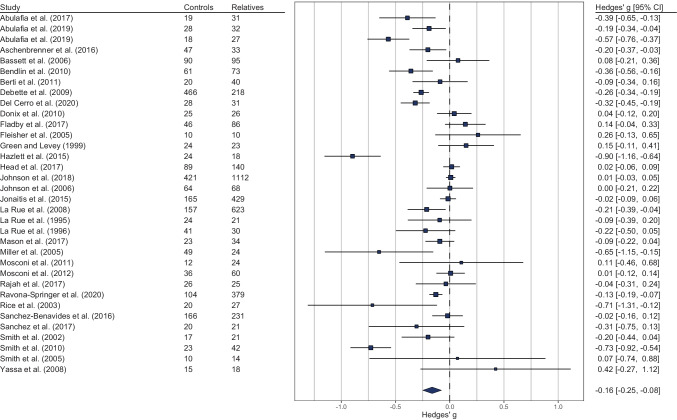
First-degree relatives of individuals with late-onset Alzheimer's disease (LOAD) are at increased risk for developing dementia, yet the associations between family history of LOAD and cognitive dysfunction remain unclear. In this quantitative review, we provide the first meta-analysis on the cognitive profile of unaffected first-degree blood relatives of LOAD-affected individuals compared to controls without a family history of LOAD. A systematic literature search was conducted in PsycINFO, PubMed /MEDLINE, and Scopus. We fitted a three-level structural equation modeling meta-analysis to control for non-independent effect sizes. Heterogeneity and risk of publication bias were also investigated. Thirty-four studies enabled us to estimate 218 effect sizes across several cognitive domains. Overall, first-degree relatives (n = 4,086, mean age = 57.40, SD = 4.71) showed significantly inferior cognitive performance (Hedges' g = -0.16; 95% CI, -0.25 to -0.08; p < .001) compared to controls (n = 2,388, mean age = 58.43, SD = 5.69). Specifically, controls outperformed first-degree relatives in language, visuospatial and verbal long-term memory, executive functions, verbal short-term memory, and verbal IQ. Among the first-degree relatives, APOE ɛ4 carriership was associated with more significant dysfunction in cognition (g = -0.24; 95% CI, -0.38 to -0.11; p < .001) compared to non-carriers (g = -0.14; 95% CI, -0.28 to -0.01; p = .04). Cognitive test type was significantly associated with between-group differences, accounting for 65% (R23 = .6499) of the effect size heterogeneity in the fitted regression model. No evidence of publication bias was found. The current findings provide support for mild but robust cognitive dysfunction in first-degree relatives of LOAD-affected individuals that appears to be moderated by cognitive domain, cognitive test type, and APOE ɛ4.
期刊介绍:
ACS Applied Materials & Interfaces is a leading interdisciplinary journal that brings together chemists, engineers, physicists, and biologists to explore the development and utilization of newly-discovered materials and interfacial processes for specific applications. Our journal has experienced remarkable growth since its establishment in 2009, both in terms of the number of articles published and the impact of the research showcased. We are proud to foster a truly global community, with the majority of published articles originating from outside the United States, reflecting the rapid growth of applied research worldwide.





 京公网安备 11010802042870号
京ICP备2023020795号-1
京公网安备 11010802042870号
京ICP备2023020795号-1

 分享
分享
 求助内容:
求助内容: 应助结果提醒方式:
 扫码关注我们
