Sabuj Kanti Mistry, A R M Mehrab Ali, Uday Narayan Yadav, Fouzia Khanam, Md Nazmul Huda
{"title":"Changes in loneliness prevalence and its associated factors among Bangladeshi older adults during the COVID-19 pandemic.","authors":"Sabuj Kanti Mistry, A R M Mehrab Ali, Uday Narayan Yadav, Fouzia Khanam, Md Nazmul Huda","doi":"10.1371/journal.pone.0277247","DOIUrl":null,"url":null,"abstract":"<p><strong>Aims: </strong>Worldwide, loneliness is one of the most common psychological phenomena among older adults, adversely affecting their physical and mental health conditions during the COVID-19 pandemic. This study aims to assess changes in the prevalence of loneliness in the two timeframes (first and second waves of COVID-19 in Bangladesh) and identify its correlates in pooled data.</p><p><strong>Methods: </strong>This repeated cross-sectional study was conducted on two successive occasions (October 2020 and September 2021), overlapping with the first and second waves of the COVID-19 pandemic in Bangladesh. The survey was conducted remotely through telephone interviews among 2077 (1032 in the 2020-survey and 1045 in the 2021-survey) older Bangladeshi adults aged 60 years and above. Loneliness was measured using the 3-item UCLA Loneliness scale. The binary logistic regression model was used to identify the factors associated with loneliness in pooled data.</p><p><strong>Results: </strong>We found a decline in the loneliness prevalence among the participants in two survey rounds (51.5% in 2021 versus 45.7% in 2020; P = 0.008), corresponding to 33% lower odds in the 2021-survey (AOR 0.67, 95% CI 0.54-0.84). Still, nearly half of the participants were found to be lonely in the latest survey. We also found that, compared to their respective counterparts, the odds of loneliness were significantly higher among the participants without a partner (AOR 1.58, 95% CI 1.20-2.08), with a monthly family income less than 5000 BDT (AOR 2.34, 95% CI 1.58-3.47), who lived alone (AOR 2.17, 95% CI 1.34-3.51), with poor memory or concentration (AOR 1.58, 95% CI 1.23-2.03), and suffering from non-communicable chronic conditions (AOR 1.55, 95% CI 1.23-1.95). Various COVID-19-related characteristics, such as concern about COVID-19 (AOR 1.28, 95% CI 0.94-1.73), overwhelm by COVID-19 (AOR 1.53, 95% CI 1.14-2.06), difficulty earning (AOR 2.00, 95% CI 1.54-2.59), and receiving routine medical care during COVID-19 (AOR 2.08, 95% CI 1.61-2.68), and perception that the participants required additional care during the pandemic (AOR 2.93, 95% CI 2.27-3.79) were also associated with significantly higher odds of loneliness. However, the odds of loneliness were significantly lower among the participants with formal schooling (AOR 0.71, 95% CI 0.57-0.89) and with a family of more than four members (AOR 0.76, 95% CI 0.60-0.96).</p><p><strong>Conclusions: </strong>The current study found a decreased prevalence of loneliness among Bangladeshi older adults during the ongoing pandemic. However, the prevalence is still very high. The findings suggest the need for mental health interventions that may include improving social interactions increasing opportunities for meaningful social connections with family and community members and providing psychosocial support to the vulnerable population including older adults during the pandemic. It also suggests that policymakers and public health practitioners should emphasise providing mental health services at the peripheral level where the majority of older adults reside.</p>","PeriodicalId":20189,"journal":{"name":"PLoS ONE","volume":" ","pages":"e0277247"},"PeriodicalIF":2.6000,"publicationDate":"2022-11-04","publicationTypes":"Journal Article","fieldsOfStudy":null,"isOpenAccess":false,"openAccessPdf":"https://www.ncbi.nlm.nih.gov/pmc/articles/PMC9635750/pdf/","citationCount":"1","resultStr":null,"platform":"Semanticscholar","paperid":null,"PeriodicalName":"PLoS ONE","FirstCategoryId":"103","ListUrlMain":"https://doi.org/10.1371/journal.pone.0277247","RegionNum":3,"RegionCategory":"综合性期刊","ArticlePicture":[],"TitleCN":null,"AbstractTextCN":null,"PMCID":null,"EPubDate":"2022/1/1 0:00:00","PubModel":"eCollection","JCR":"Q1","JCRName":"MULTIDISCIPLINARY SCIENCES","Score":null,"Total":0}
引用次数: 1
Abstract
Aims: Worldwide, loneliness is one of the most common psychological phenomena among older adults, adversely affecting their physical and mental health conditions during the COVID-19 pandemic. This study aims to assess changes in the prevalence of loneliness in the two timeframes (first and second waves of COVID-19 in Bangladesh) and identify its correlates in pooled data.
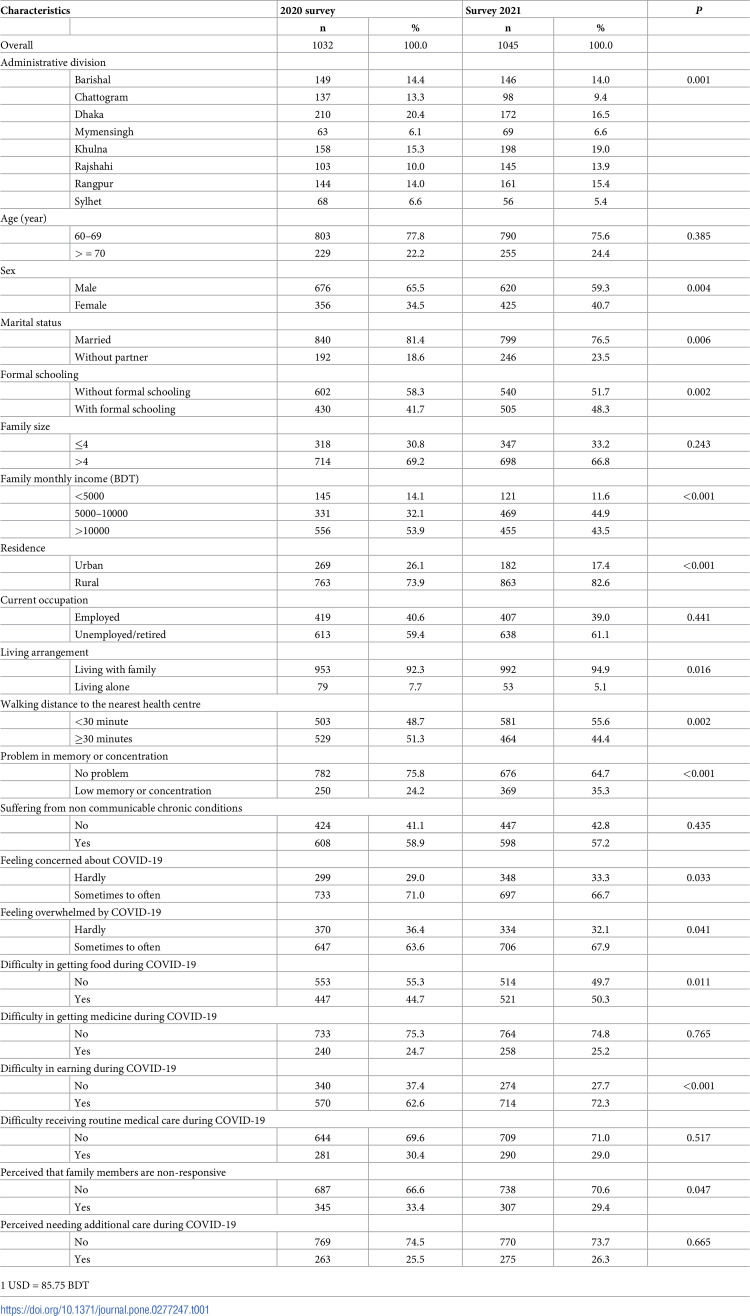
Methods: This repeated cross-sectional study was conducted on two successive occasions (October 2020 and September 2021), overlapping with the first and second waves of the COVID-19 pandemic in Bangladesh. The survey was conducted remotely through telephone interviews among 2077 (1032 in the 2020-survey and 1045 in the 2021-survey) older Bangladeshi adults aged 60 years and above. Loneliness was measured using the 3-item UCLA Loneliness scale. The binary logistic regression model was used to identify the factors associated with loneliness in pooled data.
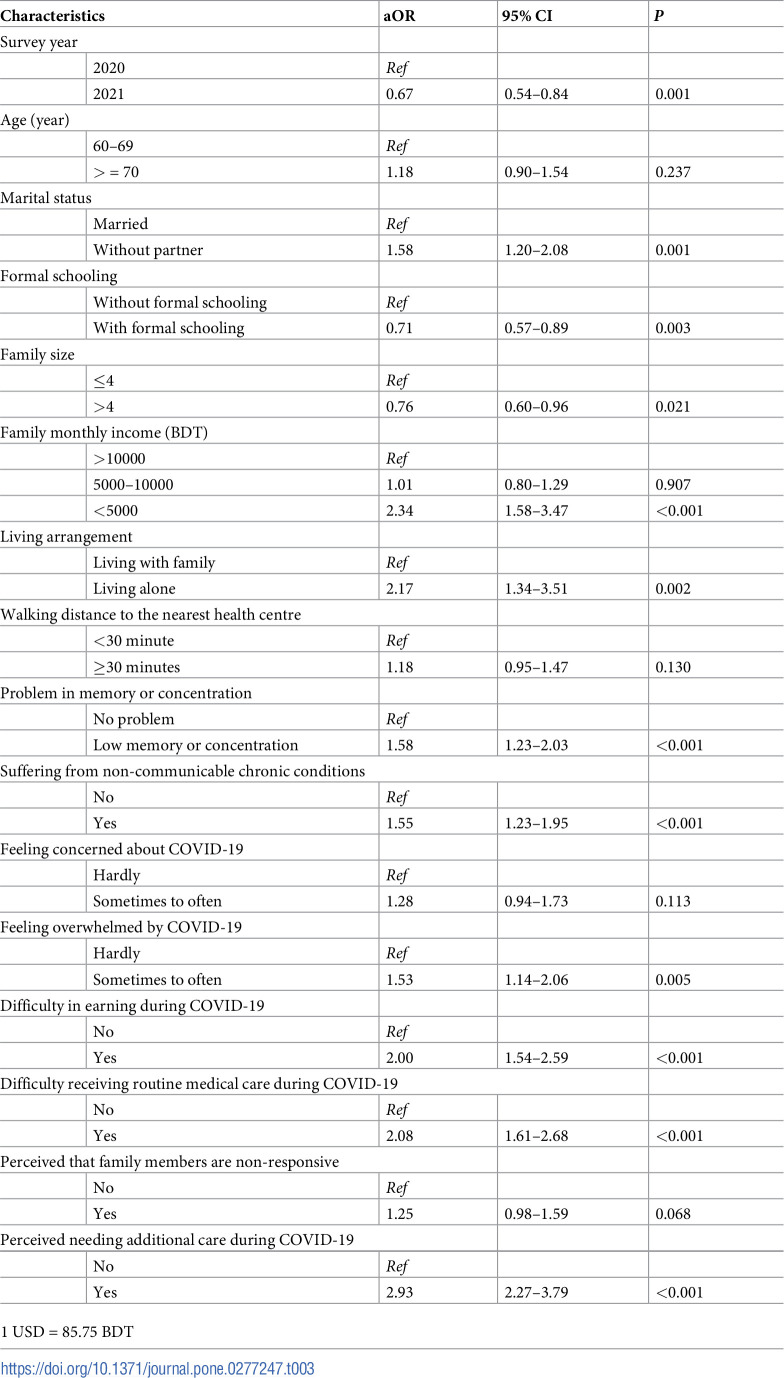
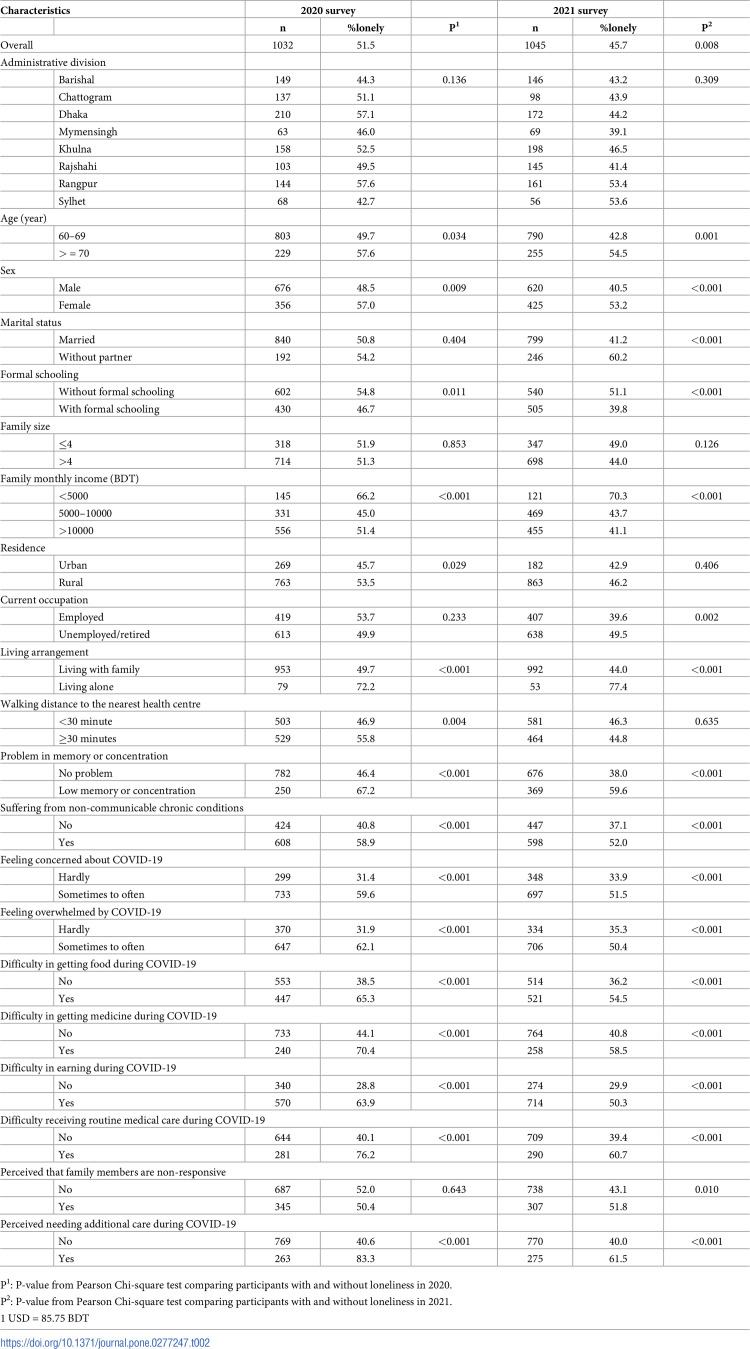
Results: We found a decline in the loneliness prevalence among the participants in two survey rounds (51.5% in 2021 versus 45.7% in 2020; P = 0.008), corresponding to 33% lower odds in the 2021-survey (AOR 0.67, 95% CI 0.54-0.84). Still, nearly half of the participants were found to be lonely in the latest survey. We also found that, compared to their respective counterparts, the odds of loneliness were significantly higher among the participants without a partner (AOR 1.58, 95% CI 1.20-2.08), with a monthly family income less than 5000 BDT (AOR 2.34, 95% CI 1.58-3.47), who lived alone (AOR 2.17, 95% CI 1.34-3.51), with poor memory or concentration (AOR 1.58, 95% CI 1.23-2.03), and suffering from non-communicable chronic conditions (AOR 1.55, 95% CI 1.23-1.95). Various COVID-19-related characteristics, such as concern about COVID-19 (AOR 1.28, 95% CI 0.94-1.73), overwhelm by COVID-19 (AOR 1.53, 95% CI 1.14-2.06), difficulty earning (AOR 2.00, 95% CI 1.54-2.59), and receiving routine medical care during COVID-19 (AOR 2.08, 95% CI 1.61-2.68), and perception that the participants required additional care during the pandemic (AOR 2.93, 95% CI 2.27-3.79) were also associated with significantly higher odds of loneliness. However, the odds of loneliness were significantly lower among the participants with formal schooling (AOR 0.71, 95% CI 0.57-0.89) and with a family of more than four members (AOR 0.76, 95% CI 0.60-0.96).
Conclusions: The current study found a decreased prevalence of loneliness among Bangladeshi older adults during the ongoing pandemic. However, the prevalence is still very high. The findings suggest the need for mental health interventions that may include improving social interactions increasing opportunities for meaningful social connections with family and community members and providing psychosocial support to the vulnerable population including older adults during the pandemic. It also suggests that policymakers and public health practitioners should emphasise providing mental health services at the peripheral level where the majority of older adults reside.
在全球范围内,孤独是老年人最常见的心理现象之一,在2019冠状病毒病大流行期间对他们的身心健康状况产生不利影响。本研究旨在评估两个时间段(孟加拉国COVID-19的第一波和第二波)孤独感流行率的变化,并在汇总数据中确定其相关性。方法:这项重复的横断面研究是在连续两次(2020年10月和2021年9月)进行的,与孟加拉国COVID-19大流行的第一波和第二波重叠。该调查是通过远程电话采访对2077名(2020年调查为1032人,2021年调查为1045人)60岁及以上的孟加拉国老年人进行的。孤独感采用UCLA孤独感量表进行测量。采用二元logistic回归模型在汇总数据中识别与孤独感相关的因素。结果:我们发现,在两轮调查中,参与者的孤独感患病率有所下降(2021年为51.5%,2020年为45.7%;P = 0.008),对应于2021年调查中33%的低概率(AOR 0.67, 95% CI 0.54-0.84)。尽管如此,在最新的调查中,近一半的参与者被发现感到孤独。我们还发现,与各自的同行相比,没有伴侣的参与者(AOR 1.58, 95% CI 1.20-2.08)、家庭月收入低于5000 BDT的参与者(AOR 2.34, 95% CI 1.58-3.47)、独居的参与者(AOR 2.17, 95% CI 1.34-3.51)、记忆力或注意力较差的参与者(AOR 1.58, 95% CI 1.23-2.03)、患有非传染性慢性疾病的参与者(AOR 1.55, 95% CI 1.23-1.95)的孤独感几率明显更高。各种与COVID-19相关的特征,如对COVID-19的担忧(AOR 1.28, 95% CI 0.94-1.73),被COVID-19压倒(AOR 1.53, 95% CI 1.14-2.06),收入困难(AOR 2.00, 95% CI 1.54-2.59),以及在COVID-19期间接受常规医疗护理(AOR 2.08, 95% CI 1.61-2.68),以及参与者在大流行期间需要额外护理的感知(AOR 2.93, 95% CI 2.27-3.79)也与孤独感的显著增加相关。然而,接受过正规教育的参与者(AOR 0.71, 95% CI 0.57-0.89)和家庭成员超过四人的参与者(AOR 0.76, 95% CI 0.60-0.96)孤独感的几率明显较低。结论:目前的研究发现,在持续的大流行期间,孟加拉国老年人的孤独感有所下降。然而,患病率仍然很高。研究结果表明,需要采取精神卫生干预措施,其中可能包括改善社会互动,增加与家庭和社区成员建立有意义的社会联系的机会,以及在大流行期间向包括老年人在内的弱势群体提供心理社会支持。它还建议决策者和公共卫生从业人员应强调在大多数老年人居住的外围水平提供精神卫生服务。
期刊介绍:
PLOS ONE is an international, peer-reviewed, open-access, online publication. PLOS ONE welcomes reports on primary research from any scientific discipline. It provides:
* Open-access—freely accessible online, authors retain copyright
* Fast publication times
* Peer review by expert, practicing researchers
* Post-publication tools to indicate quality and impact
* Community-based dialogue on articles
* Worldwide media coverage




 京公网安备 11010802042870号
京ICP备2023020795号-1
京公网安备 11010802042870号
京ICP备2023020795号-1

 分享
分享
 求助内容:
求助内容: 应助结果提醒方式:
 扫码关注我们
