R Taheem, K Woods-Townsend, W Lawrence, J Baird, K M Godfrey, M Hanson
{"title":"How do local authority plans to tackle obesity reflect systems thinking?","authors":"R Taheem, K Woods-Townsend, W Lawrence, J Baird, K M Godfrey, M Hanson","doi":"10.1177/17579139221106337","DOIUrl":null,"url":null,"abstract":"<p><strong>Aims: </strong>A whole systems approach to tackling obesity has been recommended by Public Health England for several years. This qualitative study aimed to investigate whether systems thinking is reflected in local authority plans and strategies to tackle obesity, using the leverage points for intervention in a complex system, as a framework.</p><p><strong>Method: </strong>We sought to identify obesity strategies/plans for Southampton and 19 other local authority comparators (based on children's services and Office for National Statistics data). A healthy weight strategy was available for 10 local authorities and a qualitative document analysis was undertaken. The policy actions proposed in the plans were coded against the leverage points for intervention in a complex system and themes were developed to characterise interventions in each category.</p><p><strong>Results: </strong>A majority of actions included in the plans were categorised as 'Numbers, Constants and Parameters' which reflect downstream measures. However, there were examples of actions that could act on higher leverage points. In addition, some local authority plans included interventions that could act on 10 of the 12 leverage points suggesting incorporation of systems thinking.</p><p><strong>Conclusions: </strong>Some local authority plans to tackle obesity do reflect systems thinking when viewed through the lens of the leverage points for intervention in a complex system. Interventions at higher leverage points should be prioritised by public health decision-makers, especially in a climate of competing agendas and limited resources.</p>","PeriodicalId":3,"journal":{"name":"ACS Applied Electronic Materials","volume":" ","pages":"324-336"},"PeriodicalIF":4.7000,"publicationDate":"2023-11-01","publicationTypes":"Journal Article","fieldsOfStudy":null,"isOpenAccess":false,"openAccessPdf":"https://www.ncbi.nlm.nih.gov/pmc/articles/PMC10683337/pdf/","citationCount":"0","resultStr":null,"platform":"Semanticscholar","paperid":null,"PeriodicalName":"ACS Applied Electronic Materials","FirstCategoryId":"88","ListUrlMain":"https://doi.org/10.1177/17579139221106337","RegionNum":3,"RegionCategory":"材料科学","ArticlePicture":[],"TitleCN":null,"AbstractTextCN":null,"PMCID":null,"EPubDate":"2022/7/7 0:00:00","PubModel":"Epub","JCR":"Q1","JCRName":"ENGINEERING, ELECTRICAL & ELECTRONIC","Score":null,"Total":0}
引用次数: 0
Abstract
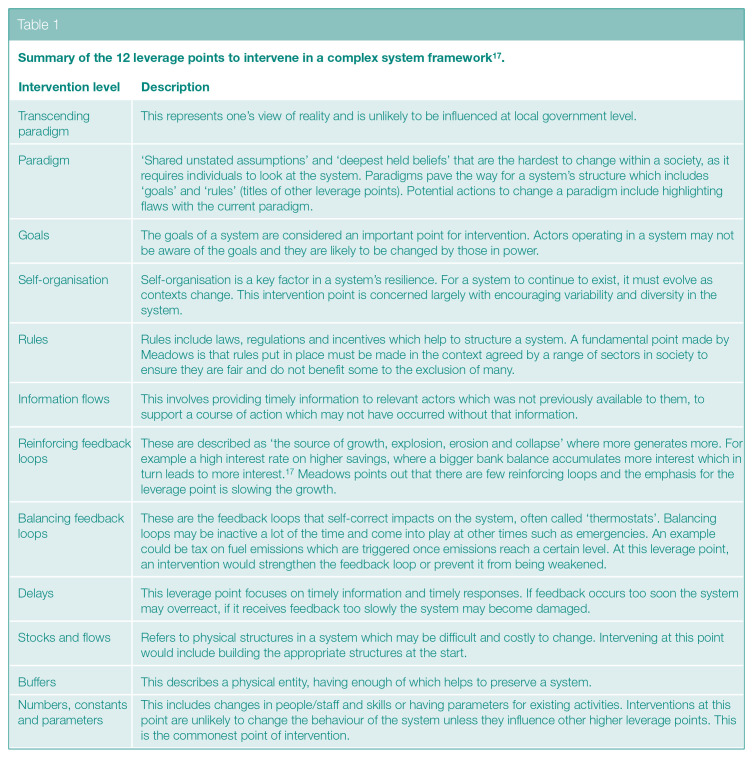
Aims: A whole systems approach to tackling obesity has been recommended by Public Health England for several years. This qualitative study aimed to investigate whether systems thinking is reflected in local authority plans and strategies to tackle obesity, using the leverage points for intervention in a complex system, as a framework.
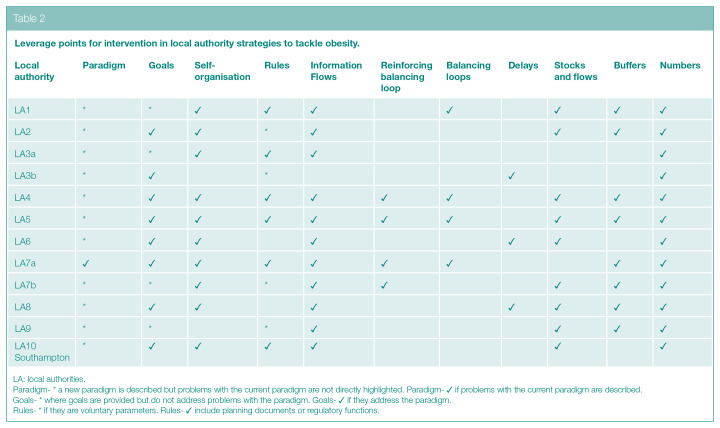
Method: We sought to identify obesity strategies/plans for Southampton and 19 other local authority comparators (based on children's services and Office for National Statistics data). A healthy weight strategy was available for 10 local authorities and a qualitative document analysis was undertaken. The policy actions proposed in the plans were coded against the leverage points for intervention in a complex system and themes were developed to characterise interventions in each category.
Results: A majority of actions included in the plans were categorised as 'Numbers, Constants and Parameters' which reflect downstream measures. However, there were examples of actions that could act on higher leverage points. In addition, some local authority plans included interventions that could act on 10 of the 12 leverage points suggesting incorporation of systems thinking.
Conclusions: Some local authority plans to tackle obesity do reflect systems thinking when viewed through the lens of the leverage points for intervention in a complex system. Interventions at higher leverage points should be prioritised by public health decision-makers, especially in a climate of competing agendas and limited resources.
期刊介绍:
ACS Applied Electronic Materials is an interdisciplinary journal publishing original research covering all aspects of electronic materials. The journal is devoted to reports of new and original experimental and theoretical research of an applied nature that integrate knowledge in the areas of materials science, engineering, optics, physics, and chemistry into important applications of electronic materials. Sample research topics that span the journal's scope are inorganic, organic, ionic and polymeric materials with properties that include conducting, semiconducting, superconducting, insulating, dielectric, magnetic, optoelectronic, piezoelectric, ferroelectric and thermoelectric.
Indexed/Abstracted:
Web of Science SCIE
Scopus
CAS
INSPEC
Portico





 京公网安备 11010802042870号
京ICP备2023020795号-1
京公网安备 11010802042870号
京ICP备2023020795号-1

 分享
分享
 求助内容:
求助内容: 应助结果提醒方式:
 扫码关注我们
