{"title":"Menstrual hygiene management knowledge, practice and associated factors Among School Girls, Northeast Ethiopia.","authors":"Zeru Shikur Shumie, Zinie Abita Mengie","doi":"10.1371/journal.pone.0271275","DOIUrl":null,"url":null,"abstract":"<p><strong>Background: </strong>Women in rural settings particularly in schools suffer more from stigma and lack of services and facilities during menstruation. However, the issue has not received proper attention from school water sanitation and hygiene programs. And this study was aimed to identify knowledge and practice of menstrual hygiene, and associated factors.</p><p><strong>Method: </strong>Institution based cross-sectional study was employed among 441 school girls in Mekidela city. EpiData Version 4.6 and the Statistical Package for the Social Sciences Version 25.0 were used for data entry and analysis, respectively. Bivariable and multivariable logistic regression was employed to identify factors associated with the outcome variables. Variables with a p-value<0.25 in the bivariable analysis were a candidate for multivariable logistic regression and p-value<0.05 in the multivariable analysis was used to declare significant association.</p><p><strong>Results: </strong>Of the respondents, 64.9% reported good knowledge of menstrual hygiene management. In multivariable analysis; grade level (grade 11 & 12) [adjusted odds ratio (AOR) = 2.23, 95% C.I (1.19-4.16)], age ≥ 19 years [AOR = 3.45, 95% C.I (1.78-6.69)], residence [AOR = 1.90, 95% C.I: (1.12-3.23)], know sanitary pads [AOR = 2.67, 95% CI: (1.19-6.00)] and learned about menstrual hygiene [AOR = 1.71, 95% CI: (1.02-2.87)] found to be associated with knowledge. About 62.4% have good menstrual hygiene practices. Knowledge on menstrual hygiene [AOR = 1.73, 95% C.I (1.07-2.80)], know about reproductive tract/sexually transmitted infections [AOR = 2.46, 95% CI: (1.37-4.43)], having private shower [AOR = 2.04, 95% C.I 2.04(1.24-3.37)] and residence [AOR = 3.76, 95% C.I:(2.18-6.51)] were factors associated with practice.</p><p><strong>Conclusion: </strong>Overall nearly two-third of respondents had good knowledge and good practice of menstrual hygiene management. Factors significantly associated with their knowledge included age, grade level, residence, learning on menstrual hygiene, and knowledge of sanitary pads. Residence, knowledge on menstrual hygiene, know about sexually transmitted infections and having a private shower were found to be associated with practice of menstrual hygiene management. In general, our finding indicates that menstrual hygiene was unsatisfactory among adolescent school girls and more should be done on the factors identified.</p>","PeriodicalId":20189,"journal":{"name":"PLoS ONE","volume":" ","pages":"e0271275"},"PeriodicalIF":2.6000,"publicationDate":"2022-07-19","publicationTypes":"Journal Article","fieldsOfStudy":null,"isOpenAccess":false,"openAccessPdf":"https://www.ncbi.nlm.nih.gov/pmc/articles/PMC9295965/pdf/","citationCount":"4","resultStr":null,"platform":"Semanticscholar","paperid":null,"PeriodicalName":"PLoS ONE","FirstCategoryId":"103","ListUrlMain":"https://doi.org/10.1371/journal.pone.0271275","RegionNum":3,"RegionCategory":"综合性期刊","ArticlePicture":[],"TitleCN":null,"AbstractTextCN":null,"PMCID":null,"EPubDate":"2022/1/1 0:00:00","PubModel":"eCollection","JCR":"Q1","JCRName":"MULTIDISCIPLINARY SCIENCES","Score":null,"Total":0}
引用次数: 4
Abstract
Background: Women in rural settings particularly in schools suffer more from stigma and lack of services and facilities during menstruation. However, the issue has not received proper attention from school water sanitation and hygiene programs. And this study was aimed to identify knowledge and practice of menstrual hygiene, and associated factors.
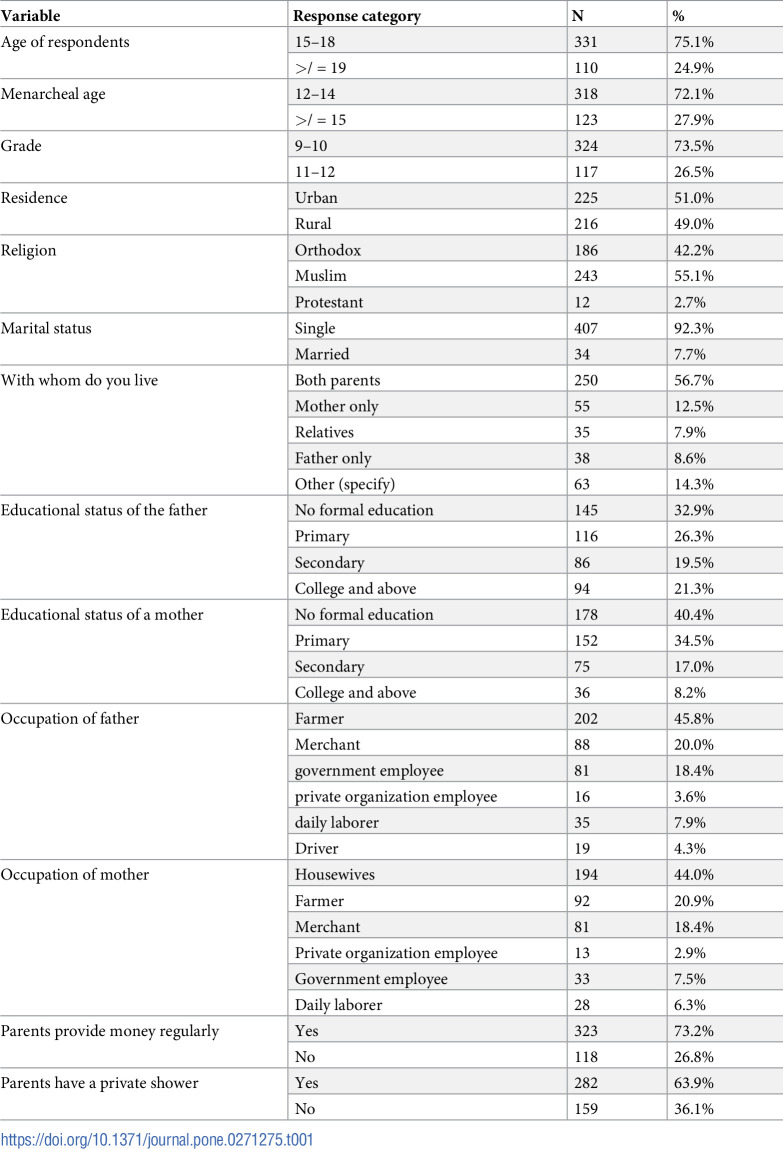
Method: Institution based cross-sectional study was employed among 441 school girls in Mekidela city. EpiData Version 4.6 and the Statistical Package for the Social Sciences Version 25.0 were used for data entry and analysis, respectively. Bivariable and multivariable logistic regression was employed to identify factors associated with the outcome variables. Variables with a p-value<0.25 in the bivariable analysis were a candidate for multivariable logistic regression and p-value<0.05 in the multivariable analysis was used to declare significant association.
Results: Of the respondents, 64.9% reported good knowledge of menstrual hygiene management. In multivariable analysis; grade level (grade 11 & 12) [adjusted odds ratio (AOR) = 2.23, 95% C.I (1.19-4.16)], age ≥ 19 years [AOR = 3.45, 95% C.I (1.78-6.69)], residence [AOR = 1.90, 95% C.I: (1.12-3.23)], know sanitary pads [AOR = 2.67, 95% CI: (1.19-6.00)] and learned about menstrual hygiene [AOR = 1.71, 95% CI: (1.02-2.87)] found to be associated with knowledge. About 62.4% have good menstrual hygiene practices. Knowledge on menstrual hygiene [AOR = 1.73, 95% C.I (1.07-2.80)], know about reproductive tract/sexually transmitted infections [AOR = 2.46, 95% CI: (1.37-4.43)], having private shower [AOR = 2.04, 95% C.I 2.04(1.24-3.37)] and residence [AOR = 3.76, 95% C.I:(2.18-6.51)] were factors associated with practice.
Conclusion: Overall nearly two-third of respondents had good knowledge and good practice of menstrual hygiene management. Factors significantly associated with their knowledge included age, grade level, residence, learning on menstrual hygiene, and knowledge of sanitary pads. Residence, knowledge on menstrual hygiene, know about sexually transmitted infections and having a private shower were found to be associated with practice of menstrual hygiene management. In general, our finding indicates that menstrual hygiene was unsatisfactory among adolescent school girls and more should be done on the factors identified.
期刊介绍:
PLOS ONE is an international, peer-reviewed, open-access, online publication. PLOS ONE welcomes reports on primary research from any scientific discipline. It provides:
* Open-access—freely accessible online, authors retain copyright
* Fast publication times
* Peer review by expert, practicing researchers
* Post-publication tools to indicate quality and impact
* Community-based dialogue on articles
* Worldwide media coverage





 京公网安备 11010802042870号
京ICP备2023020795号-1
京公网安备 11010802042870号
京ICP备2023020795号-1

 分享
分享
 求助内容:
求助内容: 应助结果提醒方式:
 扫码关注我们
