Robert A. Sohn, Claire Willis, Susan Humphris, Timothy M. Shank, Hanumant Singh, Henrietta N. Edmonds, Clayton Kunz, Ulf Hedman, Elisabeth Helmke, Michael Jakuba, Bengt Liljebladh, Julia Linder, Christopher Murphy, Ko-ichi Nakamura, Taichi Sato, Vera Schlindwein, Christian Stranne, Maria Tausenfreund, Lucia Upchurch, Peter Winsor, Martin Jakobsson, Adam Soule
{"title":"Explosive volcanism on the ultraslow-spreading Gakkel ridge, Arctic Ocean","authors":"Robert A. Sohn, Claire Willis, Susan Humphris, Timothy M. Shank, Hanumant Singh, Henrietta N. Edmonds, Clayton Kunz, Ulf Hedman, Elisabeth Helmke, Michael Jakuba, Bengt Liljebladh, Julia Linder, Christopher Murphy, Ko-ichi Nakamura, Taichi Sato, Vera Schlindwein, Christian Stranne, Maria Tausenfreund, Lucia Upchurch, Peter Winsor, Martin Jakobsson, Adam Soule","doi":"10.1038/nature07075","DOIUrl":null,"url":null,"abstract":"The latest deep submergence technologies have been used to perform the first high-definition photographic survey of the ultra-slow spreading Gakkel Ridge in the Arctic Basin, focusing on an area that is believed to have experienced a major eruption event in 1999. The images show that the axial valley at 4,000 m water depth is blanketed by an extensive set of pyroclastic deposits, raising important questions regarding the accumulation and discharge of magmatic volatiles on such ridges and demonstrating that large-scale pyroclastic activity is possible along even the deepest portions of the global mid-ocean ridge volcanic system. New deep submergence technologies are used to obtain photographic images of a ''zero-age'' volcanic terrain on the ultra-slow spreading Gakkel Ridge in the Arctic Basin. The imagery reveals that the axial valley at 4,000m water depth is blanketed with unconsolidated pyroclastic deposits, raising important questions regarding the accumulation and discharge of magmatic volatiles on such ridges and demonstrating that large-scale pyroclastic activity is possible along even the deepest portions of the global mid-ocean ridge volcanic system. Roughly 60% of the Earth’s outer surface is composed of oceanic crust formed by volcanic processes at mid-ocean ridges. Although only a small fraction of this vast volcanic terrain has been visually surveyed or sampled, the available evidence suggests that explosive eruptions are rare on mid-ocean ridges, particularly at depths below the critical point for seawater (3,000 m)1. A pyroclastic deposit has never been observed on the sea floor below 3,000 m, presumably because the volatile content of mid-ocean-ridge basalts is generally too low to produce the gas fractions required for fragmenting a magma at such high hydrostatic pressure. We employed new deep submergence technologies during an International Polar Year expedition to the Gakkel ridge in the Arctic Basin at 85° E, to acquire photographic and video images of ‘zero-age’ volcanic terrain on this remote, ice-covered ridge. Here we present images revealing that the axial valley at 4,000 m water depth is blanketed with unconsolidated pyroclastic deposits, including bubble wall fragments (limu o Pele)2, covering a large (>10 km2) area. At least 13.5 wt% CO2 is necessary to fragment magma at these depths3, which is about tenfold the highest values previously measured in a mid-ocean-ridge basalt4. These observations raise important questions about the accumulation and discharge of magmatic volatiles at ultraslow spreading rates on the Gakkel ridge5 and demonstrate that large-scale pyroclastic activity is possible along even the deepest portions of the global mid-ocean ridge volcanic system.","PeriodicalId":18787,"journal":{"name":"Nature","volume":"453 7199","pages":"1236-1238"},"PeriodicalIF":48.5000,"publicationDate":"2008-06-26","publicationTypes":"Journal Article","fieldsOfStudy":null,"isOpenAccess":false,"openAccessPdf":"https://sci-hub-pdf.com/10.1038/nature07075","citationCount":"121","resultStr":null,"platform":"Semanticscholar","paperid":null,"PeriodicalName":"Nature","FirstCategoryId":"103","ListUrlMain":"https://www.nature.com/articles/nature07075","RegionNum":1,"RegionCategory":"综合性期刊","ArticlePicture":[],"TitleCN":null,"AbstractTextCN":null,"PMCID":null,"EPubDate":"","PubModel":"","JCR":"Q1","JCRName":"MULTIDISCIPLINARY SCIENCES","Score":null,"Total":0}
引用次数: 121
Abstract
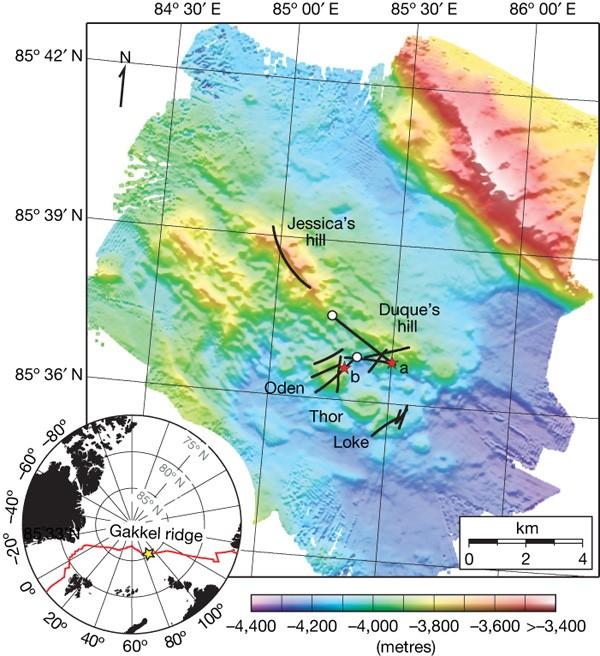
The latest deep submergence technologies have been used to perform the first high-definition photographic survey of the ultra-slow spreading Gakkel Ridge in the Arctic Basin, focusing on an area that is believed to have experienced a major eruption event in 1999. The images show that the axial valley at 4,000 m water depth is blanketed by an extensive set of pyroclastic deposits, raising important questions regarding the accumulation and discharge of magmatic volatiles on such ridges and demonstrating that large-scale pyroclastic activity is possible along even the deepest portions of the global mid-ocean ridge volcanic system. New deep submergence technologies are used to obtain photographic images of a ''zero-age'' volcanic terrain on the ultra-slow spreading Gakkel Ridge in the Arctic Basin. The imagery reveals that the axial valley at 4,000m water depth is blanketed with unconsolidated pyroclastic deposits, raising important questions regarding the accumulation and discharge of magmatic volatiles on such ridges and demonstrating that large-scale pyroclastic activity is possible along even the deepest portions of the global mid-ocean ridge volcanic system. Roughly 60% of the Earth’s outer surface is composed of oceanic crust formed by volcanic processes at mid-ocean ridges. Although only a small fraction of this vast volcanic terrain has been visually surveyed or sampled, the available evidence suggests that explosive eruptions are rare on mid-ocean ridges, particularly at depths below the critical point for seawater (3,000 m)1. A pyroclastic deposit has never been observed on the sea floor below 3,000 m, presumably because the volatile content of mid-ocean-ridge basalts is generally too low to produce the gas fractions required for fragmenting a magma at such high hydrostatic pressure. We employed new deep submergence technologies during an International Polar Year expedition to the Gakkel ridge in the Arctic Basin at 85° E, to acquire photographic and video images of ‘zero-age’ volcanic terrain on this remote, ice-covered ridge. Here we present images revealing that the axial valley at 4,000 m water depth is blanketed with unconsolidated pyroclastic deposits, including bubble wall fragments (limu o Pele)2, covering a large (>10 km2) area. At least 13.5 wt% CO2 is necessary to fragment magma at these depths3, which is about tenfold the highest values previously measured in a mid-ocean-ridge basalt4. These observations raise important questions about the accumulation and discharge of magmatic volatiles at ultraslow spreading rates on the Gakkel ridge5 and demonstrate that large-scale pyroclastic activity is possible along even the deepest portions of the global mid-ocean ridge volcanic system.
期刊介绍:
Nature is a prestigious international journal that publishes peer-reviewed research in various scientific and technological fields. The selection of articles is based on criteria such as originality, importance, interdisciplinary relevance, timeliness, accessibility, elegance, and surprising conclusions. In addition to showcasing significant scientific advances, Nature delivers rapid, authoritative, insightful news, and interpretation of current and upcoming trends impacting science, scientists, and the broader public. The journal serves a dual purpose: firstly, to promptly share noteworthy scientific advances and foster discussions among scientists, and secondly, to ensure the swift dissemination of scientific results globally, emphasizing their significance for knowledge, culture, and daily life.




 京公网安备 11010802042870号
京ICP备2023020795号-1
京公网安备 11010802042870号
京ICP备2023020795号-1

 分享
分享
 求助内容:
求助内容: 应助结果提醒方式:
 扫码关注我们
