{"title":"Determining states of consciousness in the electroencephalogram based on spectral, complexity, and criticality features.","authors":"Nike Walter, Thilo Hinterberger","doi":"10.1093/nc/niac008","DOIUrl":null,"url":null,"abstract":"<p><p>This study was based on the contemporary proposal that distinct states of consciousness are quantifiable by neural complexity and critical dynamics. To test this hypothesis, it was aimed at comparing the electrophysiological correlates of three meditation conditions using nonlinear techniques from the complexity and criticality framework as well as power spectral density. Thirty participants highly proficient in meditation were measured with 64-channel electroencephalography (EEG) during one session consisting of a task-free baseline resting (eyes closed and eyes open), a reading condition, and three meditation conditions (thoughtless emptiness, presence monitoring, and focused attention). The data were analyzed applying analytical tools from criticality theory (detrended fluctuation analysis, neuronal avalanche analysis), complexity measures (multiscale entropy, Higuchi's fractal dimension), and power spectral density. Task conditions were contrasted, and effect sizes were compared. Partial least square regression and receiver operating characteristics analysis were applied to determine the discrimination accuracy of each measure. Compared to resting with eyes closed, the meditation categories emptiness and focused attention showed higher values of entropy and fractal dimension. Long-range temporal correlations were declined in all meditation conditions. The critical exponent yielded the lowest values for focused attention and reading. The highest discrimination accuracy was found for the gamma band (0.83-0.98), the global power spectral density (0.78-0.96), and the sample entropy (0.86-0.90). Electrophysiological correlates of distinct meditation states were identified and the relationship between nonlinear complexity, critical brain dynamics, and spectral features was determined. The meditation states could be discriminated with nonlinear measures and quantified by the degree of neuronal complexity, long-range temporal correlations, and power law distributions in neuronal avalanches.</p>","PeriodicalId":3,"journal":{"name":"ACS Applied Electronic Materials","volume":" ","pages":"niac008"},"PeriodicalIF":4.7000,"publicationDate":"2022-06-17","publicationTypes":"Journal Article","fieldsOfStudy":null,"isOpenAccess":false,"openAccessPdf":"https://ftp.ncbi.nlm.nih.gov/pub/pmc/oa_pdf/cb/85/niac008.PMC9319002.pdf","citationCount":"0","resultStr":null,"platform":"Semanticscholar","paperid":null,"PeriodicalName":"ACS Applied Electronic Materials","FirstCategoryId":"1085","ListUrlMain":"https://doi.org/10.1093/nc/niac008","RegionNum":3,"RegionCategory":"材料科学","ArticlePicture":[],"TitleCN":null,"AbstractTextCN":null,"PMCID":null,"EPubDate":"2022/1/1 0:00:00","PubModel":"eCollection","JCR":"Q1","JCRName":"ENGINEERING, ELECTRICAL & ELECTRONIC","Score":null,"Total":0}
引用次数: 0
Abstract
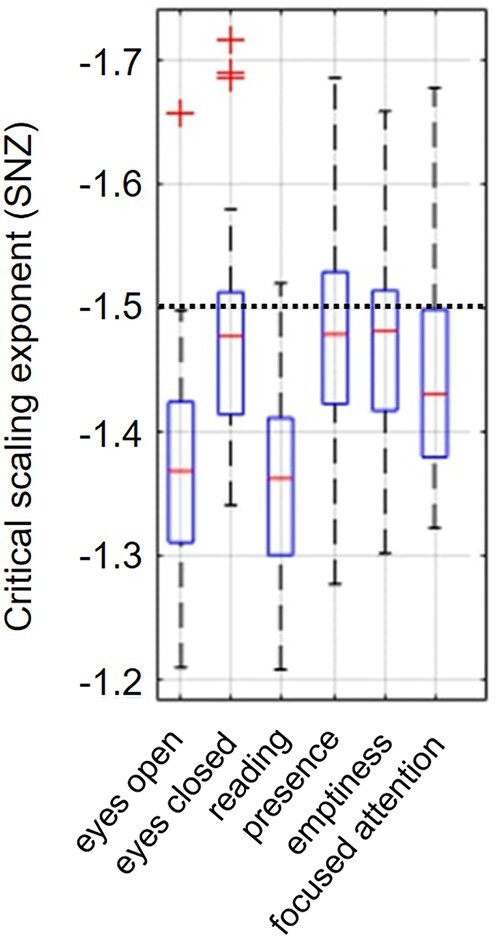
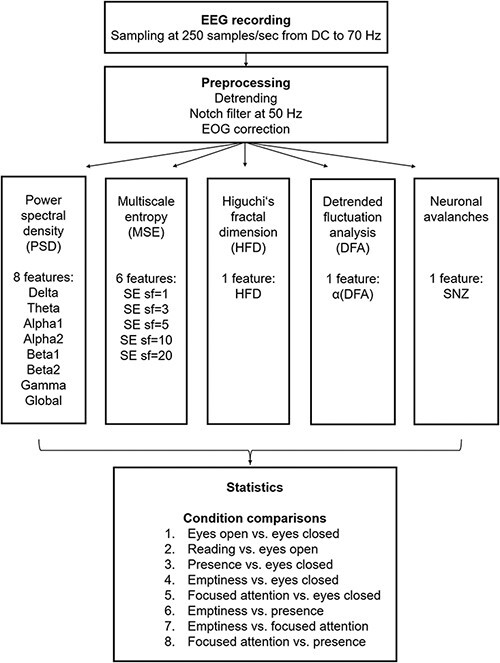
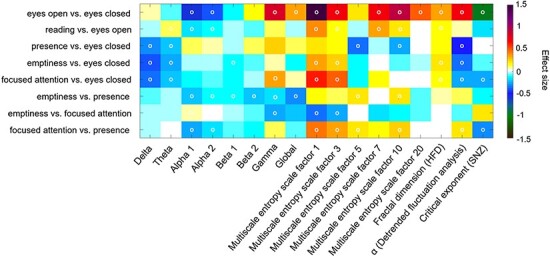
This study was based on the contemporary proposal that distinct states of consciousness are quantifiable by neural complexity and critical dynamics. To test this hypothesis, it was aimed at comparing the electrophysiological correlates of three meditation conditions using nonlinear techniques from the complexity and criticality framework as well as power spectral density. Thirty participants highly proficient in meditation were measured with 64-channel electroencephalography (EEG) during one session consisting of a task-free baseline resting (eyes closed and eyes open), a reading condition, and three meditation conditions (thoughtless emptiness, presence monitoring, and focused attention). The data were analyzed applying analytical tools from criticality theory (detrended fluctuation analysis, neuronal avalanche analysis), complexity measures (multiscale entropy, Higuchi's fractal dimension), and power spectral density. Task conditions were contrasted, and effect sizes were compared. Partial least square regression and receiver operating characteristics analysis were applied to determine the discrimination accuracy of each measure. Compared to resting with eyes closed, the meditation categories emptiness and focused attention showed higher values of entropy and fractal dimension. Long-range temporal correlations were declined in all meditation conditions. The critical exponent yielded the lowest values for focused attention and reading. The highest discrimination accuracy was found for the gamma band (0.83-0.98), the global power spectral density (0.78-0.96), and the sample entropy (0.86-0.90). Electrophysiological correlates of distinct meditation states were identified and the relationship between nonlinear complexity, critical brain dynamics, and spectral features was determined. The meditation states could be discriminated with nonlinear measures and quantified by the degree of neuronal complexity, long-range temporal correlations, and power law distributions in neuronal avalanches.
期刊介绍:
ACS Applied Electronic Materials is an interdisciplinary journal publishing original research covering all aspects of electronic materials. The journal is devoted to reports of new and original experimental and theoretical research of an applied nature that integrate knowledge in the areas of materials science, engineering, optics, physics, and chemistry into important applications of electronic materials. Sample research topics that span the journal's scope are inorganic, organic, ionic and polymeric materials with properties that include conducting, semiconducting, superconducting, insulating, dielectric, magnetic, optoelectronic, piezoelectric, ferroelectric and thermoelectric.
Indexed/Abstracted:
Web of Science SCIE
Scopus
CAS
INSPEC
Portico




 京公网安备 11010802042870号
京ICP备2023020795号-1
京公网安备 11010802042870号
京ICP备2023020795号-1

 分享
分享
 求助内容:
求助内容: 应助结果提醒方式:
 扫码关注我们
