{"title":"Editing reality in the brain.","authors":"Eamonn Walsh, David A Oakley","doi":"10.1093/nc/niac009","DOIUrl":null,"url":null,"abstract":"<p><p>Recent information technologies such as virtual reality (VR) and augmented reality (AR) allow the creation of simulated sensory worlds with which we can interact. Using programming language, digital details can be overlaid onto displays of our environment, confounding what is real and what has been artificially engineered. Natural language, particularly the use of direct verbal suggestion (DVS) in everyday and hypnotic contexts, can also manipulate the meaning and significance of objects and events in ourselves and others. In this review, we focus on how socially rewarding language can construct and influence reality. Language is symbolic, automatic and flexible and can be used to augment bodily sensations e.g. feelings of heaviness in a limb or suggest a colour that is not there. We introduce the term 'suggested reality' (SR) to refer to the important role that language, specifically DVS, plays in constructing, maintaining and manipulating our shared reality. We also propose the term edited reality to encompass the wider influence of information technology and linguistic techniques that results in altered subjective experience and review its use in clinical settings, while acknowledging its limitations. We develop a cognitive model indicating how the brain's central executive structures use our personal and linguistic-based narrative in subjective awareness, arguing for a central role for language in DVS. A better understanding of the characteristics of VR, AR and SR and their applications in everyday life, research and clinical settings can help us to better understand our own reality and how it can be edited.</p>","PeriodicalId":3,"journal":{"name":"ACS Applied Electronic Materials","volume":" ","pages":"niac009"},"PeriodicalIF":4.7000,"publicationDate":"2022-07-23","publicationTypes":"Journal Article","fieldsOfStudy":null,"isOpenAccess":false,"openAccessPdf":"https://ftp.ncbi.nlm.nih.gov/pub/pmc/oa_pdf/aa/4f/niac009.PMC9319104.pdf","citationCount":"0","resultStr":null,"platform":"Semanticscholar","paperid":null,"PeriodicalName":"ACS Applied Electronic Materials","FirstCategoryId":"1085","ListUrlMain":"https://doi.org/10.1093/nc/niac009","RegionNum":3,"RegionCategory":"材料科学","ArticlePicture":[],"TitleCN":null,"AbstractTextCN":null,"PMCID":null,"EPubDate":"2022/1/1 0:00:00","PubModel":"eCollection","JCR":"Q1","JCRName":"ENGINEERING, ELECTRICAL & ELECTRONIC","Score":null,"Total":0}
引用次数: 0
Abstract
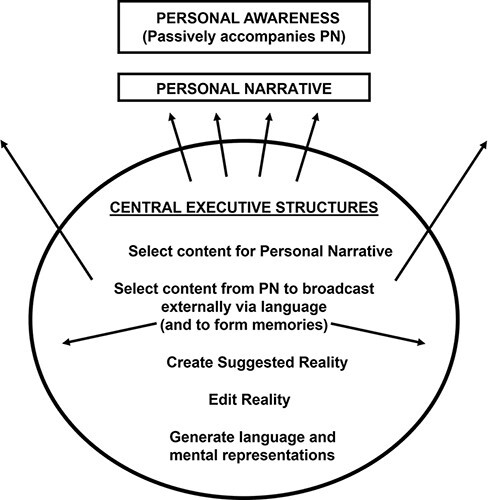
Recent information technologies such as virtual reality (VR) and augmented reality (AR) allow the creation of simulated sensory worlds with which we can interact. Using programming language, digital details can be overlaid onto displays of our environment, confounding what is real and what has been artificially engineered. Natural language, particularly the use of direct verbal suggestion (DVS) in everyday and hypnotic contexts, can also manipulate the meaning and significance of objects and events in ourselves and others. In this review, we focus on how socially rewarding language can construct and influence reality. Language is symbolic, automatic and flexible and can be used to augment bodily sensations e.g. feelings of heaviness in a limb or suggest a colour that is not there. We introduce the term 'suggested reality' (SR) to refer to the important role that language, specifically DVS, plays in constructing, maintaining and manipulating our shared reality. We also propose the term edited reality to encompass the wider influence of information technology and linguistic techniques that results in altered subjective experience and review its use in clinical settings, while acknowledging its limitations. We develop a cognitive model indicating how the brain's central executive structures use our personal and linguistic-based narrative in subjective awareness, arguing for a central role for language in DVS. A better understanding of the characteristics of VR, AR and SR and their applications in everyday life, research and clinical settings can help us to better understand our own reality and how it can be edited.
期刊介绍:
ACS Applied Electronic Materials is an interdisciplinary journal publishing original research covering all aspects of electronic materials. The journal is devoted to reports of new and original experimental and theoretical research of an applied nature that integrate knowledge in the areas of materials science, engineering, optics, physics, and chemistry into important applications of electronic materials. Sample research topics that span the journal's scope are inorganic, organic, ionic and polymeric materials with properties that include conducting, semiconducting, superconducting, insulating, dielectric, magnetic, optoelectronic, piezoelectric, ferroelectric and thermoelectric.
Indexed/Abstracted:
Web of Science SCIE
Scopus
CAS
INSPEC
Portico




 京公网安备 11010802042870号
京ICP备2023020795号-1
京公网安备 11010802042870号
京ICP备2023020795号-1

 分享
分享
 求助内容:
求助内容: 应助结果提醒方式:
 扫码关注我们
