{"title":"Rich cities, poor countryside? Social structure of the poor and poverty risks in urban and rural places in an affluent country.","authors":"Oliver Hümbelin, Lukas Hobi, Robert Fluder","doi":"10.1177/02690942221104774","DOIUrl":null,"url":null,"abstract":"<p><p>This paper contributes to the field of regional poverty literature by using linked tax data to examine poverty in a large district in Switzerland with one million inhabitants and rural and urban parts. We measure poverty using income and asset-based approaches. Our regional comparison of the social structure of the poor shows that poor people in rural areas are more likely to be of retirement age. Among the workforce, the share of poor is larger for those who work in agriculture compared to those working in industry or the service sector. In urban areas, the poor are more often freelancers and people of foreign origin. Despite where they live, people with little education, single parents, and people working in gastronomy/tourism are disproportionately often poor. We then use a random forest based variable importance assessment to clarify whether the importance of poverty risks factors differs in urban and rural locations. It shows little regional differences among the major poverty risk factors, and it demonstrates that the opportunity structure, like density of workplaces or aggravated access in mountain areas, seem to be of minor importance compared to risk factors that relate to the immediate social situation.</p>","PeriodicalId":47006,"journal":{"name":"Local Economy","volume":"37 3","pages":"169-193"},"PeriodicalIF":1.6000,"publicationDate":"2022-05-01","publicationTypes":"Journal Article","fieldsOfStudy":null,"isOpenAccess":false,"openAccessPdf":"https://www.ncbi.nlm.nih.gov/pmc/articles/PMC9253928/pdf/","citationCount":"0","resultStr":null,"platform":"Semanticscholar","paperid":null,"PeriodicalName":"Local Economy","FirstCategoryId":"1085","ListUrlMain":"https://doi.org/10.1177/02690942221104774","RegionNum":0,"RegionCategory":null,"ArticlePicture":[],"TitleCN":null,"AbstractTextCN":null,"PMCID":null,"EPubDate":"2022/6/5 0:00:00","PubModel":"Epub","JCR":"Q2","JCRName":"ECONOMICS","Score":null,"Total":0}
引用次数: 0
Abstract
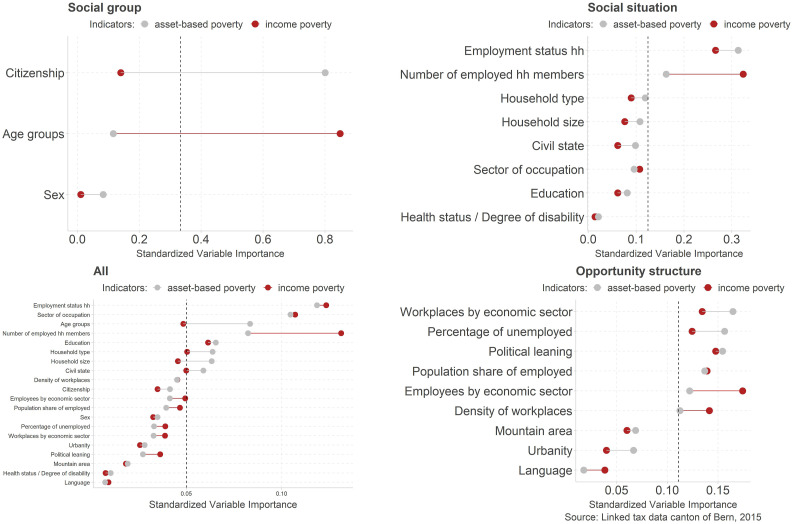
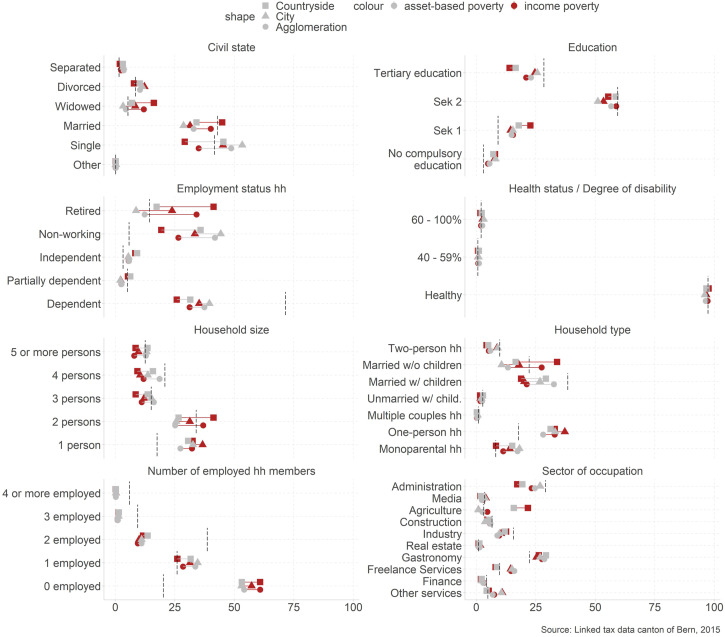
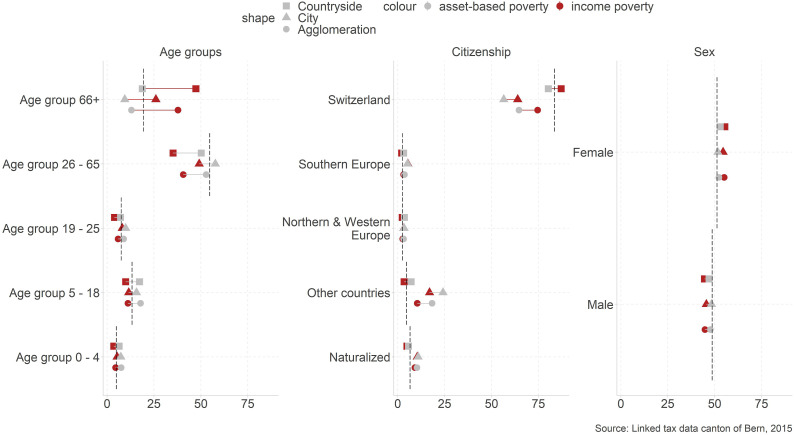
This paper contributes to the field of regional poverty literature by using linked tax data to examine poverty in a large district in Switzerland with one million inhabitants and rural and urban parts. We measure poverty using income and asset-based approaches. Our regional comparison of the social structure of the poor shows that poor people in rural areas are more likely to be of retirement age. Among the workforce, the share of poor is larger for those who work in agriculture compared to those working in industry or the service sector. In urban areas, the poor are more often freelancers and people of foreign origin. Despite where they live, people with little education, single parents, and people working in gastronomy/tourism are disproportionately often poor. We then use a random forest based variable importance assessment to clarify whether the importance of poverty risks factors differs in urban and rural locations. It shows little regional differences among the major poverty risk factors, and it demonstrates that the opportunity structure, like density of workplaces or aggravated access in mountain areas, seem to be of minor importance compared to risk factors that relate to the immediate social situation.
期刊介绍:
Local Economy is a peer-reviewed journal operating as an interdisciplinary forum for the critical review of policy developments in the broad area of local economic development and urban regeneration. It seeks not only to publish analysis and critique but also to disseminate innovative practice. One particular concern is with grassroots community economic development strategies and the work of voluntary organisations, considered within the context of wider social, political and economic change.




 京公网安备 11010802042870号
京ICP备2023020795号-1
京公网安备 11010802042870号
京ICP备2023020795号-1

 分享
分享
 求助内容:
求助内容: 应助结果提醒方式:
 扫码关注我们
