Breanna Lepre, Helena Trigueiro, Jørgen Torgerstuen Johnsen, Ali Ahsan Khalid, Lauren Ball, Sumantra Ray
{"title":"Global architecture for the nutrition training of health professionals: a scoping review and blueprint for next steps.","authors":"Breanna Lepre, Helena Trigueiro, Jørgen Torgerstuen Johnsen, Ali Ahsan Khalid, Lauren Ball, Sumantra Ray","doi":"10.1136/bmjnph-2021-000354","DOIUrl":null,"url":null,"abstract":"<p><strong>Background: </strong>This paper provides an overview of capacity-building efforts in the context of nutrition education for medical and healthcare professionals.</p><p><strong>Methods: </strong>Content analysis of eighteen reports related to nutrition education and capacity building, and interviews with key personnel from the WHO and NNEdPro Global Centre for Nutrition and Health were synthesised. Recommendations to improve nutrition education and subsequent nutrition capacity of healthcare professionals were identified based on policy guidance and interviews.</p><p><strong>Findings: </strong>Most included documents noted the importance of nutrition education and capacity building for medical and healthcare professionals. Healthcare professionals and the 'health sector' were positioned as central to achieving improved public health, and the promotion of nutrition knowledge and awareness in the general population.</p><p><strong>Conclusion: </strong>Increased focus on nutrition education and capacity of the health workforce are key to improvements in population health and well-being. The WHO is well placed to support global nutrition education.</p><p><strong>Recommendations: </strong>Key recommendations from the literature review and interviews include improved global data collection mechanisms, a pledge from governments to prioritise nutrition education and capacity building, along with implementation of standardised nutrition curricula for all healthcare sectors. This would include the development and expansion of on-line resources.</p>","PeriodicalId":3,"journal":{"name":"ACS Applied Electronic Materials","volume":" ","pages":"106-117"},"PeriodicalIF":4.7000,"publicationDate":"2022-02-16","publicationTypes":"Journal Article","fieldsOfStudy":null,"isOpenAccess":false,"openAccessPdf":"https://ftp.ncbi.nlm.nih.gov/pub/pmc/oa_pdf/2f/54/bmjnph-2021-000354.PMC9237864.pdf","citationCount":"0","resultStr":null,"platform":"Semanticscholar","paperid":null,"PeriodicalName":"ACS Applied Electronic Materials","FirstCategoryId":"88","ListUrlMain":"https://doi.org/10.1136/bmjnph-2021-000354","RegionNum":3,"RegionCategory":"材料科学","ArticlePicture":[],"TitleCN":null,"AbstractTextCN":null,"PMCID":null,"EPubDate":"2022/1/1 0:00:00","PubModel":"eCollection","JCR":"Q1","JCRName":"ENGINEERING, ELECTRICAL & ELECTRONIC","Score":null,"Total":0}
引用次数: 0
Abstract
Background: This paper provides an overview of capacity-building efforts in the context of nutrition education for medical and healthcare professionals.
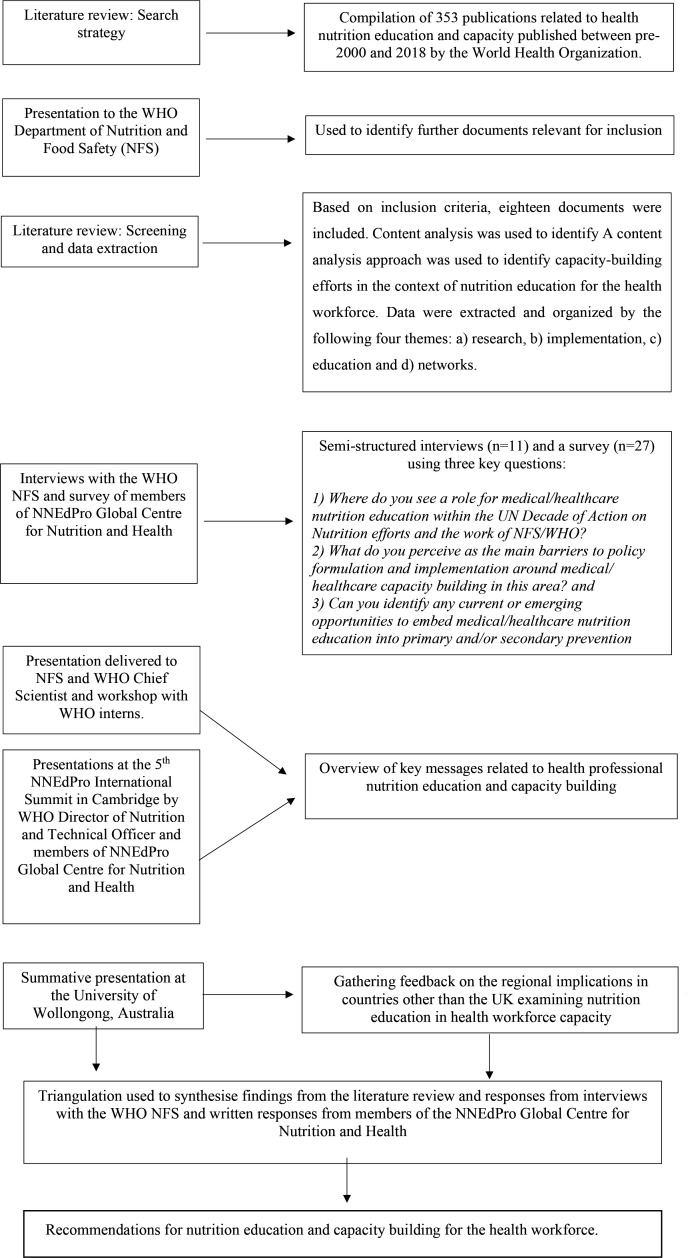
Methods: Content analysis of eighteen reports related to nutrition education and capacity building, and interviews with key personnel from the WHO and NNEdPro Global Centre for Nutrition and Health were synthesised. Recommendations to improve nutrition education and subsequent nutrition capacity of healthcare professionals were identified based on policy guidance and interviews.
Findings: Most included documents noted the importance of nutrition education and capacity building for medical and healthcare professionals. Healthcare professionals and the 'health sector' were positioned as central to achieving improved public health, and the promotion of nutrition knowledge and awareness in the general population.
Conclusion: Increased focus on nutrition education and capacity of the health workforce are key to improvements in population health and well-being. The WHO is well placed to support global nutrition education.
Recommendations: Key recommendations from the literature review and interviews include improved global data collection mechanisms, a pledge from governments to prioritise nutrition education and capacity building, along with implementation of standardised nutrition curricula for all healthcare sectors. This would include the development and expansion of on-line resources.
期刊介绍:
ACS Applied Electronic Materials is an interdisciplinary journal publishing original research covering all aspects of electronic materials. The journal is devoted to reports of new and original experimental and theoretical research of an applied nature that integrate knowledge in the areas of materials science, engineering, optics, physics, and chemistry into important applications of electronic materials. Sample research topics that span the journal's scope are inorganic, organic, ionic and polymeric materials with properties that include conducting, semiconducting, superconducting, insulating, dielectric, magnetic, optoelectronic, piezoelectric, ferroelectric and thermoelectric.
Indexed/Abstracted:
Web of Science SCIE
Scopus
CAS
INSPEC
Portico




 京公网安备 11010802042870号
京ICP备2023020795号-1
京公网安备 11010802042870号
京ICP备2023020795号-1

 分享
分享
 求助内容:
求助内容: 应助结果提醒方式:
 扫码关注我们
