{"title":"Trouble doing two differently timed actions at once: What is the problem?","authors":"Dana Maslovat, Stuart T Klapp","doi":"10.1037/rev0000383","DOIUrl":null,"url":null,"abstract":"<p><p>It is nearly impossible to concurrently initiate and execute two motor actions with independent timing. For example, it is difficult to tap one rhythm with the right hand while tapping a different rhythm with the left hand, even after these rhythms have been practiced individually. However, if this task is restructured so that it is represented internally as one action done by two hands rather than as two actions, one with each hand, these same rhythms can be produced easily. These findings, which indicate that motor action is limited to a single time base, are in marked contrast with the fact that it is easy to mechanically generate two independent rhythms simply by using mechanisms that are not linked to each other. After an in-depth review of the extensive research on this topic we propose a new theoretical interpretation. This attributes the difficulty to a fundamental constraint that prevents initiation of any motor action until after completion of programming the internal code that controls timing. The timing code is volatile in the sense that it must be generated immediately prior to the action to be controlled and then it must be implemented without delay. This constraint, which has been studied as it applies to single motor actions, can be extended to concurrent motor actions where it can account for the difficulty in doing two differently timed actions at once. Additional phenomena which may be attributed to this constraint are described in a concluding section. (PsycInfo Database Record (c) 2024 APA, all rights reserved).</p>","PeriodicalId":5,"journal":{"name":"ACS Applied Materials & Interfaces","volume":" ","pages":"231-246"},"PeriodicalIF":8.2000,"publicationDate":"2024-01-01","publicationTypes":"Journal Article","fieldsOfStudy":null,"isOpenAccess":false,"openAccessPdf":"","citationCount":"0","resultStr":null,"platform":"Semanticscholar","paperid":null,"PeriodicalName":"ACS Applied Materials & Interfaces","FirstCategoryId":"102","ListUrlMain":"https://doi.org/10.1037/rev0000383","RegionNum":2,"RegionCategory":"材料科学","ArticlePicture":[],"TitleCN":null,"AbstractTextCN":null,"PMCID":null,"EPubDate":"2022/7/11 0:00:00","PubModel":"Epub","JCR":"Q1","JCRName":"MATERIALS SCIENCE, MULTIDISCIPLINARY","Score":null,"Total":0}
引用次数: 0
Abstract
It is nearly impossible to concurrently initiate and execute two motor actions with independent timing. For example, it is difficult to tap one rhythm with the right hand while tapping a different rhythm with the left hand, even after these rhythms have been practiced individually. However, if this task is restructured so that it is represented internally as one action done by two hands rather than as two actions, one with each hand, these same rhythms can be produced easily. These findings, which indicate that motor action is limited to a single time base, are in marked contrast with the fact that it is easy to mechanically generate two independent rhythms simply by using mechanisms that are not linked to each other. After an in-depth review of the extensive research on this topic we propose a new theoretical interpretation. This attributes the difficulty to a fundamental constraint that prevents initiation of any motor action until after completion of programming the internal code that controls timing. The timing code is volatile in the sense that it must be generated immediately prior to the action to be controlled and then it must be implemented without delay. This constraint, which has been studied as it applies to single motor actions, can be extended to concurrent motor actions where it can account for the difficulty in doing two differently timed actions at once. Additional phenomena which may be attributed to this constraint are described in a concluding section. (PsycInfo Database Record (c) 2024 APA, all rights reserved).
期刊介绍:
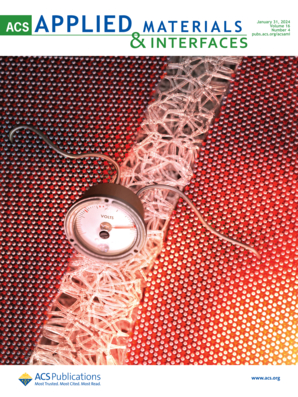
ACS Applied Materials & Interfaces is a leading interdisciplinary journal that brings together chemists, engineers, physicists, and biologists to explore the development and utilization of newly-discovered materials and interfacial processes for specific applications. Our journal has experienced remarkable growth since its establishment in 2009, both in terms of the number of articles published and the impact of the research showcased. We are proud to foster a truly global community, with the majority of published articles originating from outside the United States, reflecting the rapid growth of applied research worldwide.



 京公网安备 11010802042870号
京ICP备2023020795号-1
京公网安备 11010802042870号
京ICP备2023020795号-1

 分享
分享
 求助内容:
求助内容: 应助结果提醒方式:
 扫码关注我们
