Fabian Herold, Paula Theobald, Thomas Gronwald, Michael A Rapp, Notger G Müller
{"title":"Going digital - a commentary on the terminology used at the intersection of physical activity and digital health.","authors":"Fabian Herold, Paula Theobald, Thomas Gronwald, Michael A Rapp, Notger G Müller","doi":"10.1186/s11556-022-00296-y","DOIUrl":null,"url":null,"abstract":"<p><p>In recent years digital technologies have become a major means for providing health-related services and this trend was strongly reinforced by the current Coronavirus disease 2019 (COVID-19) pandemic. As it is well-known that regular physical activity has positive effects on individual physical and mental health and thus is an important prerequisite for healthy aging, digital technologies are also increasingly used to promote unstructured and structured forms of physical activity. However, in the course of this development, several terms (e.g., Digital Health, Electronic Health, Mobile Health, Telehealth, Telemedicine, and Telerehabilitation) have been introduced to refer to the application of digital technologies to provide health-related services such as physical interventions. Unfortunately, the above-mentioned terms are often used in several different ways, but also relatively interchangeably. Given that ambiguous terminology is a major source of difficulty in scientific communication which can impede the progress of theoretical and empirical research, this article aims to make the reader aware of the subtle differences between the relevant terms which are applied at the intersection of physical activity and Digital Health and to provide state-of-art definitions for them.</p>","PeriodicalId":3,"journal":{"name":"ACS Applied Electronic Materials","volume":" ","pages":"17"},"PeriodicalIF":4.7000,"publicationDate":"2022-07-16","publicationTypes":"Journal Article","fieldsOfStudy":null,"isOpenAccess":false,"openAccessPdf":"https://www.ncbi.nlm.nih.gov/pmc/articles/PMC9287128/pdf/","citationCount":"0","resultStr":null,"platform":"Semanticscholar","paperid":null,"PeriodicalName":"ACS Applied Electronic Materials","FirstCategoryId":"3","ListUrlMain":"https://doi.org/10.1186/s11556-022-00296-y","RegionNum":3,"RegionCategory":"材料科学","ArticlePicture":[],"TitleCN":null,"AbstractTextCN":null,"PMCID":null,"EPubDate":"","PubModel":"","JCR":"Q1","JCRName":"ENGINEERING, ELECTRICAL & ELECTRONIC","Score":null,"Total":0}
引用次数: 0
Abstract
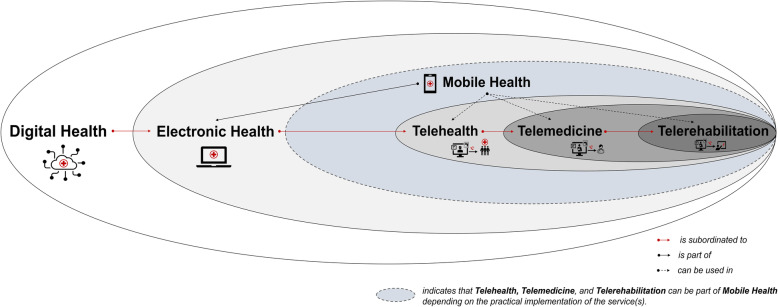
In recent years digital technologies have become a major means for providing health-related services and this trend was strongly reinforced by the current Coronavirus disease 2019 (COVID-19) pandemic. As it is well-known that regular physical activity has positive effects on individual physical and mental health and thus is an important prerequisite for healthy aging, digital technologies are also increasingly used to promote unstructured and structured forms of physical activity. However, in the course of this development, several terms (e.g., Digital Health, Electronic Health, Mobile Health, Telehealth, Telemedicine, and Telerehabilitation) have been introduced to refer to the application of digital technologies to provide health-related services such as physical interventions. Unfortunately, the above-mentioned terms are often used in several different ways, but also relatively interchangeably. Given that ambiguous terminology is a major source of difficulty in scientific communication which can impede the progress of theoretical and empirical research, this article aims to make the reader aware of the subtle differences between the relevant terms which are applied at the intersection of physical activity and Digital Health and to provide state-of-art definitions for them.
期刊介绍:
ACS Applied Electronic Materials is an interdisciplinary journal publishing original research covering all aspects of electronic materials. The journal is devoted to reports of new and original experimental and theoretical research of an applied nature that integrate knowledge in the areas of materials science, engineering, optics, physics, and chemistry into important applications of electronic materials. Sample research topics that span the journal's scope are inorganic, organic, ionic and polymeric materials with properties that include conducting, semiconducting, superconducting, insulating, dielectric, magnetic, optoelectronic, piezoelectric, ferroelectric and thermoelectric.
Indexed/Abstracted:
Web of Science SCIE
Scopus
CAS
INSPEC
Portico




 京公网安备 11010802042870号
京ICP备2023020795号-1
京公网安备 11010802042870号
京ICP备2023020795号-1

 分享
分享
 求助内容:
求助内容: 应助结果提醒方式:
 扫码关注我们
