Anna-Leena Lohiniva, Anastasiya Nurzhynska, Al-Hassan Hudi, Bridget Anim, Da Costa Aboagye
{"title":"Infodemic Management Using Digital Information and Knowledge Cocreation to Address COVID-19 Vaccine Hesitancy: Case Study From Ghana.","authors":"Anna-Leena Lohiniva, Anastasiya Nurzhynska, Al-Hassan Hudi, Bridget Anim, Da Costa Aboagye","doi":"10.2196/37134","DOIUrl":null,"url":null,"abstract":"<p><strong>Background: </strong>Infodemic management is an integral part of pandemic management. Ghana Health Services (GHS) together with the UNICEF (United Nations International Children's Emergency Fund) Country Office have developed a systematic process that effectively identifies, analyzes, and responds to COVID-19 and vaccine-related misinformation in Ghana.</p><p><strong>Objective: </strong>This paper describes an infodemic management system workflow based on digital data collection, qualitative methodology, and human-centered systems to support the COVID-19 vaccine rollout in Ghana with examples of system implementation.</p><p><strong>Methods: </strong>The infodemic management system was developed by the Health Promotion Division of the GHS and the UNICEF Country Office. It uses Talkwalker, a social listening software platform, to collect misinformation on the web. The methodology relies on qualitative data analysis and interpretation as well as knowledge cocreation to verify the findings.</p><p><strong>Results: </strong>A multi-sectoral National Misinformation Task Force was established to implement and oversee the misinformation management system. Two members of the task force were responsible for carrying out the analysis. They used Talkwalker to find posts that include the keywords related to COVID-19 vaccine-related discussions. They then assessed the significance of the posts on the basis of the engagement rate and potential reach of the posts, negative sentiments, and contextual factors. The process continues by identifying misinformation within the posts, rating the risk of identified misinformation posts, and developing proposed responses to address them. The results of the analysis are shared weekly with the Misinformation Task Force for their review and verification to ensure that the risk assessment and responses are feasible, practical, and acceptable in the context of Ghana.</p><p><strong>Conclusions: </strong>The paper describes an infodemic management system workflow in Ghana based on qualitative data synthesis that can be used to manage real-time infodemic responses.</p>","PeriodicalId":3,"journal":{"name":"ACS Applied Electronic Materials","volume":" ","pages":"e37134"},"PeriodicalIF":4.7000,"publicationDate":"2022-07-12","publicationTypes":"Journal Article","fieldsOfStudy":null,"isOpenAccess":false,"openAccessPdf":"https://www.ncbi.nlm.nih.gov/pmc/articles/PMC9281514/pdf/","citationCount":"0","resultStr":null,"platform":"Semanticscholar","paperid":null,"PeriodicalName":"ACS Applied Electronic Materials","FirstCategoryId":"1085","ListUrlMain":"https://doi.org/10.2196/37134","RegionNum":3,"RegionCategory":"材料科学","ArticlePicture":[],"TitleCN":null,"AbstractTextCN":null,"PMCID":null,"EPubDate":"2022/7/1 0:00:00","PubModel":"eCollection","JCR":"Q1","JCRName":"ENGINEERING, ELECTRICAL & ELECTRONIC","Score":null,"Total":0}
引用次数: 0
Abstract
Background: Infodemic management is an integral part of pandemic management. Ghana Health Services (GHS) together with the UNICEF (United Nations International Children's Emergency Fund) Country Office have developed a systematic process that effectively identifies, analyzes, and responds to COVID-19 and vaccine-related misinformation in Ghana.
Objective: This paper describes an infodemic management system workflow based on digital data collection, qualitative methodology, and human-centered systems to support the COVID-19 vaccine rollout in Ghana with examples of system implementation.
Methods: The infodemic management system was developed by the Health Promotion Division of the GHS and the UNICEF Country Office. It uses Talkwalker, a social listening software platform, to collect misinformation on the web. The methodology relies on qualitative data analysis and interpretation as well as knowledge cocreation to verify the findings.
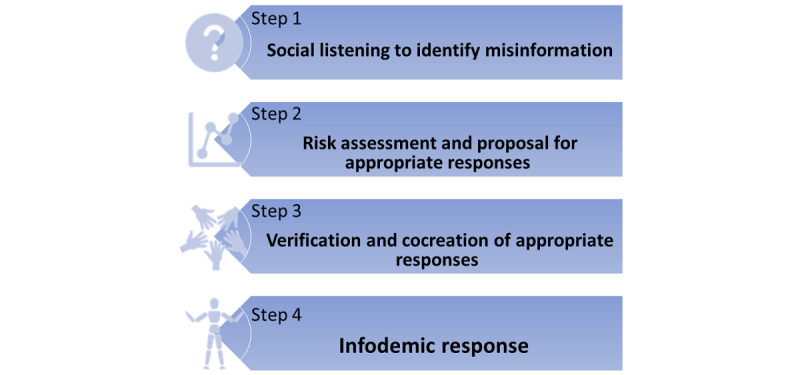
Results: A multi-sectoral National Misinformation Task Force was established to implement and oversee the misinformation management system. Two members of the task force were responsible for carrying out the analysis. They used Talkwalker to find posts that include the keywords related to COVID-19 vaccine-related discussions. They then assessed the significance of the posts on the basis of the engagement rate and potential reach of the posts, negative sentiments, and contextual factors. The process continues by identifying misinformation within the posts, rating the risk of identified misinformation posts, and developing proposed responses to address them. The results of the analysis are shared weekly with the Misinformation Task Force for their review and verification to ensure that the risk assessment and responses are feasible, practical, and acceptable in the context of Ghana.
Conclusions: The paper describes an infodemic management system workflow in Ghana based on qualitative data synthesis that can be used to manage real-time infodemic responses.
期刊介绍:
ACS Applied Electronic Materials is an interdisciplinary journal publishing original research covering all aspects of electronic materials. The journal is devoted to reports of new and original experimental and theoretical research of an applied nature that integrate knowledge in the areas of materials science, engineering, optics, physics, and chemistry into important applications of electronic materials. Sample research topics that span the journal's scope are inorganic, organic, ionic and polymeric materials with properties that include conducting, semiconducting, superconducting, insulating, dielectric, magnetic, optoelectronic, piezoelectric, ferroelectric and thermoelectric.
Indexed/Abstracted:
Web of Science SCIE
Scopus
CAS
INSPEC
Portico




 京公网安备 11010802042870号
京ICP备2023020795号-1
京公网安备 11010802042870号
京ICP备2023020795号-1

 分享
分享
 求助内容:
求助内容: 应助结果提醒方式:
 扫码关注我们
