{"title":"Barriers to consumption of fruits and vegetables and strategies to overcome them in low- and middle-income countries: a narrative review.","authors":"Sukhdeep Kaur","doi":"10.1017/S0954422422000166","DOIUrl":null,"url":null,"abstract":"<p><p>This review provides an overview of the barriers to the consumption of fruits and vegetables (FVs) as well as strategies to improve the intake of FVs in low- and middle-income countries (LMICs). The importance of the consumption of FVs and its role in disease prevention are discussed briefly. Trends in the consumption of FVs in LMICs are also summarised. The WHO recommends that every individual should consume at least five servings or 400 grams of FVs per day. Epidemiological and clinical investigations have demonstrated that FVs contain numerous bioactive compounds with health-protecting activities. Despite their health benefits, the intake of FVs in LMICs remains low. Major barriers identified were socio-demographic factors, environmental conditions, individual and cultural factors, and macrosystem influences. These barriers may be lowered at the household, school, community, and national level through multi-component interventions including behaviour change communication (BCC) initiatives, nutrition education (NE), gardening initiatives, farm to institution programs (FIPs), food baskets, cash transfers, nutrition-agriculture policy and program linkages, and food-market environment-based strategies. This review has research implications due to the positive outcomes of strategies that lower such barriers and boost consumption of FVs in LMICs.</p>","PeriodicalId":5,"journal":{"name":"ACS Applied Materials & Interfaces","volume":" ","pages":"420-447"},"PeriodicalIF":8.2000,"publicationDate":"2023-12-01","publicationTypes":"Journal Article","fieldsOfStudy":null,"isOpenAccess":false,"openAccessPdf":"","citationCount":"0","resultStr":null,"platform":"Semanticscholar","paperid":null,"PeriodicalName":"ACS Applied Materials & Interfaces","FirstCategoryId":"88","ListUrlMain":"https://doi.org/10.1017/S0954422422000166","RegionNum":2,"RegionCategory":"材料科学","ArticlePicture":[],"TitleCN":null,"AbstractTextCN":null,"PMCID":null,"EPubDate":"2022/8/25 0:00:00","PubModel":"Epub","JCR":"Q1","JCRName":"MATERIALS SCIENCE, MULTIDISCIPLINARY","Score":null,"Total":0}
引用次数: 0
Abstract
This review provides an overview of the barriers to the consumption of fruits and vegetables (FVs) as well as strategies to improve the intake of FVs in low- and middle-income countries (LMICs). The importance of the consumption of FVs and its role in disease prevention are discussed briefly. Trends in the consumption of FVs in LMICs are also summarised. The WHO recommends that every individual should consume at least five servings or 400 grams of FVs per day. Epidemiological and clinical investigations have demonstrated that FVs contain numerous bioactive compounds with health-protecting activities. Despite their health benefits, the intake of FVs in LMICs remains low. Major barriers identified were socio-demographic factors, environmental conditions, individual and cultural factors, and macrosystem influences. These barriers may be lowered at the household, school, community, and national level through multi-component interventions including behaviour change communication (BCC) initiatives, nutrition education (NE), gardening initiatives, farm to institution programs (FIPs), food baskets, cash transfers, nutrition-agriculture policy and program linkages, and food-market environment-based strategies. This review has research implications due to the positive outcomes of strategies that lower such barriers and boost consumption of FVs in LMICs.
期刊介绍:
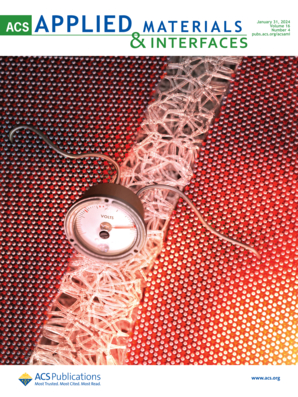
ACS Applied Materials & Interfaces is a leading interdisciplinary journal that brings together chemists, engineers, physicists, and biologists to explore the development and utilization of newly-discovered materials and interfacial processes for specific applications. Our journal has experienced remarkable growth since its establishment in 2009, both in terms of the number of articles published and the impact of the research showcased. We are proud to foster a truly global community, with the majority of published articles originating from outside the United States, reflecting the rapid growth of applied research worldwide.



 京公网安备 11010802042870号
京ICP备2023020795号-1
京公网安备 11010802042870号
京ICP备2023020795号-1

 分享
分享
 求助内容:
求助内容: 应助结果提醒方式:
 扫码关注我们
