Peer education interventions for HIV prevention and sexual health with young people in Mekong Region countries: a scoping review and conceptual framework.
Peter A Newman, Pakorn Akkakanjanasupar, Suchon Tepjan, Sharafdzhon Boborakhimov, Jan Willem de Lind van Wijngaarden, Nuttapon Chonwanarat
{"title":"Peer education interventions for HIV prevention and sexual health with young people in Mekong Region countries: a scoping review and conceptual framework.","authors":"Peter A Newman, Pakorn Akkakanjanasupar, Suchon Tepjan, Sharafdzhon Boborakhimov, Jan Willem de Lind van Wijngaarden, Nuttapon Chonwanarat","doi":"10.1080/26410397.2022.2129374","DOIUrl":null,"url":null,"abstract":"<p><p>WHO-recommended rights-based approaches to sexual health emphasise participatory and youth-centred processes. Among these, peer education (PE) interventions are commonly used to promote HIV prevention and sexual health for young people, particularly in low-resource, high HIV prevalence contexts. We conducted a scoping review to identify key characteristics, implementation challenges, and knowledge gaps in the literature regarding PE interventions in Mekong Region countries. Out of 6521 publications identified through database searches, 17 peer-reviewed articles were included in the review (<i>n</i> = 21,469 participants). Studies from Thailand (<i>n</i> = 7), Vietnam (<i>n</i> = 5), Myanmar (<i>n</i> = 3), Cambodia (<i>n</i> = 1), and Lao PDR (<i>n</i> = 1) included adolescent and young key populations (<i>n</i> = 11) and general population youth (<i>n</i> = 6). Findings from quantitative (descriptive) and qualitative (thematic) analysis illustrate benefits and challenges of various elements of multicomponent PE interventions in reaching vulnerable young people and improving HIV prevention and sexual health outcomes. Focal knowledge gaps emerged in regard to peer educator outcomes (increased knowledge, skill-building, empowerment); interpersonal processes between peer educators and young people (role modelling, social dynamics); and social-structural contexts (sociocultural influences, gendered power relations), which may affect PE programme implementation and effectiveness. Future research should evaluate the potential benefits of complementing evidence-based intervention approaches - focused predominantly on assessing individual-level behavioural outcomes conceptualised as external to PE programmes - with evidence-making intervention approaches that support rights-based PE programmes: incorporating a focus on dialectical and relational processes between peer educators and young people; assessing salutary outcomes among peer educators themselves; and evaluating the situated implementation of youth-engaged PE interventions in complex sociocultural systems.</p>","PeriodicalId":3,"journal":{"name":"ACS Applied Electronic Materials","volume":" ","pages":"2129374"},"PeriodicalIF":4.7000,"publicationDate":"2022-12-01","publicationTypes":"Journal Article","fieldsOfStudy":null,"isOpenAccess":false,"openAccessPdf":"https://www.ncbi.nlm.nih.gov/pmc/articles/PMC9621210/pdf/","citationCount":"0","resultStr":null,"platform":"Semanticscholar","paperid":null,"PeriodicalName":"ACS Applied Electronic Materials","FirstCategoryId":"88","ListUrlMain":"https://doi.org/10.1080/26410397.2022.2129374","RegionNum":3,"RegionCategory":"材料科学","ArticlePicture":[],"TitleCN":null,"AbstractTextCN":null,"PMCID":null,"EPubDate":"","PubModel":"","JCR":"Q1","JCRName":"ENGINEERING, ELECTRICAL & ELECTRONIC","Score":null,"Total":0}
引用次数: 0
Abstract
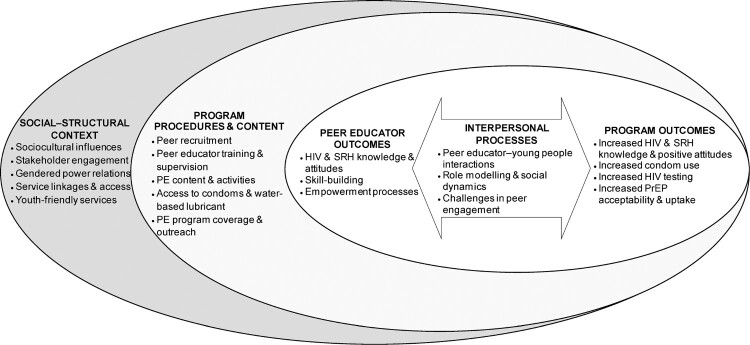
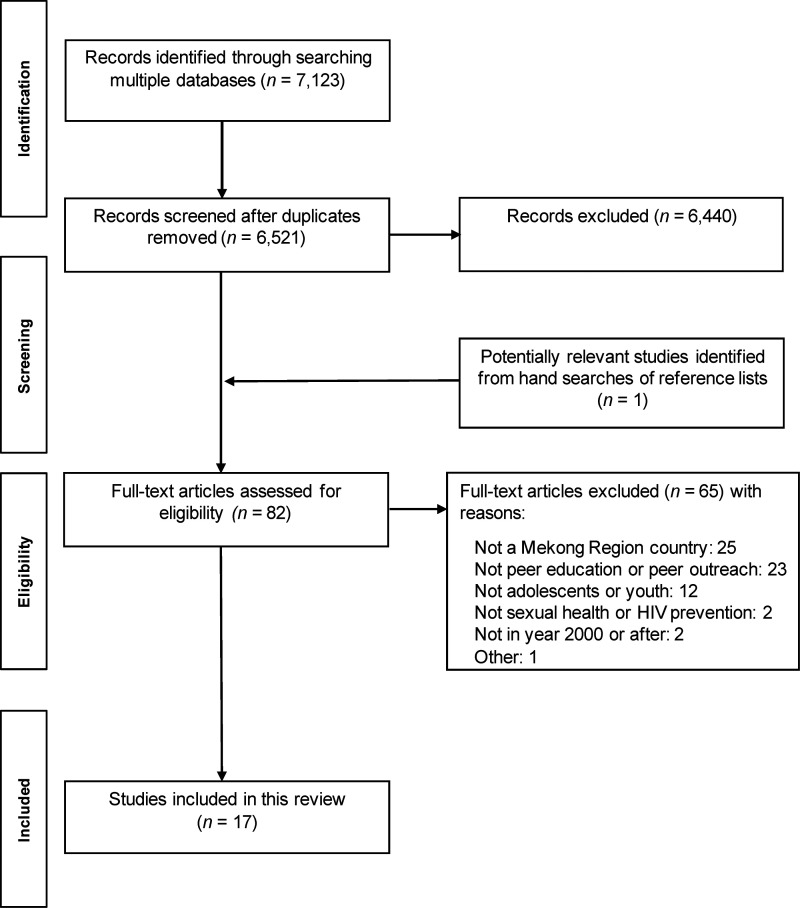
WHO-recommended rights-based approaches to sexual health emphasise participatory and youth-centred processes. Among these, peer education (PE) interventions are commonly used to promote HIV prevention and sexual health for young people, particularly in low-resource, high HIV prevalence contexts. We conducted a scoping review to identify key characteristics, implementation challenges, and knowledge gaps in the literature regarding PE interventions in Mekong Region countries. Out of 6521 publications identified through database searches, 17 peer-reviewed articles were included in the review (n = 21,469 participants). Studies from Thailand (n = 7), Vietnam (n = 5), Myanmar (n = 3), Cambodia (n = 1), and Lao PDR (n = 1) included adolescent and young key populations (n = 11) and general population youth (n = 6). Findings from quantitative (descriptive) and qualitative (thematic) analysis illustrate benefits and challenges of various elements of multicomponent PE interventions in reaching vulnerable young people and improving HIV prevention and sexual health outcomes. Focal knowledge gaps emerged in regard to peer educator outcomes (increased knowledge, skill-building, empowerment); interpersonal processes between peer educators and young people (role modelling, social dynamics); and social-structural contexts (sociocultural influences, gendered power relations), which may affect PE programme implementation and effectiveness. Future research should evaluate the potential benefits of complementing evidence-based intervention approaches - focused predominantly on assessing individual-level behavioural outcomes conceptualised as external to PE programmes - with evidence-making intervention approaches that support rights-based PE programmes: incorporating a focus on dialectical and relational processes between peer educators and young people; assessing salutary outcomes among peer educators themselves; and evaluating the situated implementation of youth-engaged PE interventions in complex sociocultural systems.
期刊介绍:
ACS Applied Electronic Materials is an interdisciplinary journal publishing original research covering all aspects of electronic materials. The journal is devoted to reports of new and original experimental and theoretical research of an applied nature that integrate knowledge in the areas of materials science, engineering, optics, physics, and chemistry into important applications of electronic materials. Sample research topics that span the journal's scope are inorganic, organic, ionic and polymeric materials with properties that include conducting, semiconducting, superconducting, insulating, dielectric, magnetic, optoelectronic, piezoelectric, ferroelectric and thermoelectric.
Indexed/Abstracted:
Web of Science SCIE
Scopus
CAS
INSPEC
Portico




 京公网安备 11010802042870号
京ICP备2023020795号-1
京公网安备 11010802042870号
京ICP备2023020795号-1

 分享
分享
 求助内容:
求助内容: 应助结果提醒方式:
 扫码关注我们
