Qi Zhou, Kerstin Schirrmann, Eleanor Doman, Qi Chen, Naval Singh, P Ravi Selvaganapathy, Miguel O Bernabeu, Oliver E Jensen, Anne Juel, Igor L Chernyavsky, Timm Krüger
{"title":"Red blood cell dynamics in extravascular biological tissues modelled as canonical disordered porous media.","authors":"Qi Zhou, Kerstin Schirrmann, Eleanor Doman, Qi Chen, Naval Singh, P Ravi Selvaganapathy, Miguel O Bernabeu, Oliver E Jensen, Anne Juel, Igor L Chernyavsky, Timm Krüger","doi":"10.1098/rsfs.2022.0037","DOIUrl":null,"url":null,"abstract":"<p><p>The dynamics of blood flow in the smallest vessels and passages of the human body, where the cellular character of blood becomes prominent, plays a dominant role in the transport and exchange of solutes. Recent studies have revealed that the microhaemodynamics of a vascular network is underpinned by its interconnected structure, and certain structural alterations such as capillary dilation and blockage can substantially change blood flow patterns. However, for extravascular media with disordered microstructure (e.g. the porous intervillous space in the placenta), it remains unclear how the medium's structure affects the haemodynamics. Here, we simulate cellular blood flow in simple models of canonical porous media representative of extravascular biological tissue, with corroborative microfluidic experiments performed for validation purposes. For the media considered here, we observe three main effects: first, the relative apparent viscosity of blood increases with the structural disorder of the medium; second, the presence of red blood cells (RBCs) dynamically alters the flow distribution in the medium; third, symmetry breaking introduced by moderate structural disorder can promote more homogeneous distribution of RBCs. Our findings contribute to a better understanding of the cell-scale haemodynamics that mediates the relationship linking the function of certain biological tissues to their microstructure.</p>","PeriodicalId":3,"journal":{"name":"ACS Applied Electronic Materials","volume":" ","pages":"20220037"},"PeriodicalIF":4.7000,"publicationDate":"2022-10-14","publicationTypes":"Journal Article","fieldsOfStudy":null,"isOpenAccess":false,"openAccessPdf":"https://www.ncbi.nlm.nih.gov/pmc/articles/PMC9560785/pdf/","citationCount":"0","resultStr":null,"platform":"Semanticscholar","paperid":null,"PeriodicalName":"ACS Applied Electronic Materials","FirstCategoryId":"99","ListUrlMain":"https://doi.org/10.1098/rsfs.2022.0037","RegionNum":3,"RegionCategory":"材料科学","ArticlePicture":[],"TitleCN":null,"AbstractTextCN":null,"PMCID":null,"EPubDate":"2022/12/6 0:00:00","PubModel":"eCollection","JCR":"Q1","JCRName":"ENGINEERING, ELECTRICAL & ELECTRONIC","Score":null,"Total":0}
引用次数: 0
Abstract
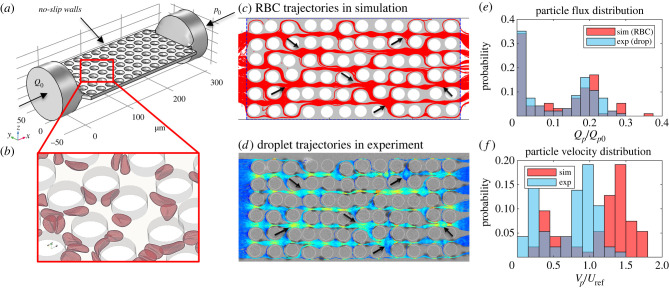
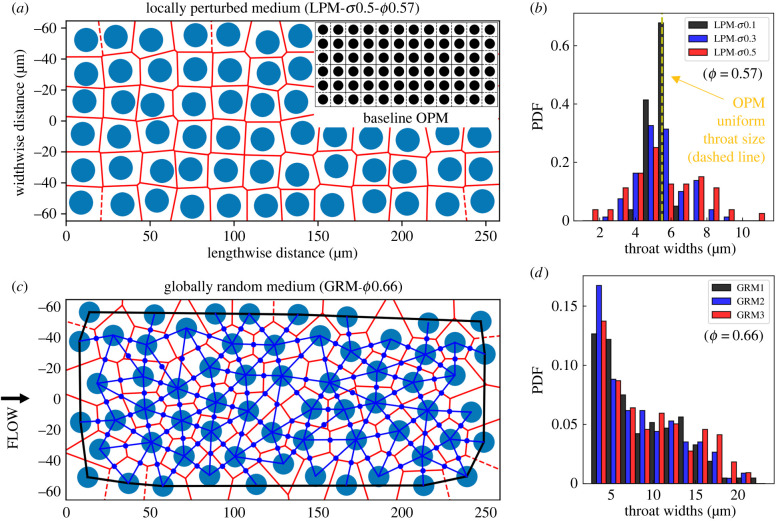
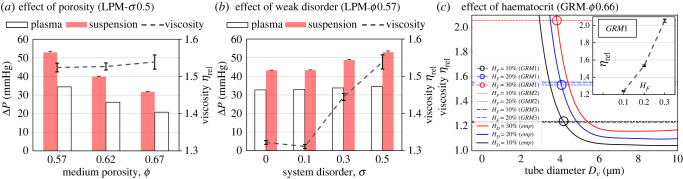
The dynamics of blood flow in the smallest vessels and passages of the human body, where the cellular character of blood becomes prominent, plays a dominant role in the transport and exchange of solutes. Recent studies have revealed that the microhaemodynamics of a vascular network is underpinned by its interconnected structure, and certain structural alterations such as capillary dilation and blockage can substantially change blood flow patterns. However, for extravascular media with disordered microstructure (e.g. the porous intervillous space in the placenta), it remains unclear how the medium's structure affects the haemodynamics. Here, we simulate cellular blood flow in simple models of canonical porous media representative of extravascular biological tissue, with corroborative microfluidic experiments performed for validation purposes. For the media considered here, we observe three main effects: first, the relative apparent viscosity of blood increases with the structural disorder of the medium; second, the presence of red blood cells (RBCs) dynamically alters the flow distribution in the medium; third, symmetry breaking introduced by moderate structural disorder can promote more homogeneous distribution of RBCs. Our findings contribute to a better understanding of the cell-scale haemodynamics that mediates the relationship linking the function of certain biological tissues to their microstructure.
期刊介绍:
ACS Applied Electronic Materials is an interdisciplinary journal publishing original research covering all aspects of electronic materials. The journal is devoted to reports of new and original experimental and theoretical research of an applied nature that integrate knowledge in the areas of materials science, engineering, optics, physics, and chemistry into important applications of electronic materials. Sample research topics that span the journal's scope are inorganic, organic, ionic and polymeric materials with properties that include conducting, semiconducting, superconducting, insulating, dielectric, magnetic, optoelectronic, piezoelectric, ferroelectric and thermoelectric.
Indexed/Abstracted:
Web of Science SCIE
Scopus
CAS
INSPEC
Portico




 京公网安备 11010802042870号
京ICP备2023020795号-1
京公网安备 11010802042870号
京ICP备2023020795号-1

 分享
分享
 求助内容:
求助内容: 应助结果提醒方式:
 扫码关注我们
