{"title":"Management of Heart Failure in Patients with Chronic Kidney Disease.","authors":"David K Ryan, Debasish Banerjee, Fadi Jouhra","doi":"10.15420/ecr.2021.33","DOIUrl":null,"url":null,"abstract":"<p><p>Chronic kidney disease (CKD) is increasingly prevalent in patients with heart failure (HF) and HF is one of the leading causes of hospitalisation, morbidity and mortality in patients with impaired renal function. Currently, there is strong evidence to support the symptomatic and prognostic benefits of β-blockers, renin-angiotensin-aldosterone inhibitors (RAASis), angiotensin receptor-neprilysin inhibitors (ARNIs) and mineralocorticoid receptor antagonists (MRA) in patients with HF and CKD stages 1-3. However, ARNIs, RAASis and MRAs are often suboptimally prescribed for patients with CKD owing to concerns about hyperkalaemia and worsening renal function. There is growing evidence for the use of sodium-glucose co-transporter 2 inhibitors and IV iron therapy in the management of HF in patients with CKD. However, few studies have included patients with CKD stages 4-5 and patients receiving dialysis, limiting the assessment of the safety and efficacy of these therapies in advanced CKD. Interdisciplinary input from HF and renal specialists is required to provide integrated care for the growing number of patients with HF and CKD.</p>","PeriodicalId":3,"journal":{"name":"ACS Applied Electronic Materials","volume":" ","pages":"e17"},"PeriodicalIF":4.7000,"publicationDate":"2022-07-26","publicationTypes":"Journal Article","fieldsOfStudy":null,"isOpenAccess":false,"openAccessPdf":"https://ftp.ncbi.nlm.nih.gov/pub/pmc/oa_pdf/9d/92/ecr-17-e17.PMC9376857.pdf","citationCount":"0","resultStr":null,"platform":"Semanticscholar","paperid":null,"PeriodicalName":"ACS Applied Electronic Materials","FirstCategoryId":"1085","ListUrlMain":"https://doi.org/10.15420/ecr.2021.33","RegionNum":3,"RegionCategory":"材料科学","ArticlePicture":[],"TitleCN":null,"AbstractTextCN":null,"PMCID":null,"EPubDate":"2022/2/1 0:00:00","PubModel":"eCollection","JCR":"Q1","JCRName":"ENGINEERING, ELECTRICAL & ELECTRONIC","Score":null,"Total":0}
引用次数: 0
Abstract
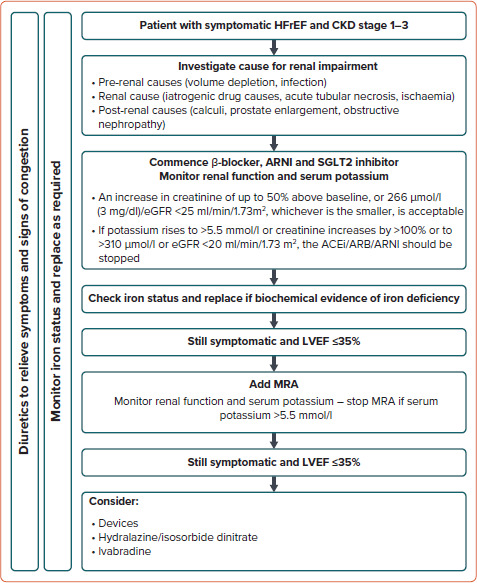
Chronic kidney disease (CKD) is increasingly prevalent in patients with heart failure (HF) and HF is one of the leading causes of hospitalisation, morbidity and mortality in patients with impaired renal function. Currently, there is strong evidence to support the symptomatic and prognostic benefits of β-blockers, renin-angiotensin-aldosterone inhibitors (RAASis), angiotensin receptor-neprilysin inhibitors (ARNIs) and mineralocorticoid receptor antagonists (MRA) in patients with HF and CKD stages 1-3. However, ARNIs, RAASis and MRAs are often suboptimally prescribed for patients with CKD owing to concerns about hyperkalaemia and worsening renal function. There is growing evidence for the use of sodium-glucose co-transporter 2 inhibitors and IV iron therapy in the management of HF in patients with CKD. However, few studies have included patients with CKD stages 4-5 and patients receiving dialysis, limiting the assessment of the safety and efficacy of these therapies in advanced CKD. Interdisciplinary input from HF and renal specialists is required to provide integrated care for the growing number of patients with HF and CKD.
期刊介绍:
ACS Applied Electronic Materials is an interdisciplinary journal publishing original research covering all aspects of electronic materials. The journal is devoted to reports of new and original experimental and theoretical research of an applied nature that integrate knowledge in the areas of materials science, engineering, optics, physics, and chemistry into important applications of electronic materials. Sample research topics that span the journal's scope are inorganic, organic, ionic and polymeric materials with properties that include conducting, semiconducting, superconducting, insulating, dielectric, magnetic, optoelectronic, piezoelectric, ferroelectric and thermoelectric.
Indexed/Abstracted:
Web of Science SCIE
Scopus
CAS
INSPEC
Portico




 京公网安备 11010802042870号
京ICP备2023020795号-1
京公网安备 11010802042870号
京ICP备2023020795号-1

 分享
分享
 求助内容:
求助内容: 应助结果提醒方式:
 扫码关注我们
