{"title":"Bioprinted Scaffold Remodels the Neuromodulatory Microenvironment for Enhancing Bone Regeneration","authors":"Shuting Guo, Chuanglong He","doi":"10.1002/adfm.202304172","DOIUrl":null,"url":null,"abstract":"<p>Herein, a 3D bioprinted scaffold is proposed, containing a calcitonin gene-related peptide (CGRP) and the <i>β</i>-adrenergic receptor blocker propranolol (PRN) as a new method to achieve effective repair of bone defects. By leveraging the neuromodulation mechanism of bone regeneration, CGRP and PRN loaded mesoporous silica nanoparticles are added into a hybrid bio-ink, which initially contains gelatin methacrylate, Poly (ethylene glycol) diacrylate and bone marrow mesenchymal stem cells (BMSCs). Subsequently, the optimized bio-ink is used for 3D bioprinting to create a composite scaffold with a pre-designed micro-nano hierarchical structure. The migration and tube formation of human umbilical vein endothelial cells (HUVECs) can be promoted by the scaffold, which is beneficial to the formation of a new capillary network during the bone repair process. With the release of CGRP from the scaffold, the secretion of neuropeptides by sensory nerves is simulated. Meanwhile, the release of PRN can inhibit the binding process of catecholamine to <i>β</i>-adrenergic receptor, co-promoting the osteogenic differentiation of BMSCs with CGRP and silicon ions, which will effectively enhance bone repair of a critical-sized cranial defect in a rat model. In conclusion, this study provides a promising strategy for bone defect repair by understanding the neuromodulatory mechanisms during bone regeneration.</p>","PeriodicalId":112,"journal":{"name":"Advanced Functional Materials","volume":"33 40","pages":""},"PeriodicalIF":19.0000,"publicationDate":"2023-05-31","publicationTypes":"Journal Article","fieldsOfStudy":null,"isOpenAccess":false,"openAccessPdf":"","citationCount":"2","resultStr":null,"platform":"Semanticscholar","paperid":null,"PeriodicalName":"Advanced Functional Materials","FirstCategoryId":"88","ListUrlMain":"https://onlinelibrary.wiley.com/doi/10.1002/adfm.202304172","RegionNum":1,"RegionCategory":"材料科学","ArticlePicture":[],"TitleCN":null,"AbstractTextCN":null,"PMCID":null,"EPubDate":"","PubModel":"","JCR":"Q1","JCRName":"CHEMISTRY, MULTIDISCIPLINARY","Score":null,"Total":0}
引用次数: 2
Abstract
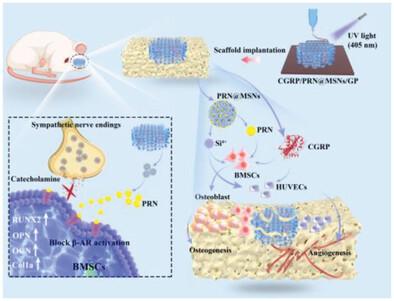
Herein, a 3D bioprinted scaffold is proposed, containing a calcitonin gene-related peptide (CGRP) and the β-adrenergic receptor blocker propranolol (PRN) as a new method to achieve effective repair of bone defects. By leveraging the neuromodulation mechanism of bone regeneration, CGRP and PRN loaded mesoporous silica nanoparticles are added into a hybrid bio-ink, which initially contains gelatin methacrylate, Poly (ethylene glycol) diacrylate and bone marrow mesenchymal stem cells (BMSCs). Subsequently, the optimized bio-ink is used for 3D bioprinting to create a composite scaffold with a pre-designed micro-nano hierarchical structure. The migration and tube formation of human umbilical vein endothelial cells (HUVECs) can be promoted by the scaffold, which is beneficial to the formation of a new capillary network during the bone repair process. With the release of CGRP from the scaffold, the secretion of neuropeptides by sensory nerves is simulated. Meanwhile, the release of PRN can inhibit the binding process of catecholamine to β-adrenergic receptor, co-promoting the osteogenic differentiation of BMSCs with CGRP and silicon ions, which will effectively enhance bone repair of a critical-sized cranial defect in a rat model. In conclusion, this study provides a promising strategy for bone defect repair by understanding the neuromodulatory mechanisms during bone regeneration.
期刊介绍:
Firmly established as a top-tier materials science journal, Advanced Functional Materials reports breakthrough research in all aspects of materials science, including nanotechnology, chemistry, physics, and biology every week.
Advanced Functional Materials is known for its rapid and fair peer review, quality content, and high impact, making it the first choice of the international materials science community.



 京公网安备 11010802042870号
京ICP备2023020795号-1
京公网安备 11010802042870号
京ICP备2023020795号-1

 分享
分享
 求助内容:
求助内容: 应助结果提醒方式:
 扫码关注我们
