Photocatalytic degradation of multiple-organic-pollutant under visible light by graphene oxide modified composite: degradation pathway, DFT calculation and mechanism
Qiansu Ma , Jie Ming , Xiang Sun , Hongjian Zhang , Guangqi An , Naoki Kawazoe , Guoping Chen , Yingnan Yang
{"title":"Photocatalytic degradation of multiple-organic-pollutant under visible light by graphene oxide modified composite: degradation pathway, DFT calculation and mechanism","authors":"Qiansu Ma , Jie Ming , Xiang Sun , Hongjian Zhang , Guangqi An , Naoki Kawazoe , Guoping Chen , Yingnan Yang","doi":"10.1016/j.jenvman.2023.119128","DOIUrl":null,"url":null,"abstract":"<div><p><span>Wastewater containing antibiotics, organic dyes, and waterborne bacteria is a severe threat to human health and the environment. Amoxicillin has a slow metabolism rate in humans. Methylene blue is mutagenic and carcinogenic. In addition, </span><em>Salmonella</em><span><span> causes serious diarrhea. In this study, an effective 2D/2D photocatalyst with excellent elimination of these pollutants was fabricated by combining </span>graphene oxide (GO), Bi</span><sub>2</sub>WO<sub>6</sub>, BiPO<sub>4</sub><span> and Ag species. GO was applied at varying loading contents (0.8, 1.6, 2.4, 3.2 wt%) to improve the properties of the photocatalyst toward the removal of representative pollutants. The chemical structures, morphology, light absorption and charge mobility were investigated by different GO loading samples. The results indicated that when the wt% of GO was 2.4%, the photocatalyst showed excellent photocatalytic properties and removal rates for typical pollutants. Amoxicillin and methylene blue were mineralized into CO</span><sub>2</sub>, H<sub>2</sub>O, and small molecules, while <em>Salmonella</em><span><span><span> was disinfected with excellent photocatalytic efficiency. Furthermore, the possible photodecomposition pathways of amoxicillin and methylene blue were proposed by </span>DFT calculations<span> and intermediates identified by LCMS. The mechanism of the photocatalytic process was investigated by radical trapping experiments, ESR spectroscopy, and Motty-Schottky plots. The free radicals could be produced constantly during the photocatalytic process, leading to </span></span>mineralization<span> of amoxicillin and methylene blue, and disinfection of </span></span><em>Salmonella</em>. In this work, a new perspective on GO modified Bi<sub>2</sub>WO<sub>6</sub><span> with different loading contents and the degradation pathways of antibiotics and dyes was proposed.</span></p></div>","PeriodicalId":356,"journal":{"name":"Journal of Environmental Management","volume":"347 ","pages":"Article 119128"},"PeriodicalIF":8.4000,"publicationDate":"2023-12-01","publicationTypes":"Journal Article","fieldsOfStudy":null,"isOpenAccess":false,"openAccessPdf":"","citationCount":"0","resultStr":null,"platform":"Semanticscholar","paperid":null,"PeriodicalName":"Journal of Environmental Management","FirstCategoryId":"93","ListUrlMain":"https://www.sciencedirect.com/science/article/pii/S0301479723019163","RegionNum":2,"RegionCategory":"环境科学与生态学","ArticlePicture":[],"TitleCN":null,"AbstractTextCN":null,"PMCID":null,"EPubDate":"2023/9/29 0:00:00","PubModel":"Epub","JCR":"Q1","JCRName":"ENVIRONMENTAL SCIENCES","Score":null,"Total":0}
引用次数: 0
Abstract
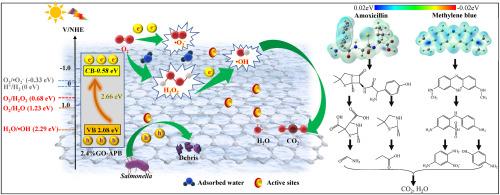
Wastewater containing antibiotics, organic dyes, and waterborne bacteria is a severe threat to human health and the environment. Amoxicillin has a slow metabolism rate in humans. Methylene blue is mutagenic and carcinogenic. In addition, Salmonella causes serious diarrhea. In this study, an effective 2D/2D photocatalyst with excellent elimination of these pollutants was fabricated by combining graphene oxide (GO), Bi2WO6, BiPO4 and Ag species. GO was applied at varying loading contents (0.8, 1.6, 2.4, 3.2 wt%) to improve the properties of the photocatalyst toward the removal of representative pollutants. The chemical structures, morphology, light absorption and charge mobility were investigated by different GO loading samples. The results indicated that when the wt% of GO was 2.4%, the photocatalyst showed excellent photocatalytic properties and removal rates for typical pollutants. Amoxicillin and methylene blue were mineralized into CO2, H2O, and small molecules, while Salmonella was disinfected with excellent photocatalytic efficiency. Furthermore, the possible photodecomposition pathways of amoxicillin and methylene blue were proposed by DFT calculations and intermediates identified by LCMS. The mechanism of the photocatalytic process was investigated by radical trapping experiments, ESR spectroscopy, and Motty-Schottky plots. The free radicals could be produced constantly during the photocatalytic process, leading to mineralization of amoxicillin and methylene blue, and disinfection of Salmonella. In this work, a new perspective on GO modified Bi2WO6 with different loading contents and the degradation pathways of antibiotics and dyes was proposed.
期刊介绍:
The Journal of Environmental Management is a journal for the publication of peer reviewed, original research for all aspects of management and the managed use of the environment, both natural and man-made.Critical review articles are also welcome; submission of these is strongly encouraged.




 京公网安备 11010802042870号
京ICP备2023020795号-1
京公网安备 11010802042870号
京ICP备2023020795号-1

 分享
分享
 求助内容:
求助内容: 应助结果提醒方式:
 扫码关注我们
