Crop-livestock-forestry systems as a strategy for mitigating greenhouse gas emissions and enhancing the sustainability of forage-based livestock systems in the Amazon biome
Alyce Monteiro , Luciano Barreto-Mendes , Audrey Fanchone , Diego P. Morgavi , Bruno C. Pedreira , Ciro A.S. Magalhães , Adibe L. Abdalla , Maguy Eugène
{"title":"Crop-livestock-forestry systems as a strategy for mitigating greenhouse gas emissions and enhancing the sustainability of forage-based livestock systems in the Amazon biome","authors":"Alyce Monteiro , Luciano Barreto-Mendes , Audrey Fanchone , Diego P. Morgavi , Bruno C. Pedreira , Ciro A.S. Magalhães , Adibe L. Abdalla , Maguy Eugène","doi":"10.1016/j.scitotenv.2023.167396","DOIUrl":null,"url":null,"abstract":"<div><p>Intensification of livestock systems becomes essential to meet the food demand of the growing world population, but it is important to consider the environmental impact of these systems. To assess the potential of forage-based livestock systems to offset greenhouse gas (GHG) emissions, the net carbon (C) balance of four systems in the Brazilian Amazon Biome was estimated: livestock (L) with a monoculture of Marandu palisade grass [<em>Brachiaria brizantha</em> (Hochst. ex A. Rich.) R. D. Webster]; livestock-forestry (LF) with palisade grass intercropped with three rows of eucalyptus at 128 trees/ha; crop-livestock (CL) with soybeans and then corn + palisade grass, rotated with livestock every two years; and crop-livestock-forestry (CLF) with CL + one row of eucalyptus at 72 trees/ha. Over the four years studied, the systems with crops (CL and CLF) produced more human-edible protein than those without them (L and LF) (3010 vs. 755 kg/ha). Methane contributed the most to total GHG emissions: a mean of 85 % for L and LF and 67 % for CL and CLF. Consequently, L and LF had greater total GHG emissions (mean of 30 Mg CO<sub>2</sub>eq/ha/year). Over the four years, the system with the most negative net C balance (i.e., C storage) was LF when expressed per ha (−53.3 Mg CO<sub>2</sub>eq/ha), CLF when expressed per kg of carcass (−26 kg CO<sub>2</sub>eq/kg carcass), and LF when expressed per kg of human-edible protein (−72 kg CO<sub>2</sub>eq/kg human-edible protein). Even the L system can store C if well managed, leading to benefits such as increased meat as well as improved soil quality. Moreover, including crops and forestry in these livestock systems enhances these benefits, emphasizing the potential of integrated systems to offset GHG emissions.</p></div>","PeriodicalId":422,"journal":{"name":"Science of the Total Environment","volume":"906 ","pages":"Article 167396"},"PeriodicalIF":8.0000,"publicationDate":"2023-09-30","publicationTypes":"Journal Article","fieldsOfStudy":null,"isOpenAccess":false,"openAccessPdf":"https://www.sciencedirect.com/science/article/pii/S0048969723060230/pdfft?md5=ce936f01e3358d8c3efd82c2584c43d9&pid=1-s2.0-S0048969723060230-main.pdf","citationCount":"1","resultStr":null,"platform":"Semanticscholar","paperid":null,"PeriodicalName":"Science of the Total Environment","FirstCategoryId":"93","ListUrlMain":"https://www.sciencedirect.com/science/article/pii/S0048969723060230","RegionNum":1,"RegionCategory":"环境科学与生态学","ArticlePicture":[],"TitleCN":null,"AbstractTextCN":null,"PMCID":null,"EPubDate":"","PubModel":"","JCR":"Q1","JCRName":"ENVIRONMENTAL SCIENCES","Score":null,"Total":0}
引用次数: 1
Abstract
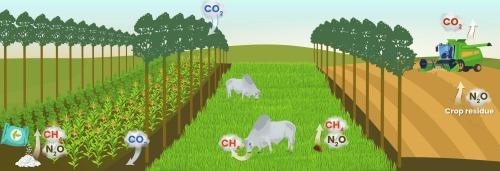
Intensification of livestock systems becomes essential to meet the food demand of the growing world population, but it is important to consider the environmental impact of these systems. To assess the potential of forage-based livestock systems to offset greenhouse gas (GHG) emissions, the net carbon (C) balance of four systems in the Brazilian Amazon Biome was estimated: livestock (L) with a monoculture of Marandu palisade grass [Brachiaria brizantha (Hochst. ex A. Rich.) R. D. Webster]; livestock-forestry (LF) with palisade grass intercropped with three rows of eucalyptus at 128 trees/ha; crop-livestock (CL) with soybeans and then corn + palisade grass, rotated with livestock every two years; and crop-livestock-forestry (CLF) with CL + one row of eucalyptus at 72 trees/ha. Over the four years studied, the systems with crops (CL and CLF) produced more human-edible protein than those without them (L and LF) (3010 vs. 755 kg/ha). Methane contributed the most to total GHG emissions: a mean of 85 % for L and LF and 67 % for CL and CLF. Consequently, L and LF had greater total GHG emissions (mean of 30 Mg CO2eq/ha/year). Over the four years, the system with the most negative net C balance (i.e., C storage) was LF when expressed per ha (−53.3 Mg CO2eq/ha), CLF when expressed per kg of carcass (−26 kg CO2eq/kg carcass), and LF when expressed per kg of human-edible protein (−72 kg CO2eq/kg human-edible protein). Even the L system can store C if well managed, leading to benefits such as increased meat as well as improved soil quality. Moreover, including crops and forestry in these livestock systems enhances these benefits, emphasizing the potential of integrated systems to offset GHG emissions.
期刊介绍:
The Science of the Total Environment is an international journal dedicated to scientific research on the environment and its interaction with humanity. It covers a wide range of disciplines and seeks to publish innovative, hypothesis-driven, and impactful research that explores the entire environment, including the atmosphere, lithosphere, hydrosphere, biosphere, and anthroposphere.
The journal's updated Aims & Scope emphasizes the importance of interdisciplinary environmental research with broad impact. Priority is given to studies that advance fundamental understanding and explore the interconnectedness of multiple environmental spheres. Field studies are preferred, while laboratory experiments must demonstrate significant methodological advancements or mechanistic insights with direct relevance to the environment.



 京公网安备 11010802042870号
京ICP备2023020795号-1
京公网安备 11010802042870号
京ICP备2023020795号-1

 分享
分享
 求助内容:
求助内容: 应助结果提醒方式:
 扫码关注我们
