Alonso Viladomat Jasso, Ark Modi, Roberto Ferrara, Christian Deppe, Janis Nötzel, Fred Fung, Maximilian Schädler
{"title":"Quantum and Quantum-Inspired Stereographic K Nearest-Neighbour Clustering.","authors":"Alonso Viladomat Jasso, Ark Modi, Roberto Ferrara, Christian Deppe, Janis Nötzel, Fred Fung, Maximilian Schädler","doi":"10.3390/e25091361","DOIUrl":null,"url":null,"abstract":"<p><p>Nearest-neighbour clustering is a simple yet powerful machine learning algorithm that finds natural application in the decoding of signals in classical optical-fibre communication systems. Quantum <i>k</i>-means clustering promises a speed-up over the classical <i>k</i>-means algorithm; however, it has been shown to not currently provide this speed-up for decoding optical-fibre signals due to the embedding of classical data, which introduces inaccuracies and slowdowns. Although still not achieving an exponential speed-up for NISQ implementations, this work proposes the generalised inverse stereographic projection as an improved embedding into the Bloch sphere for quantum distance estimation in k-nearest-neighbour clustering, which allows us to get closer to the classical performance. We also use the generalised inverse stereographic projection to develop an analogous classical clustering algorithm and benchmark its accuracy, runtime and convergence for decoding real-world experimental optical-fibre communication data. This proposed 'quantum-inspired' algorithm provides an improvement in both the accuracy and convergence rate with respect to the <i>k</i>-means algorithm. Hence, this work presents two main contributions. Firstly, we propose the general inverse stereographic projection into the Bloch sphere as a better embedding for quantum machine learning algorithms; here, we use the problem of clustering quadrature amplitude modulated optical-fibre signals as an example. Secondly, as a purely classical contribution inspired by the first contribution, we propose and benchmark the use of the general inverse stereographic projection and spherical centroid for clustering optical-fibre signals, showing that optimizing the radius yields a consistent improvement in accuracy and convergence rate.</p>","PeriodicalId":11694,"journal":{"name":"Entropy","volume":"25 9","pages":""},"PeriodicalIF":2.0000,"publicationDate":"2023-09-20","publicationTypes":"Journal Article","fieldsOfStudy":null,"isOpenAccess":false,"openAccessPdf":"https://www.ncbi.nlm.nih.gov/pmc/articles/PMC10527652/pdf/","citationCount":"0","resultStr":null,"platform":"Semanticscholar","paperid":null,"PeriodicalName":"Entropy","FirstCategoryId":"101","ListUrlMain":"https://doi.org/10.3390/e25091361","RegionNum":3,"RegionCategory":"物理与天体物理","ArticlePicture":[],"TitleCN":null,"AbstractTextCN":null,"PMCID":null,"EPubDate":"","PubModel":"","JCR":"Q2","JCRName":"PHYSICS, MULTIDISCIPLINARY","Score":null,"Total":0}
引用次数: 0
Abstract
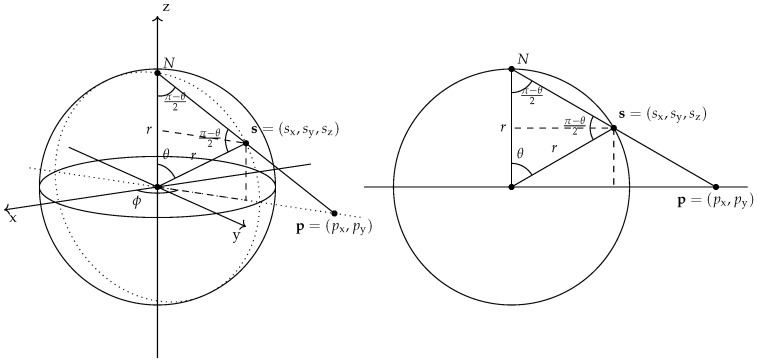
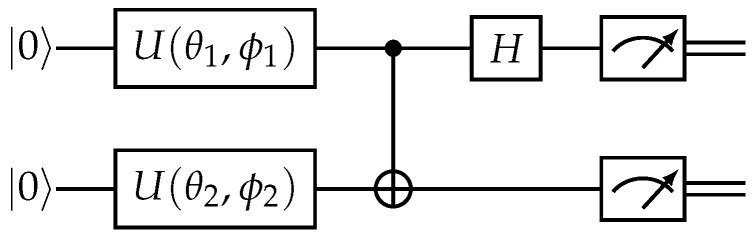
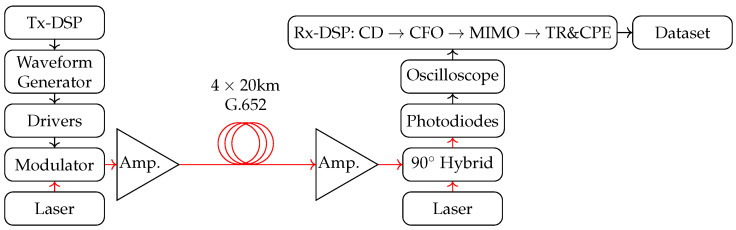
Nearest-neighbour clustering is a simple yet powerful machine learning algorithm that finds natural application in the decoding of signals in classical optical-fibre communication systems. Quantum k-means clustering promises a speed-up over the classical k-means algorithm; however, it has been shown to not currently provide this speed-up for decoding optical-fibre signals due to the embedding of classical data, which introduces inaccuracies and slowdowns. Although still not achieving an exponential speed-up for NISQ implementations, this work proposes the generalised inverse stereographic projection as an improved embedding into the Bloch sphere for quantum distance estimation in k-nearest-neighbour clustering, which allows us to get closer to the classical performance. We also use the generalised inverse stereographic projection to develop an analogous classical clustering algorithm and benchmark its accuracy, runtime and convergence for decoding real-world experimental optical-fibre communication data. This proposed 'quantum-inspired' algorithm provides an improvement in both the accuracy and convergence rate with respect to the k-means algorithm. Hence, this work presents two main contributions. Firstly, we propose the general inverse stereographic projection into the Bloch sphere as a better embedding for quantum machine learning algorithms; here, we use the problem of clustering quadrature amplitude modulated optical-fibre signals as an example. Secondly, as a purely classical contribution inspired by the first contribution, we propose and benchmark the use of the general inverse stereographic projection and spherical centroid for clustering optical-fibre signals, showing that optimizing the radius yields a consistent improvement in accuracy and convergence rate.
期刊介绍:
Entropy (ISSN 1099-4300), an international and interdisciplinary journal of entropy and information studies, publishes reviews, regular research papers and short notes. Our aim is to encourage scientists to publish as much as possible their theoretical and experimental details. There is no restriction on the length of the papers. If there are computation and the experiment, the details must be provided so that the results can be reproduced.




 京公网安备 11010802042870号
京ICP备2023020795号-1
京公网安备 11010802042870号
京ICP备2023020795号-1

 分享
分享
 求助内容:
求助内容: 应助结果提醒方式:
 扫码关注我们
