Arja Ray, Molly Bassette, Kenneth H Hu, Lomax F Pass, Tristan Courau, Bushra Samad, Alexis Combes, Vrinda Johri, Brittany Davidson, Katherine Wai, Patrick Ha, Grace Hernandez, Itzia Zaleta-Linares, Matthew F Krummel
{"title":"Multimodal delineation of a layer of effector function among exhausted CD8 T cells in tumors.","authors":"Arja Ray, Molly Bassette, Kenneth H Hu, Lomax F Pass, Tristan Courau, Bushra Samad, Alexis Combes, Vrinda Johri, Brittany Davidson, Katherine Wai, Patrick Ha, Grace Hernandez, Itzia Zaleta-Linares, Matthew F Krummel","doi":"10.1101/2023.09.26.559470","DOIUrl":null,"url":null,"abstract":"<p><p>The anti-tumor function of CD8 T cells is limited through well-established pathways of T cell exhaustion (T<sub>EX</sub>). Strategies to capture emergent functional states amongst this dominant trajectory of dysfunction are necessary to find pathways to durable anti-tumor immunity. By leveraging transcriptional reporting (by the fluorescent protein TFP) of the T cell activation marker <i>Cd69,</i> related to upstream AP-1 transcription factors, we define a classifier for potent versus suboptimal CD69+ activation states arising from T cell stimulation. In tumors, this delineation acts an additional functional readout along the T<sub>EX</sub> differentiation trajectory, within and across T<sub>EX</sub> subsets, marked by enhanced effector cytokine and granzyme B production. The more potent state remains differentially prominent in a T cell-mediated tumor clearance model, where they also show increased engagement in the microenvironment and are superior in tumor cell killing. Employing multimodal CITE-Seq in human head and neck tumors enables a similar strategy to identify Cd69RNA<sup>hi</sup>CD69+ cells that also have enhanced functional features in comparison to Cd69RNA<sup>lo</sup>CD69+ cells, again within and across intratumoral CD8 T cell subsets. Refining the contours of the T cell functional landscape in tumors in this way paves the way for the identification of rare exceptional effectors, with imminent relevance to cancer treatment.</p>","PeriodicalId":72407,"journal":{"name":"bioRxiv : the preprint server for biology","volume":" ","pages":""},"PeriodicalIF":0.0000,"publicationDate":"2025-02-16","publicationTypes":"Journal Article","fieldsOfStudy":null,"isOpenAccess":false,"openAccessPdf":"https://ftp.ncbi.nlm.nih.gov/pub/pmc/oa_pdf/04/1a/nihpp-2023.09.26.559470v1.PMC10557647.pdf","citationCount":"0","resultStr":null,"platform":"Semanticscholar","paperid":null,"PeriodicalName":"bioRxiv : the preprint server for biology","FirstCategoryId":"1085","ListUrlMain":"https://doi.org/10.1101/2023.09.26.559470","RegionNum":0,"RegionCategory":null,"ArticlePicture":[],"TitleCN":null,"AbstractTextCN":null,"PMCID":null,"EPubDate":"","PubModel":"","JCR":"","JCRName":"","Score":null,"Total":0}
引用次数: 0
Abstract
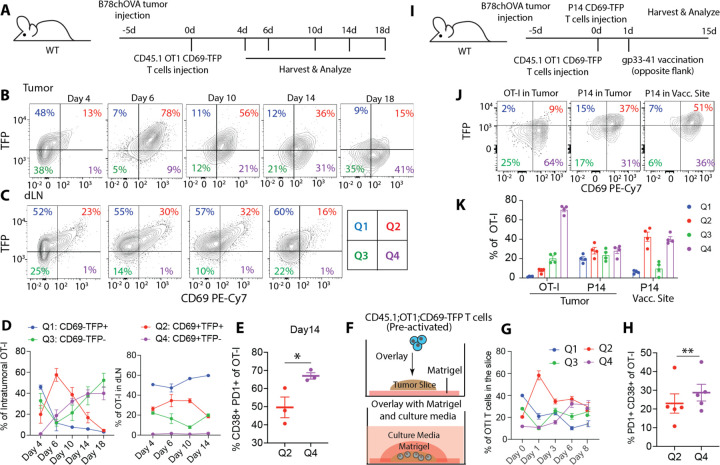
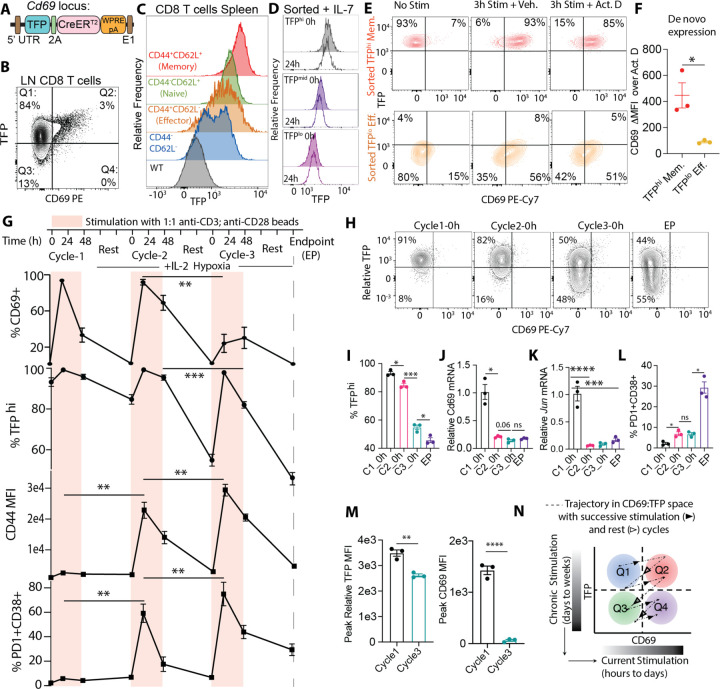
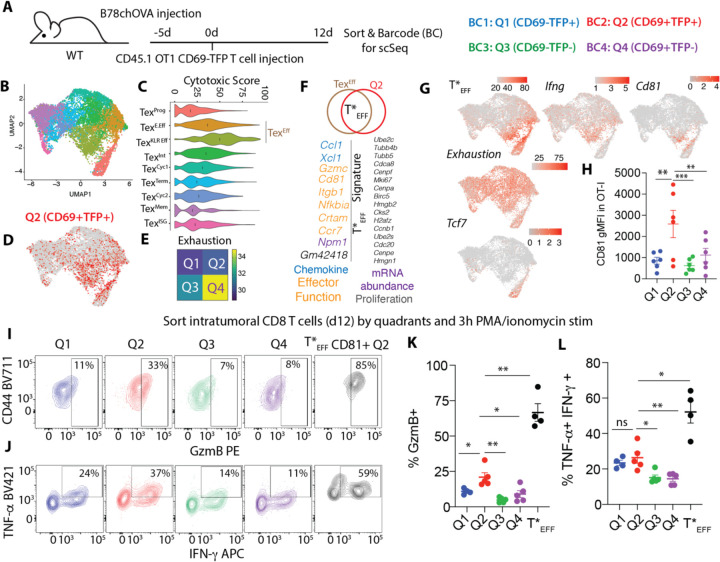
The anti-tumor function of CD8 T cells is limited through well-established pathways of T cell exhaustion (TEX). Strategies to capture emergent functional states amongst this dominant trajectory of dysfunction are necessary to find pathways to durable anti-tumor immunity. By leveraging transcriptional reporting (by the fluorescent protein TFP) of the T cell activation marker Cd69, related to upstream AP-1 transcription factors, we define a classifier for potent versus suboptimal CD69+ activation states arising from T cell stimulation. In tumors, this delineation acts an additional functional readout along the TEX differentiation trajectory, within and across TEX subsets, marked by enhanced effector cytokine and granzyme B production. The more potent state remains differentially prominent in a T cell-mediated tumor clearance model, where they also show increased engagement in the microenvironment and are superior in tumor cell killing. Employing multimodal CITE-Seq in human head and neck tumors enables a similar strategy to identify Cd69RNAhiCD69+ cells that also have enhanced functional features in comparison to Cd69RNAloCD69+ cells, again within and across intratumoral CD8 T cell subsets. Refining the contours of the T cell functional landscape in tumors in this way paves the way for the identification of rare exceptional effectors, with imminent relevance to cancer treatment.



 京公网安备 11010802042870号
京ICP备2023020795号-1
京公网安备 11010802042870号
京ICP备2023020795号-1

 分享
分享

 求助内容:
求助内容: 应助结果提醒方式:
 扫码关注我们
