Joseph Matheson, Ulises Hernández, Jason Bertram, Joanna Masel
{"title":"Human deleterious mutation rate slows adaptation and implies high fitness variance.","authors":"Joseph Matheson, Ulises Hernández, Jason Bertram, Joanna Masel","doi":"10.1101/2023.09.01.555871","DOIUrl":null,"url":null,"abstract":"<p><p>Each new human has an expected <math> <mrow><msub><mi>U</mi> <mi>d</mi></msub> <mo>=</mo> <mn>2</mn> <mo>-</mo> <mn>10</mn></mrow> </math> new deleterious mutations. Using a novel approach to capture complex linkage disequilibria from high <math> <mrow><msub><mi>U</mi> <mi>d</mi></msub> </mrow> </math> using genome-wide simulations, we confirm that fitness decline due to the fixation of many slightly deleterious mutations can be compensated by rarer beneficial mutations of larger effect. The evolution of increased genome size and complexity have previously been attributed to a similarly asymmetric pattern of fixations, but we propose that the cause might be high <math> <mrow><msub><mi>U</mi> <mi>d</mi></msub> </mrow> </math> rather than the small population size posited as causal by drift barrier theory. High within-population variance in relative fitness is an inevitable consequence of high <math> <mrow><msub><mi>U</mi> <mi>d</mi></msub> <mo>∼</mo> <mn>2</mn> <mo>-</mo> <mn>10</mn></mrow> </math> combined with inferred human deleterious effect sizes; two individuals will typically differ in fitness by 15-40%. The need to compensate for the deluge of deleterious mutations slows net adaptation (i.e. to the external environment) by ~13%-55%. The rate of beneficial fixations is more sensitive to changes in the mutation rate than the rate of deleterious fixations is. As a surprising consequence of this, an increase (e.g. 10%) in overall mutation rate leads to faster adaptation; this puts to rest dysgenic fears about increasing mutation rates due to rising paternal age.</p>","PeriodicalId":72407,"journal":{"name":"bioRxiv : the preprint server for biology","volume":" ","pages":""},"PeriodicalIF":0.0000,"publicationDate":"2025-03-25","publicationTypes":"Journal Article","fieldsOfStudy":null,"isOpenAccess":false,"openAccessPdf":"https://www.ncbi.nlm.nih.gov/pmc/articles/PMC10508744/pdf/","citationCount":"0","resultStr":null,"platform":"Semanticscholar","paperid":null,"PeriodicalName":"bioRxiv : the preprint server for biology","FirstCategoryId":"1085","ListUrlMain":"https://doi.org/10.1101/2023.09.01.555871","RegionNum":0,"RegionCategory":null,"ArticlePicture":[],"TitleCN":null,"AbstractTextCN":null,"PMCID":null,"EPubDate":"","PubModel":"","JCR":"","JCRName":"","Score":null,"Total":0}
引用次数: 0
Abstract
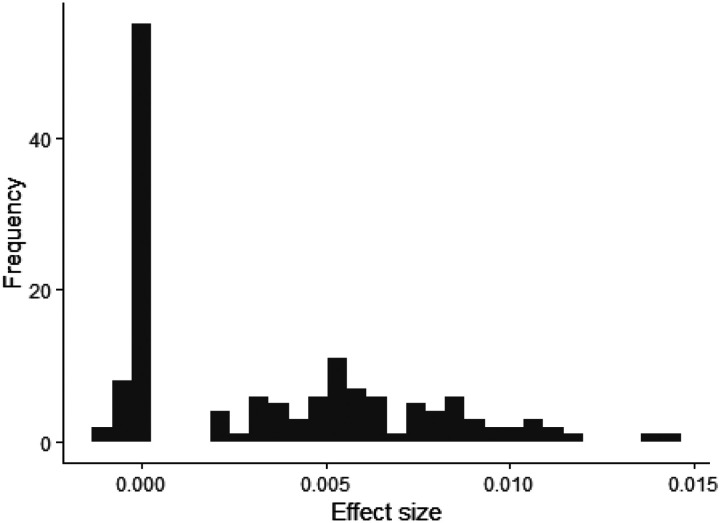
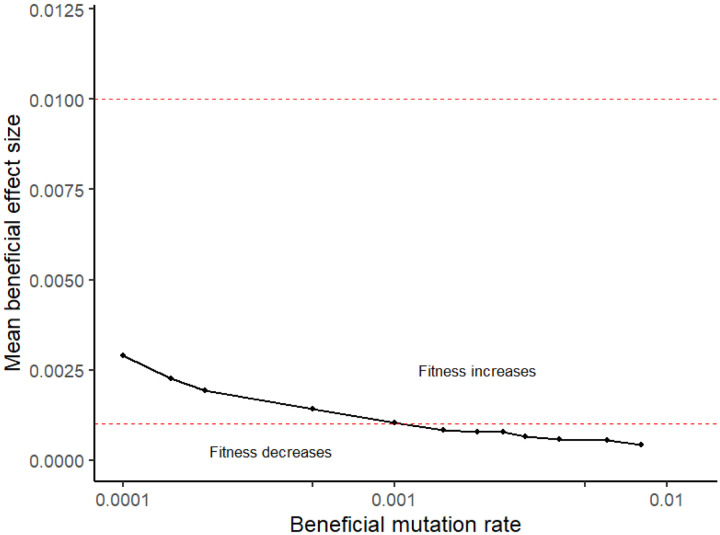
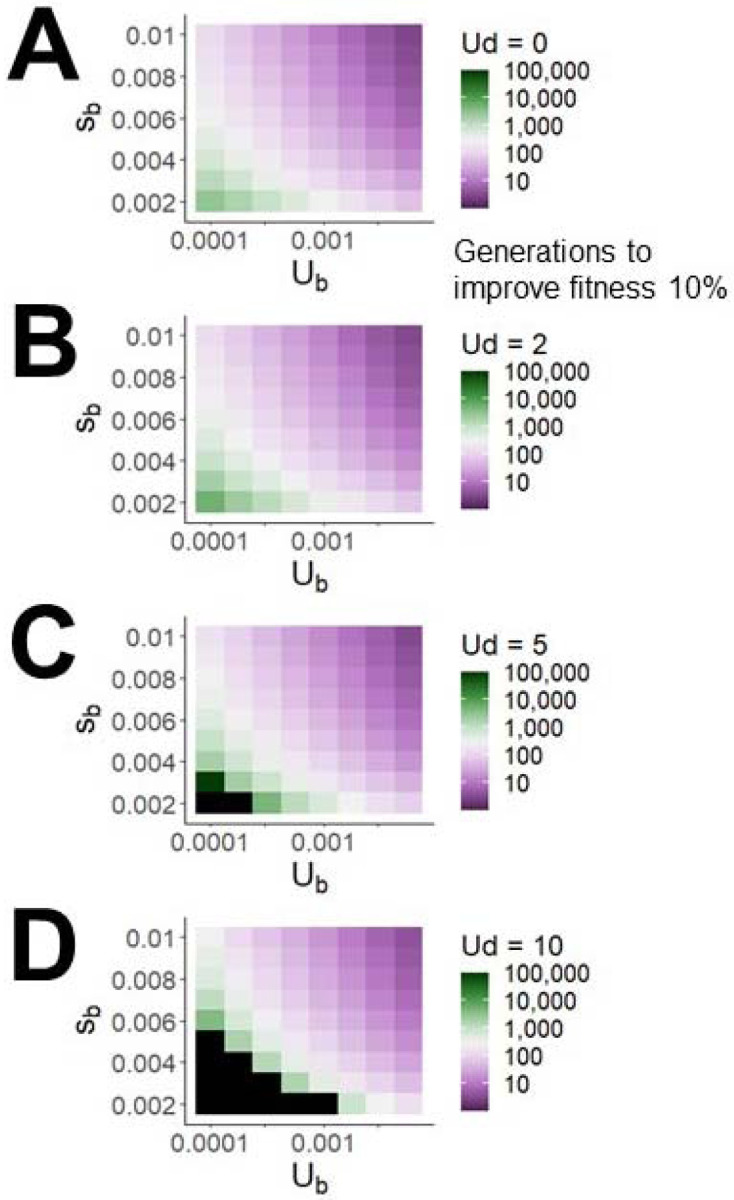
Each new human has an expected new deleterious mutations. Using a novel approach to capture complex linkage disequilibria from high using genome-wide simulations, we confirm that fitness decline due to the fixation of many slightly deleterious mutations can be compensated by rarer beneficial mutations of larger effect. The evolution of increased genome size and complexity have previously been attributed to a similarly asymmetric pattern of fixations, but we propose that the cause might be high rather than the small population size posited as causal by drift barrier theory. High within-population variance in relative fitness is an inevitable consequence of high combined with inferred human deleterious effect sizes; two individuals will typically differ in fitness by 15-40%. The need to compensate for the deluge of deleterious mutations slows net adaptation (i.e. to the external environment) by ~13%-55%. The rate of beneficial fixations is more sensitive to changes in the mutation rate than the rate of deleterious fixations is. As a surprising consequence of this, an increase (e.g. 10%) in overall mutation rate leads to faster adaptation; this puts to rest dysgenic fears about increasing mutation rates due to rising paternal age.



 京公网安备 11010802042870号
京ICP备2023020795号-1
京公网安备 11010802042870号
京ICP备2023020795号-1

 分享
分享

 求助内容:
求助内容: 应助结果提醒方式:
 扫码关注我们
