{"title":"Insights into the Fabrication and Electrochemical Aspects of Paper Microfluidics-Based Biosensor Module.","authors":"Rohini Kumari, Akanksha Singh, Uday Pratap Azad, Pranjal Chandra","doi":"10.3390/bios13090891","DOIUrl":null,"url":null,"abstract":"<p><p>Over the past ten years, microfluidic paper-based analytical devices (micro-PADs) have attracted a lot of attention as a viable analytical platform. It is expanding as a result of advances in manufacturing processes and device integration. Conventional microfluidics approaches have some drawbacks, including high costs, lengthy evaluation times, complicated fabrication, and the necessity of experienced employees. Hence, it is extremely important to construct a detection system that is quick, affordable, portable, and efficient. Nowadays, micro-PADs are frequently employed, particularly in electrochemical analyses, to replicate the classic standard laboratory experiments on a miniature paper chip. It has benefits like rapid assessment, small sample consumption, quick reaction, accuracy, and multiplex function. The goal of this review is to examine modern paper microfluidics-based electrochemical sensing devices for the detection of macromolecules, small molecules, and cells in a variety of real samples. The design and fabrication of micro-PADs using conventional and the latest techniques have also been discussed in detail. Lastly, the limitations and potential of these analytical platforms are examined in order to shed light on future research.</p>","PeriodicalId":48608,"journal":{"name":"Biosensors-Basel","volume":"13 9","pages":""},"PeriodicalIF":5.6000,"publicationDate":"2023-09-19","publicationTypes":"Journal Article","fieldsOfStudy":null,"isOpenAccess":false,"openAccessPdf":"https://www.ncbi.nlm.nih.gov/pmc/articles/PMC10526938/pdf/","citationCount":"0","resultStr":null,"platform":"Semanticscholar","paperid":null,"PeriodicalName":"Biosensors-Basel","FirstCategoryId":"5","ListUrlMain":"https://doi.org/10.3390/bios13090891","RegionNum":3,"RegionCategory":"工程技术","ArticlePicture":[],"TitleCN":null,"AbstractTextCN":null,"PMCID":null,"EPubDate":"","PubModel":"","JCR":"Q1","JCRName":"CHEMISTRY, ANALYTICAL","Score":null,"Total":0}
引用次数: 0
Abstract
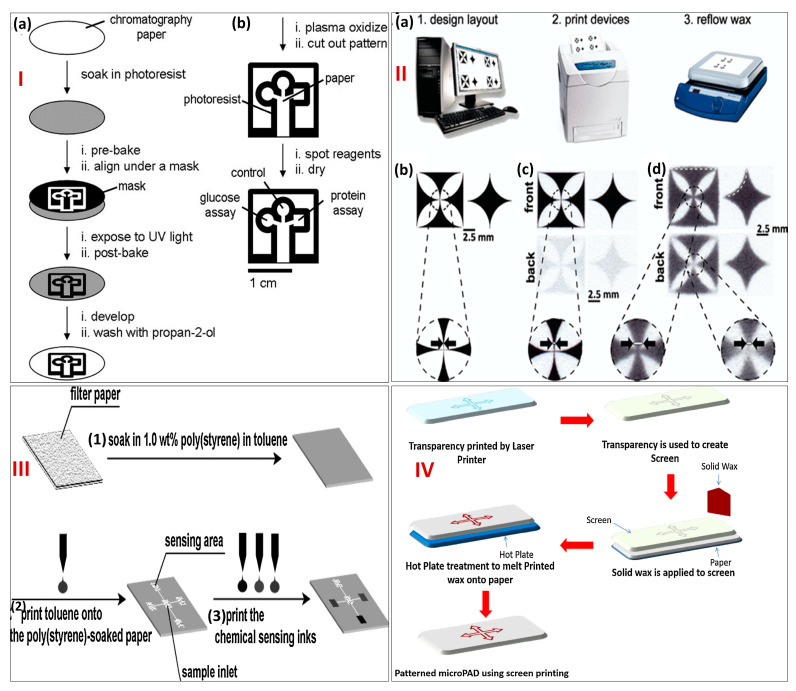
Over the past ten years, microfluidic paper-based analytical devices (micro-PADs) have attracted a lot of attention as a viable analytical platform. It is expanding as a result of advances in manufacturing processes and device integration. Conventional microfluidics approaches have some drawbacks, including high costs, lengthy evaluation times, complicated fabrication, and the necessity of experienced employees. Hence, it is extremely important to construct a detection system that is quick, affordable, portable, and efficient. Nowadays, micro-PADs are frequently employed, particularly in electrochemical analyses, to replicate the classic standard laboratory experiments on a miniature paper chip. It has benefits like rapid assessment, small sample consumption, quick reaction, accuracy, and multiplex function. The goal of this review is to examine modern paper microfluidics-based electrochemical sensing devices for the detection of macromolecules, small molecules, and cells in a variety of real samples. The design and fabrication of micro-PADs using conventional and the latest techniques have also been discussed in detail. Lastly, the limitations and potential of these analytical platforms are examined in order to shed light on future research.
Biosensors-BaselBiochemistry, Genetics and Molecular Biology-Clinical Biochemistry
CiteScore
6.60
自引率
14.80%
发文量
983
审稿时长
11 weeks
期刊介绍:
Biosensors (ISSN 2079-6374) provides an advanced forum for studies related to the science and technology of biosensors and biosensing. It publishes original research papers, comprehensive reviews and communications. Our aim is to encourage scientists to publish their experimental and theoretical results in as much detail as possible. There is no restriction on the length of the papers. The full experimental details must be provided so that the results can be reproduced. Electronic files and software regarding the full details of the calculation or experimental procedure, if unable to be published in a normal way, can be deposited as supplementary electronic material.




 京公网安备 11010802042870号
京ICP备2023020795号-1
京公网安备 11010802042870号
京ICP备2023020795号-1

 分享
分享
 求助内容:
求助内容: 应助结果提醒方式:
 扫码关注我们
